Wharflurch is not an easy band.
And they probably do not want to be.
From the opening minutes of ‘Mycodeath and Rebirth in the Outer Clusters’, it is clear that we are dealing with Death Metal, but almost immediately elements begin to appear that disturb the genre’s usual logic. Synthesizers, almost video-game-like sounds, processed vocals, psychedelic passages, and a completely cosmic aesthetic begin to contaminate a foundation that, underneath it all, remains deeply old school.
At first, it can even be confusing.
There are moments when some of these sounds feel almost too strange, even slightly funny within the overall heaviness. I found myself thinking of a kind of “musical fluorescence”: artificial, phosphorescent colors appearing inside something that would normally be expected to sound dark, cavernous, and rotten.
But the attitude is there.
And that changes things considerably.
Wharflurch does not sound like a band mocking Death Metal or adding strange elements simply to attract attention. There is conviction behind all this weirdness.
In “Non Zero Expanse,” for example, robotic vocalizations immediately took me back to Nocturnus.
And that was the point where the album began to make much more sense to me.
Not because Wharflurch is trying to reproduce the sound of Nocturnus, but because there is a spiritual connection with that extremely daring way of understanding Death Metal: bringing technology, science fiction, keyboards, and alien sounds into a genre that could still remain absolutely brutal.
For those of us who lived through that period, Nocturnus was truly crushing.
Maybe today their name does not always appear among the first classics people mention when discussing the history of Death Metal, but hearing The Key back then meant encountering something completely strange. Death Metal looking toward space while most of the genre was still looking toward graves, corpses, and cemeteries.
Wharflurch recaptures part of that spirit.
Not necessarily the sound, but the eccentricity.
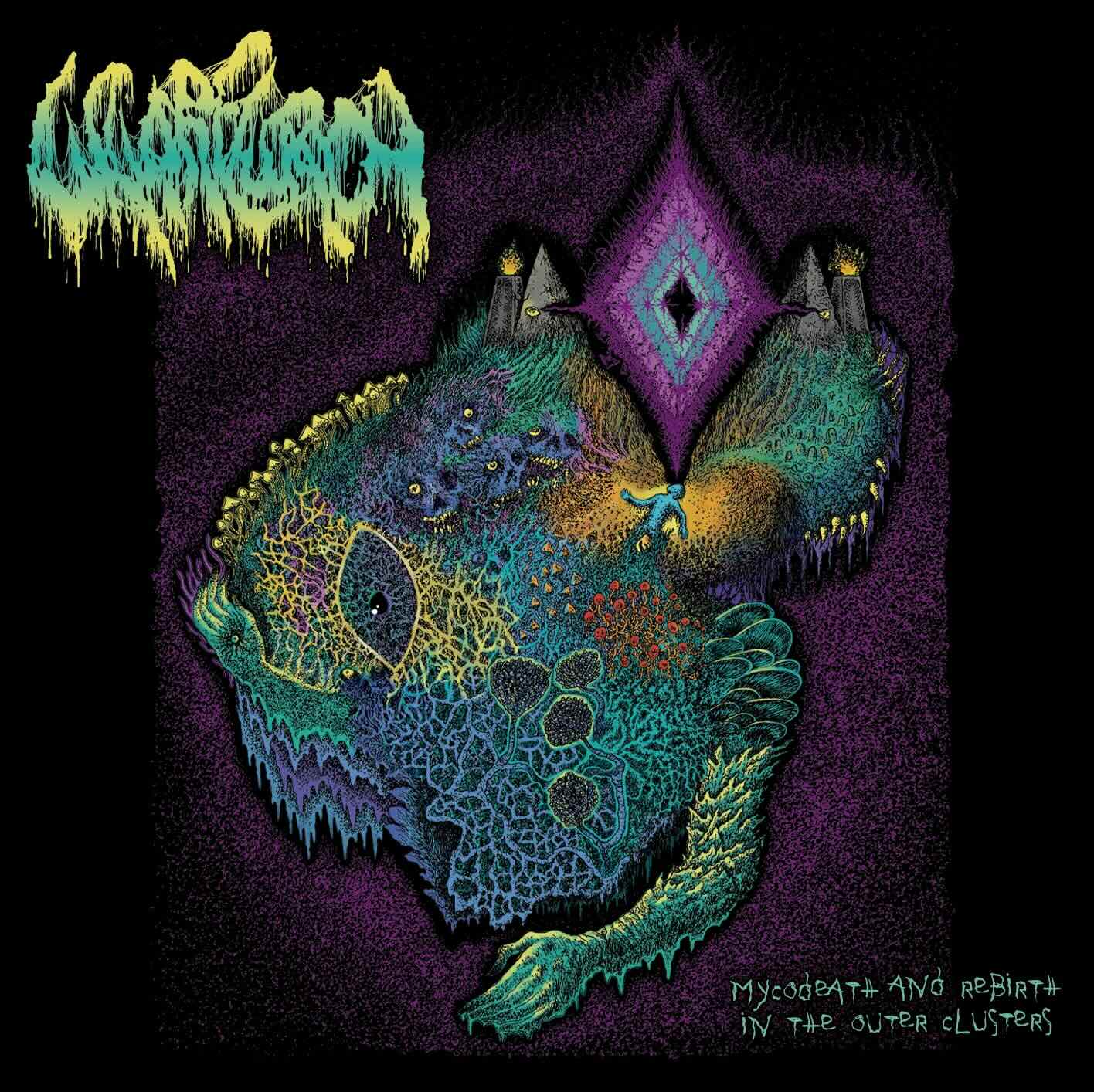
That is also present in the album’s aesthetic. From the artwork to the overall concept, there is something deliberately disturbing, extraterrestrial, and deformed about it. The music seems to move through that same universe: riffs begin in recognizable territory and are then contaminated by sounds that should not really be there.
A kind of infected Death Metal.
The single works particularly well because it concentrates many of these ideas. There are openings that are pure Death Metal, direct and aggressive, but then the band begins to alter the dynamics again, inserting elements that disorient the listener.
That is probably the most interesting thing about Wharflurch.
You never completely know where they are going to turn next.
However, after that point, I feel the final part of the album loses some of its ability to surprise.
The later songs feel more traditional and, at times, fairly average within what we could simply call regular Death Metal. They are not bad songs. They maintain the aggression, the riffs, and the attitude of the album, but after hearing Wharflurch deform its own music in such daring ways, you inevitably expect that imagination to continue all the way to the end.
And that is where my main criticism appears.
On an album, every song matters.
Not every composition needs to introduce twenty new ideas, but when a band proves it has such a distinctive personality, it would be interesting to give each song something of its own — something that allows the listener to remember it individually rather than simply as another functional piece of the record.
Wharflurch proves they can do that.
And that is exactly why you end up demanding a little more from them.
‘Mycodeath and Rebirth in the Outer Clusters’ ultimately becomes a strange mixture of many things: old Death Metal, Doom, psychedelia, science fiction, synthesizers, robotic vocals, cavernous brutality, and moments that seem almost to come from another planet.
Cosmic Death Metal?
Sci-Fi Death Metal?
Psychedelic Death Metal?
Probably all of those labels work, and none of them fully explains the record.
It has high points.
It has confusing moments.
It has genuinely daring passages and others that are considerably more traditional.
But I would rather hear a band occasionally confuse me while trying to build something of its own than listen to another flawless reproduction of a formula I have already known for forty years.
And that is probably what I value most about Wharflurch.
There are still bands willing to explore that strange territory where Death Metal can be brutal and, at the same time, deeply eccentric.
Not everything works in the same way.
But when it works, it is fascinating.
So my recommendation is quite simple: listen to the album and draw your own conclusions.
It may confuse you.
It may make you smile at times because of how absurd some of the sounds are.
It may remind you of Nocturnus.
Or it may simply leave you wondering what the hell you just listened to.
But it would be difficult to call Wharflurch a standard band.
And today, within a genre filled with so many repeated formulas, that already means quite a lot.