
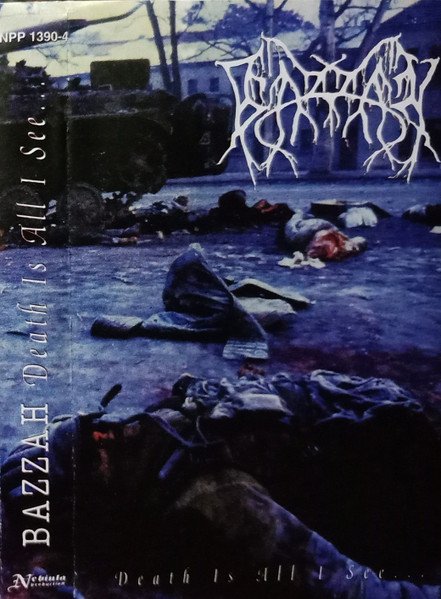
I started getting properly into Black Metal around 1993, and Bazzah were one of the first Malaysian bands I discovered, even before I had really got into the Singapore Black Metal bands. Back then, compilations and cassette releases were how you found this stuff. I was digging through tapes from a store at Queensway Shopping Centre picking up whatever caught my attention in the shop, tapes mostly produced by Valentine Sound Productions and Nebiula compilations. Bazzah were one of those names that stuck.
‘Death Is All I See…’ shows a considerably more developed Bazzah than the band heard on their 1993 ‘Necromancy’ demo. Where ‘Necromancy’ was a primitive four-track cassette running barely fifteen minutes, this album stretches across eight tracks and just over thirty-three minutes, with a much larger lineup. The Death handles drums, Azzaher and Zahar are on guitars, Shas and Rigor Mortis provide the bass, while Agathos Daemon, Tzar and Jorn handle the vocals, with Jorn also contributing guitar.
There is more weight here, but Bazzah haven’t abandoned the crude character that made the early material interesting. The guitars remain rooted in the darker side of early Extreme Metal, with Black Metal and Death Metal influences constantly rubbing against each other. The riffs aren’t particularly technical and they don’t need to be. What works is the atmosphere created through repetition, rough guitar tones and the multiple vocalists giving the songs a different character from track to track.
‘Prince Of Darkness’ gets the album moving, followed by ‘The Apparition’ and ‘Priestess’, while ‘Breath Of Dragon’ comes in shorter and more directly. ‘Incantation’ takes things further and is one of the more interesting pieces here, particularly with its unexpected use of material from Dio’s ‘Shame On The Night’ towards the end. It is a strange detail, but it somehow fits the band’s old-school approach rather than sounding like some unnecessary gimmick.
‘Widow Lust’ and ‘Witch Queen’ are among the stronger tracks, carrying that murky, ritualistic character without becoming overly atmospheric or drifting away from the Metal. Bazzah were still fundamentally a riff-driven band, and the album works best when they keep that balance between primitive Black Metal and the heavier Death Metal side of their sound.
‘Serpent King’ is particularly important because it connects this album directly back to ‘Necromancy’. This is a re-recorded version of the earlier track, and hearing it here gives you a useful comparison between the 1993 incarnation of Bazzah and the considerably fuller band heard on this album.
The recording was handled at Nebiula Sounds Recording and mastered at Mastering One, with The Death credited with production. It is obviously a more substantial recording than the demo, but it hasn’t been cleaned up to the point where the underground character disappears. There is still enough roughness in the guitars and vocals to keep the record firmly rooted in its period.
The album’s history is almost as interesting as the music. Reports state that only around 300 copies were sold before copies were confiscated and destroyed by local authorities, which contributed heavily to its rarity. I wouldn’t judge the album based on that story or its collector value, though. A rare tape can still be a shit record, and fortunately that isn’t the case here. ‘Death Is All I See…’ stands on its own as a document of Bazzah’s development.
There are weaknesses. Some of the songs could have been tightened, and the album doesn’t maintain the same level of impact throughout. The songwriting can also become predictable when the riffs settle into extended repetition. But that is part of the character of the record rather than something that completely works against it. Bazzah weren’t trying to make sophisticated Black Metal, and the straightforward approach gives the album a certain honesty that many later attempts at this style completely lost.
What makes ‘Death Is All I See…’ worth returning to is the sense that Bazzah had moved beyond the raw demo stage without losing the identity established there. You can hear the primitive roots, but there is a heavier foundation, more developed songwriting and a broader vocal presence.
For me, this is one of those Malaysian releases that I remember not simply because of its rarity today, but because Bazzah were already part of my early discovery of Black Metal in the 90s. ‘Death Is All I See…’ remains the more substantial document of what they were capable of, and it deserves to be heard as an actual album rather than treated merely as another obscure Malaysian tape that collectors happen to chase.
