Balberith is one of those Singapore underground names that has been around long enough to become part of the landscape, although the story behind the band is not quite as straightforward as simply counting years and releases. The beginnings go back to Shadow Throne in 2003, with Balberith taking shape in 2004 and gradually developing its own identity through a string of demos, splits, EPs and eventually full-length albums. The early material was firmly rooted in that filthy strain of Black Metal that Singapore was producing during the 2000s, drawing from the primitive violence of Beherit, Blasphemy and Sarcófago while throwing in enough thrashing aggression to keep things moving. ‘Rites of Blasphemy’ and the early splits showed a band that was not interested in polished songwriting or making anything particularly comfortable for the listener. It was raw, crude and deliberately underground, and that attitude carried through much of their early work.
The 2006 ‘Rites of Blasphemy’ demo and ‘Legion ov Terror’ EP established the foundations, followed by the ‘South East Goatworship’ split with Kratornas in 2007 and the ‘Eastern Hellgoat Prevails’ split with Nightmare in 2010. These releases are important because they show the progression rather than presenting Balberith as a band that suddenly appeared fully formed. The early recordings had that chaotic Black/Death/Thrash Metal character that was common among the more extreme Southeast Asian bands of the period, but Balberith gradually became less dependent on sheer speed. ‘Triumph ov Beastial Dominator’ from 2009 was a significant step, with Khaal moving beyond his original role behind the drums and taking over vocals and guitars as well. By the time ‘Darkness.Death.Legion’ appeared in 2012, Balberith had become much more closely tied to his own direction, and that change would shape the band for years afterwards.
That is also where the Balberith story becomes more complicated. Khaal has been involved in Singapore Extreme Metal for decades, through Balberith as well as his other activities and his long-running Ravage Records operation, so there is no question that his personality has become a major part of how the project is perceived. He has put a considerable amount of his own time and effort into keeping Balberith moving, and the band has continued through numerous lineup changes rather than disappearing after a few releases. At the same time, his character and individuality have become so pronounced that they have, at times, overshadowed Balberith itself. The band is often discussed through Khaal before the music or the other musicians even enter the conversation, and over the years those two identities have become increasingly difficult to separate. There is strength in having such a distinctive personality driving an underground project, but the other side of it is that Balberith can sometimes feel more like an extension of Khaal’s own chapter in Singapore metal than a band whose individual members are equally visible.
That becomes particularly noticeable when looking at the musicians who have passed through the lineup. Balberith has had a long list of contributors over the years, including Insulter, Lord Cripple, Demonomancer, Daryl Ang and others, but many of them have inevitably been overshadowed by the central figure of the band. There have also been complaints and allegations circulating within parts of the underground concerning dealings with Khaal, including people claiming they were ripped off. Those remain allegations rather than something I would present as established fact, and they should be treated accordingly. Still, they form part of the wider perception surrounding a figure who has been active and highly visible in such a small scene for so long. The interesting contradiction is that the same individuality that has kept Balberith recognisable for more than two decades has also made it harder to separate the band’s identity from the man behind it.
After a decade on drums, Khaal eventually moved away from the kit, with Haslam taking over in 2014. This was not simply a change of drummer on paper because Haslam has now been part of the band’s later recorded history across ‘Death Squad’, ‘Krushing the False Idol’ and ‘False Flag Messiah’. He effectively became the drummer for the second major chapter of Balberith, following the period when Khaal himself had been responsible for the percussion since the band’s earliest days. That gives Haslam a more important place in the band’s history than his relatively quiet presence might suggest. His playing on the later material provides the necessary weight and consistency without trying to turn Balberith into something it was never intended to be, and on ‘False Flag Messiah’ the drums remain an important part of keeping the songs moving when the riffs settle into their heavier mid-paced sections.
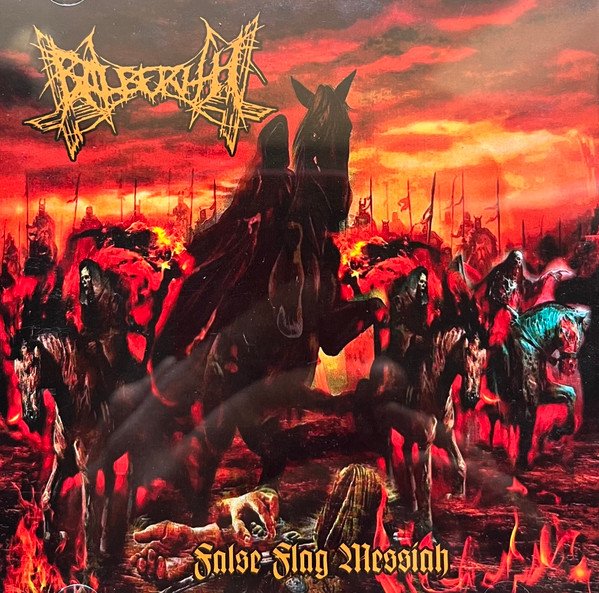
‘False Flag Messiah’, released in 2020, is where the later Balberith lineup comes together around Khaal’s vocals and guitars, with Haslam on drums, Dinn on bass and Hazathoth handling guitars. By this point the band had moved considerably further away from the primitive recordings of the mid-2000s, although the raw attitude is still there. The album does not attempt to disguise where Balberith came from. The guitars remain filthy and aggressive, the vocals are delivered with that familiar hostile edge, and the riffs move between Black Metal, Death Metal and thrashing passages without becoming overly concerned about genre boundaries.
There is something satisfying about how ‘False Flag Messiah’ sounds like a continuation rather than a reinvention. ‘Fallen Kingdoms’ gets things moving with the kind of riffing that immediately places the listener back inside Balberith’s world, while ‘Inexoerable……..Viciously’ and the title track push further into the heavier side of the band’s sound. ‘Generation of Vipers’ is another strong moment, but ‘Hordes of Gog & Magog’ gives the album more room to breathe and demonstrates that Balberith is at its best when it allows the riffs to develop rather than simply chasing speed from beginning to end. ‘Deathsquads’ and ‘Dark Legion’ bring the record back toward the more direct attack of the earlier material.
Khaal’s vocals remain one of the defining characteristics of the album, but the guitars are arguably more important because they show how much the band’s sound has changed since the early ‘Rites of Blasphemy’ material. There is still that primitive Black/Death Metal foundation underneath everything, but the riffs are heavier and more deliberate, with enough variation in tempo to prevent the whole record from becoming one long blast of noise. Haslam deserves particular mention here because the drums give the songs the necessary drive without constantly demanding attention. Considering that he stepped into a position previously occupied by Khaal himself, maintaining that role across several releases is no small part of the band’s later development.
The weakness is that ‘False Flag Messiah’ does not always escape the formulas Balberith has relied upon for years. Some riffs feel familiar, and there are moments where the songwriting settles into patterns that are predictable once the album gets going. The raw production suits the band’s character, but a little more separation between the instruments would have helped some of the guitar work and Haslam’s drumming come through with greater definition. None of this ruins the album, but it does keep ‘False Flag Messiah’ from being a major leap forward. It is more of a solid continuation of the Balberith approach than a record that completely changes the game.
There is also an unavoidable question of identity. With Khaal so strongly associated with every aspect of Balberith, the musicians around him can sometimes feel like they are operating inside an already established framework rather than leaving a clearly recognisable individual mark of their own. That is particularly interesting when you consider how long Haslam has now been behind the drums. He is no longer simply the replacement for Khaal; he has been part of the band’s sound for years, yet the public image of Balberith remains overwhelmingly tied to its founder and central figure. In that sense, the album reflects both the strength and limitation of the project.
Still, ‘False Flag Messiah’ is a worthwhile chapter in the Balberith catalogue. It is not trying to be something fashionable or polished, and there is enough aggression and genuine underground character here to make it worth returning to. More importantly, it documents a band that has survived numerous lineup changes and kept releasing material long after many of its contemporaries disappeared. Whether one sees Balberith primarily as a band or as Khaal’s long-running personal vehicle probably depends on how closely they have followed the project over the years, but that ambiguity is now part of its history.
For all the controversy and personality surrounding its central figure, the music itself deserves to be judged separately, and on that level ‘False Flag Messiah’ delivers a solid dose of Singapore Blackened Extremity. It is rough around the edges, occasionally repetitive and unmistakably tied to the Balberith formula, but it has enough character to stand as another document of the Singapore underground. After so many years, perhaps that is the most interesting thing about Balberith: the project has remained recognisable through changing members, changing recording approaches and changing underground circumstances, while Khaal’s individuality has grown so dominant that it has almost become impossible to tell where Balberith ends and Khaal begins.