
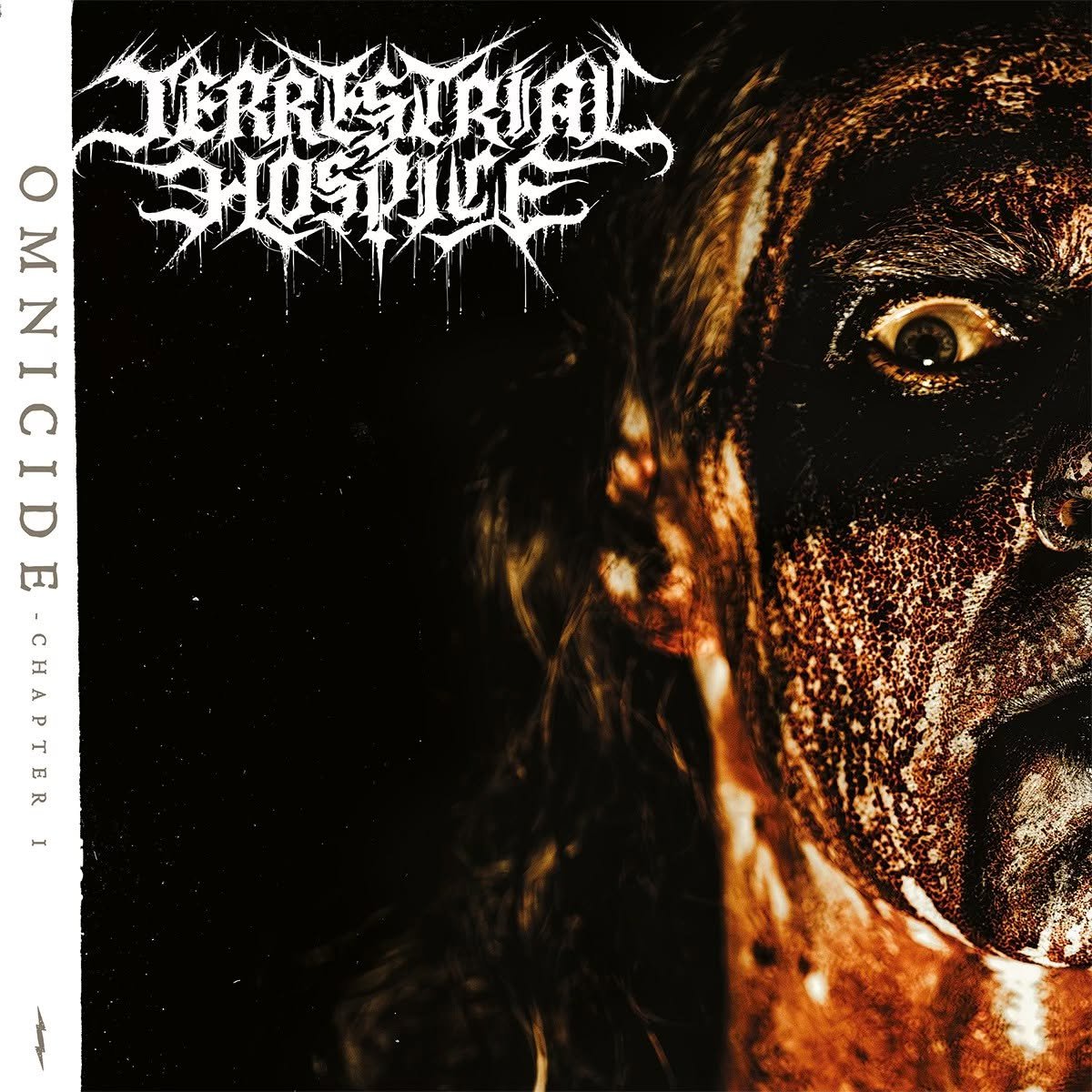
The art of self-destruction, to others, may be seen as salvation lying between wrist and razor, or tranquillity through asphyxiation brought forth by the very rope coiling around the neck. But for some, it is not merely the decimation of the physical being; rather, it is the act of ridding oneself of that which is weak and decadent, like one who rends a garment soaked in poison from the flesh as it sears the skin. For when the mind is bare, bruised, and bleeding, a state of euphoria is attained.Even though the crown of the soul is pierced and the soles of the feet are flayed, through the rivers of strife the consciousness may traverse, emerging from their depths as a more virulent and malefic being, cauterized at the core of that which breeds light. For now, a true specimen is born, one that answers not to the false tongues of spit, but rather becomes its own deity.
‘Omnicide – Chapter I’ by Terrestrial Hospice becomes the entity that possesses the blade’s edge or the barrel of a shotgun, through which freedom is relinquished amid the misanthropic dissonance of Black Metal. It is through this abolishment that the soul is ushered through the gates of the unknown and into every depth. Resonating in a similar vein to acts such as Funeral Mist and Craft, and even possessing the ritualistic proportions of Darvaza, Terrestrial Hospice chronicles in sound the very experience through which the soul erects its own Pandæmonium from the abyss into which it has been cast.
A nihilistic artery becomes ruptured, spilling its essence into sound as it infects the mind, where that which pulsates grips and rends the spine in agony. The correlation between affliction and exhalation encircles the album as it heralds the consciousness towards the depths, where the senses become lacerated as the consciousness descends through every level, feeling every sensation as the mind regresses into its primal state.
The voice that emanates from the blade’s edge as it touches the jugular, urging the spirit to let it taste more, to let blood flow and veins be severed by its might, the very intoxicating sermon that bewitches the mind, takes shape in the vocals upon the album. However, the voice that permeates is not one that seeks to be gentle or seductive; rather, it is one that berates, that forces the soul to detonate, to dredge up the bile within the stomach and let it dissolve the silver threads that tether the mind to weakness.
Infesting the album’s atmosphere with a sulphuric rancour, the vocals emerge more as an invasion upon the senses, gnawing and scraping at the soul like a rabid dog with hunger clinging to its stomach. They resonate in a decaying manner, as though every word were necrotic in its stench, with the vocals employing a harsh, abrasive, yet serrated tone. However, it is not merely the aura of the tone that gives life to the album; instead, it is the movement that the vocals undergo.
‘Phosphoric Salvation’ displays this, where the vocals do not flow in a linear current; instead, they coil around the mind, suffusing themselves into the atmosphere and the senses, rendering the consciousness helpless as they become the dominant force. This, in turn, becomes the pinnacle of the vocals’ prowess, for it is through this volatility that obedience is bred within the senses, compelling them to heed the vitriol within the vocals’ bark and surrender freedom to attain clarity.
When the senses dissolve into nothingness, when the bark devours the mind, its teeth become the liberator that severs the noose which anchors the soul to the heavens. The very descent experienced, where the sky becomes the ceiling, the pummeling sensation as one plummets into the unknown—this takes the form of the percussion, where the barrage of noises that rushes the ears and mind takes hold.
A juxtaposition presents itself within the drumming, where its essence is clinical and precise, yet, at the same time, there is a level of chaos and hostility to the barrage. These two conflicting energies become the nucleus of the percussion, for it is like the cacophony of the mind mixed with the hurling of the soul upon the downward path.
‘Depraver (Black Invocation)’ and ‘Drowning Spirit’ demonstrate this consternation through the drums, where every beat that explodes comes across as an assault, blunt and dense in sound and weight, yet expansive, as though its destruction were a mushroom cloud that blots out the sun. The production intertwines with the energy of the drums, enhancing their impact through clarity and reverberation, as well as through the nuances of the cymbals, which break up the corrosive texture of the drumming, along with the fills, which, in turn, render the more battering moments with a livid sensation.
However, the quality of the percussion arrives not in its expulsion, in creating an onslaught of sound, but rather in taking this energy and infusing it with the other elements, especially the vocals. Both the vocals and the drums carry within their own spirits a different timbre and temperament, yet they form a dialogue that speaks to a baleful energy.’Menace’ is a track that demonstrates the cohesion between the vocals and drums, where a cause-and-effect pattern exists, as though the drums coerce the vocals, and, in turn, an equal action of vehemence is taken. This exchange of energies helps cement the tenebrous air.
Through the process of reconfiguring the soul, through the act of putting the mind through the grinder, one is forced to confront every essence of oneself, each so strong and pure in its presence that it dwarfs the actual aura we hold. For the sensations of anger, hate, lust, and despair—the very negative energies that teem beneath yet rupture above the surface, may take hold during this confrontation. The act of facing these spirits and the motions they adopt, in turn, becomes the dialogue fashioned through the guitars.
A myriad of tones erupts from the strings, where the actual sound comes across as jagged and haphazard, as though a sheet of metal were transformed into a weapon by breaking off its edges, its teeth becoming uneven yet its delivery deadly. You can trace your fingers along the edges where the rust accumulates, as the slick sharpness pierces the skin. So, in turn, does the resonance of the guitars convey itself through sound.
Take, for instance, ‘Serpents In The Grass’, where the movements are serpentine yet resemble shards of iron. The tone juts out, not in an even manner, but rather in an undulating form. This gives the guitars an honest sound, where the production is able to enhance their rawness. The way the chords are constructed makes it feel as though the strings are being scraped and indented, as though you can hear an exhalation of rust from every note, fostering a more physical intimacy with the album.
Physical, naught in a serene manner, but rather as though you can feel its binding and constricting presence, where the sound lashes and grips the limbs, sinking deeper into the mind. Besides these merits of the guitars, a crucial aspect lies in their cohesion with the other elements, more importantly, the vocals and drums. Here, the guitars act as the darker shading amongst these musical structures, bestowing greater depth upon their image, wherein each note coalesces with the vocals and drums, by extension rendering the album in a tangible state.
If death becomes the orgasm of life, the sounds of Terrestrial Hospice resurrect and detonate the spirit, driving it to achieve yet another climax through the carving of the mind and the rending of that which is weak into the fire, where all that remains is something more malevolent than that which entered.From the desecration and consignment of the spirit arises a consciousness beholden neither to the golden light nor to false freedom, for within its own abode lies its own citadel, built from the bones of strife and bound through the laceration of the mind. That which assumes the soul, in turn, becomes God in its own image.