Singapore has always had two very different sides when it comes to Metal. There are bands that take what they do seriously, put real effort into their songwriting, recording and musicianship, and then there are those that seem perfectly happy treating a band as something to do whenever there is nothing else going on. I have never had much interest in the latter. Metal is not something I see as a weekend hobby, and when you come across a project where the musicians have clearly put serious thought and ability into what they are doing, the difference is immediately obvious.
Abyssal Vortex is one of those bands.
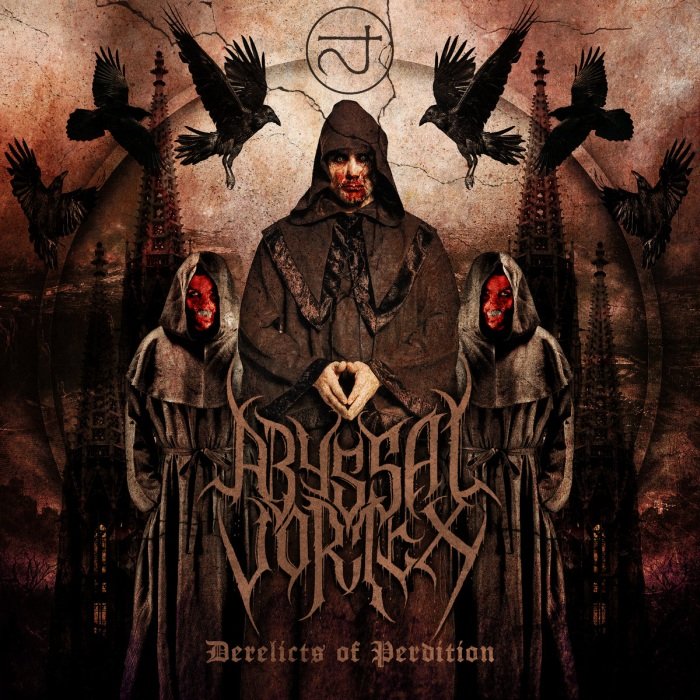
‘Derelicts of Perdition’ came out in 2015 with Devan Andoor handling the guitars and compositions, Mike Priest, now known as Mia Priest, on vocals and lyrics, Kathir Aryaputra on bass and Dirk Verbeuren on drums. That is a hell of a lineup, but what makes this EP worth talking about is not simply the names involved. There is genuine substance behind the musicianship and, most importantly, Devan’s compositions give the entire thing a strong foundation.
Devan deserves a lot of credit here because the material is properly composed rather than sounding like a collection of riffs thrown together to show off technical ability. There is detail in the guitar work, but the songs have direction and movement, with different passages fitting together naturally. That balance is not always easy to achieve, especially when you have musicians capable of playing at this level. The technical side is there, but it does not completely take over the songwriting.
‘An Iniquitous Oblivion’ starts the EP, followed by ‘Beyond the Necrolith’, ‘Ravenous Sepulchres’ and ‘The Netherist Bordure’. Four tracks and roughly seventeen minutes may not sound like a lot on paper, but there is enough happening across the EP to make it feel complete. Nothing feels unnecessarily stretched out, and the tracks have enough individuality while still belonging to the same body of work.
Kathir Aryaputra was another strong choice for the lineup. His experience within Singapore Metal, including his work with Rudra and other projects, means he was hardly coming into this without understanding how to handle demanding material. His bass work sits where it needs to sit, supporting Devan’s guitar. There is a good sense of interaction between the rhythm section and guitars, which helps keep the compositions together.
Then you have Dirk Verbeuren on drums.
For any Singapore Metal musician, seeing a project like this bring in a drummer of Dirk’s calibre is pretty damn impressive. By this point he had already established himself internationally through Soilwork and his other work, and his playing here is exactly what you would expect from someone with that level of experience. The precision is obvious, but what matters more is that he does not turn the recording into a showcase for himself. The drumming works around the compositions and gives them the drive they need.
This also brings us to Mia Priest. At the time known as Mike Priest, Mia was responsible for vocals and lyrics and was also instrumental in bringing this particular group of musicians together. That deserves recognition because putting together a lineup like this is one thing, but putting together musicians who actually complement the compositions is another. Devan’s writing needed players who could execute it properly, and Mia brought in people who were more than capable of doing exactly that.
The vocal arrangements also play an important role. Mia’s vocals do not simply sit over the guitar tracks as another layer. They are incorporated into the arrangements and give the songs their own character. Combined with the lyrical direction, it helps Abyssal Vortex sound like an actual project with an identity rather than simply a technical Metal collaboration between musicians with impressive backgrounds.
The recording approach was serious as well. The material was recorded between Singapore and Sweden and mixed at Necromorbus Studios. That is quite a different level of production from simply recording something quickly and putting it online. The sound gives the musicians enough room to come through without stripping away the character of the material.
‘Ravenous Sepulchres’ is also worth mentioning because it eventually received a music video, and it gives a good representation of the project as a whole. There is enough aggression and technical detail to satisfy anyone coming into this for the musicianship, but the atmospheric side of the compositions prevents the material from becoming a straight technical exercise.
And this is exactly why I have always had very little patience for joke bands and hobby bands from Singapore. I am not talking about young musicians learning their instruments or a new band taking its first steps. Everyone starts somewhere. I am talking about bands that have no real intention of developing beyond getting together occasionally, making some noise and calling it a day. When you put that attitude next to a project like Abyssal Vortex, the difference is simply too obvious to ignore.
Look at the musicians involved here. Look at the work that went into Devan’s compositions. Look at the standard of playing from Kathir and Dirk. Look at what Mia put together around those songs. There was clearly an ambition to make something worthwhile. That is the sort of attitude I respect, regardless of whether a band becomes famous or remains obscure.
Singapore has never lacked musicians with ability. What matters is what they choose to do with that ability. Abyssal Vortex is a good example of musicians refusing to settle for something half-hearted. There was proper songwriting, serious musicianship and an effort to present the material at the level it deserved.
What I particularly appreciate about ‘Derelicts of Perdition’ is that none of this becomes a competition between the musicians. You can hear the ability throughout the recording, but the songs remain the priority. Devan’s compositions provide the framework, Kathir strengthens the rhythm section, Dirk brings his own considerable experience behind the kit and Mia gives the project its vocal and lyrical identity. Everything has a place.
That is what separates this from the sort of local project that exists simply because a few people want to say they are in a band. Abyssal Vortex had musicians who could have easily made the whole thing about technical ability and reputation, but the EP is ultimately judged by the material itself. Thankfully, the material holds up.
‘Derelicts of Perdition’ is only four tracks, but it remains a very worthwhile document of what these musicians were capable of putting together. More importantly, it is a reminder that Singapore has produced musicians who were willing to take Extreme Metal seriously and push themselves beyond the usual limitations. Devan’s compositions are the backbone, and the quality of the players around him allows those compositions to reach their full potential.
For me, that is the real value of Abyssal Vortex. Not the names on the credits, not the international connections and not the fact that Dirk Verbeuren eventually became associated with much bigger names. It is the fact that a group of highly capable musicians came together and actually made something substantial. That is the kind of Singapore Metal I will always have more respect for.