
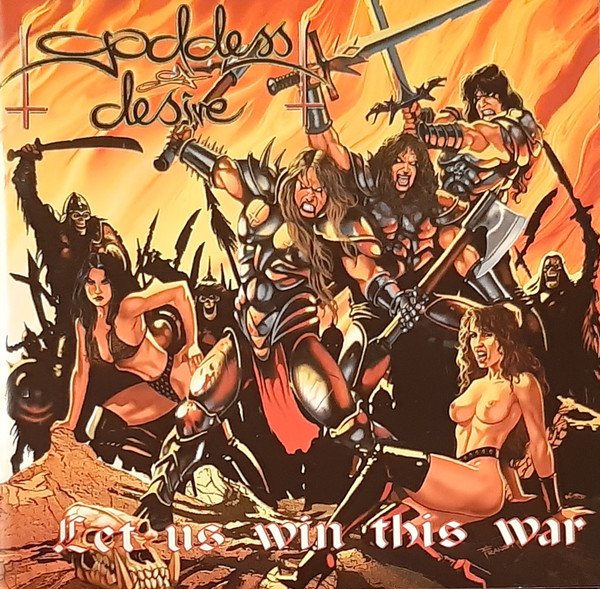
Goddess of Desire were never going to win any prizes for looking like an ordinary Heavy Metal band. Formed in Bergen, Netherlands, in 1995, the original lineup of Count August on vocals and bass, Grev Drake on guitars and vocals and Emperor Mark on drums came together with a very obvious love for the old Heavy Metal tradition, but they also had a sense of theatre that made them stand out immediately. Their early days involved playing covers in local clubs before developing their own material and turning their live shows into something considerably more outrageous, with costumes, props and pyrotechnics becoming just as much a part of the Goddess of Desire identity as the music.
I discovered ‘Let Us Win This War’ in 1997 at my friends Ram and Rattan Singh’s place, around the same time I came across Demoniac’s ‘Stormblade’. That was a pretty good afternoon for discovering strange Metal because you never quite knew what was going to come out of somebody’s CD collection. With Goddess of Desire, even the name already sounded like something that was going to involve excessive leather, swords, smoke and somebody taking the whole Heavy Metal fantasy a little too seriously. Then you actually see the band and realise that, yes, they really did commit themselves to the entire circus.
The album itself was originally self-released in December 1996 and was recorded at Studios Ozan in Den Haag. The original trio handled the music themselves, with Paul van Rijswijk credited as producer and Frans Mensink responsible for the cover art. The CD contains ten pieces and runs just over forty minutes, beginning with the instrumental ‘Intro (Midnight Overture)’ before launching into ‘Mistress of Inferno’.
Musically, Goddess of Desire were coming from a very straightforward place. This is Heavy Metal with a strong 1980s backbone, mixed with Thrash Metal touches and plenty of old-school attitude. You can hear the affection for the classic European and American Metal bands without the group pretending they had invented some revolutionary new style. ‘Mistress of Inferno’, ‘War of the Crusade’ and ‘Glory in Metal’ establish that immediately, with chunky guitar riffs, driving drums and vocals that sound like they were designed to be shouted back by a crowd.
‘Glory in Metal’ is particularly appropriate because the whole album feels like a celebration of the kind of Heavy Metal that existed before everything became polished and carefully packaged. There is a deliberately old-fashioned quality to the riffs and arrangements, and that works because Goddess of Desire clearly understood the world they were trying to recreate. ‘The Battleground’ and ‘Metal to the Metals’ keep that momentum going, while ‘Wall of Terror’ brings in a darker edge without changing the basic character of the album.
Then you have ‘Goddess of Desire’, an instrumental that gives the album another bit of atmosphere before the band gets back into the heavier material. ‘Doomsday Warrior’ closes things out with exactly the sort of grand Heavy Metal feeling you would expect from a band whose stage show apparently required enough props to make a normal gig look like somebody had emptied an entire fantasy film set onto the stage.
That theatrical side was not some afterthought either. Goddess of Desire became known for their live presentation, which included elaborate costumes, fire and other stage effects, and eventually became a major part of their reputation. Their 1997 VHS ‘Blasphemic Beer’ documented a Dynamo Open Air performance from May that year, showing just how important the live side had become so early in their career.
Looking back, I think that is why ‘Let Us Win This War’ has a certain charm. The band were not trying to make Heavy Metal complicated. They wanted big riffs, big choruses, old-school Metal spirit and a live show that could probably cause more trouble than the average club was prepared for. There is something quite refreshing about that attitude today, especially when so many bands seem to spend more time worrying about how serious they look than whether people are actually having a good time.
The story did not stop with this album. In 1997 they followed it with ‘Let Us Win This War II’, a limited picture disc containing several of the original songs alongside additional material, while ‘Symbol of Triumph’ arrived in 1998. The band would eventually move towards bigger productions and a more established lineup, but the original trio period remains the foundation of what Goddess of Desire became.
For me, ‘Let Us Win This War’ will always be connected to that 1997 discovery at Rattan’s place, when albums like this could appear completely out of nowhere and become part of your collection before you had even figured out what the hell you were listening to. Goddess of Desire were gloriously excessive, completely committed to their Heavy Metal fantasy and apparently determined to prove that a guitar riff could never be too big, a stage show could never be too ridiculous and there was absolutely no such thing as enough Metal.
And honestly, that is probably the whole point of Goddess of Desire.