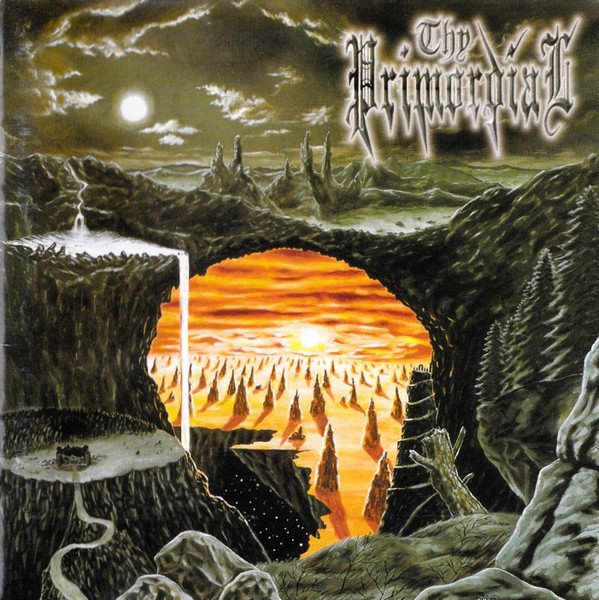
By the time ‘At the World of Untrodden Wonder’ finally appeared in 1999, Thy Primordial had already become one of those bands that seemed to exist slightly outside the attention given to some of the bigger names in Swedish Black Metal. What makes the album particularly interesting is that it was actually recorded in August 1997 at Sunlight Studios, meaning the music belongs to the same period as ‘Where Only the Seasons Mark the Paths of Time’, even though the release came considerably later. The delay was partly caused by the strange situation surrounding ‘Under Iskall Trollmåne’, the band’s earlier recording that was finally released by Gothic Records in 1998 and confused the band’s chronology for listeners and even the people involved with the releases.
The lineup remained unchanged from the previous Pulverised album, with Isidor on vocals, Mikael Andersson and Nisse Nilsson on guitars, Jonas Albrektsson on bass and Morth on drums. This continuity is important because ‘At the World of Untrodden Wonder’ does not feel like a completely different band trying to reinvent itself. Instead, it sounds like the same musicians taking the foundation of the earlier record and making the songwriting more developed, the attack more aggressive and the production much more powerful.
Moving from Rolab Music Studio to Sunlight Studios was a significant change. Tomas Skogsberg handled the engineering and mixing, with Fred Estby also involved in the recording, while Thy Primordial produced the album themselves. You can immediately hear the difference in the guitars. They have considerably more weight and definition, giving the riffs a physical presence that suits the band’s increasingly aggressive approach. The melodies are still there, but they are buried inside a much more forceful Black Metal attack.
‘Once on Fortunes Throne’ is a perfect example of where the band had gone. The opening riff grabs you immediately, and the song develops through rapid drumming and tightly constructed guitar work without losing that melodic identity that made the previous album memorable. ‘The Fatal Journey’ and ‘At the World of Untrodden Wonder’ continue in the same direction, with the guitars doing most of the atmospheric work while Isidor’s vocals cut through the music with a harsher and more commanding delivery.
One of the biggest differences from ‘Where Only the Seasons Mark the Paths of Time’ is Isidor’s vocal approach. The earlier album had a higher, sharper vocal style that gave it a distinctly raw atmosphere, whereas here his voice sits lower and sounds considerably more aggressive. The band members themselves later explained that they wanted the vocals changed because they felt the earlier shrieks reduced some of the energy in the music. They also described the new material as more aggressive and more thoroughly worked out, having spent around a year writing the songs.
That extra time in the songwriting shows. ‘Amongst the Chosen Lost’ has the kind of melodic guitar work that keeps the song memorable even while the rhythm section is charging underneath it, while ‘The Burden of Time’ gives the album another change of pace before ‘To Ruin and Decay’ and ‘My Beloved Darkness’ push the music into some of its most intense territory. There are more changes in the riffs and rhythms here, and the guitars occasionally move into more intricate territory without losing the directness that makes the album work.
The Sunlight production also gives the album a very different character from the previous Pulverised release. ‘Where Only the Seasons Mark the Paths of Time’ had that rawer underground quality; ‘At the World of Untrodden Wonder’ sounds much bigger and more defined. It is still unmistakably 1990s Black Metal, but you can hear every layer of the guitars more clearly, and that becomes particularly important when the band starts stacking melodies and changing rhythmic patterns within the longer songs.
There is also something satisfying about the fact that Roy Yeo once again handled the layout. His involvement connects this album directly back to the Singapore side of the story, just as it did with ‘Where Only the Seasons Mark the Paths of Time’. Pulverised were operating from Singapore while Thy Primordial were recording in Sweden at Sunlight, yet the physical record brought all those different parts of the underground together. Looking at the credits today, it is another reminder of how international the Extreme Metal network already was during the 1990s.
The delayed release gives ‘At the World of Untrodden Wonder’ an unusual place in the band’s history. Although it was recorded before ‘Under Iskall Trollmåne’ was finally released, listeners encountered that older album first, followed by this one. By the time ‘At the World of Untrodden Wonder’ appeared, Thy Primordial had effectively released three different chapters of their early history in an order that did not match the way they had actually been created. That makes the album even more interesting when you listen to it now because you can hear the progression without relying on the official release chronology.
For me, this is where Thy Primordial really showed how strong their particular version of Swedish Black Metal could be. The melodies are still an important part of the identity, but the music is more furious, more muscular and more carefully constructed than before. The combination of the Sunlight sound, the unchanged lineup and the band’s more developed songwriting gives the album a very distinct character.
‘At the World of Untrodden Wonder’ is therefore more than simply another Pulverised release from the late 1990s. It captures Thy Primordial at the point where their early ideas had been sharpened into something much more powerful, while still retaining the melodic character that made them interesting in the first place. And because the album was recorded in 1997 but only released in 1999, it also stands as a fascinating snapshot of that particular period of the Swedish underground, preserved through one of Pulverised Records’ most important releases.
