Khairil has been involved in Singapore’s underground Metal scene since the early 1990s, beginning with Bestial Colony before going on to form Vrykolakas in 1991 with Shafiee. What started during a time when Death Metal was still relatively new and difficult to discover in Singapore has grown into more than three decades of Vrykolakas releases, line-up changes, recordings, gigs and everything else that comes with keeping an underground band alive for that long.
That journey has taken Khairil through several very different periods of the Singapore scene. The days of tape trading, record shops, handwritten letters and word of mouth have given way to an era where almost every band, demo and obscure release is available with a few clicks. He has also watched the way musicians write, record and release Metal change dramatically, while continuing to develop his own approach to the guitar and Vrykolakas’ Death Metal.
With ‘Into Sunless Gravescapes’ now out, this seemed like a good time to go back to the beginning, talk about the Singapore underground that shaped him, the evolution of Vrykolakas and how he approaches the music after more than thirty years of doing this.
Let’s start with Bestial Colony because that is where your journey into the Singapore underground really began. What do you remember about those early days around 1990 and 1991, when you were discovering extreme Metal and trying to find your place in what was still a very small scene?
Hail Brother Darkness! Thank you for giving Vrykolakas this opportunity to be featured in VM-Underground Fanzine! It is always an honour to respond to interviews, probably the only way Metalheads could find out more about the various entities existing in the scene.
I remember vividly the atmosphere back in 1990–1991. Singapore was probably the first country in the South-East Asian region to produce extreme Metal bands. I believe it was probably a year or two later that other countries such as Malaysia, Indonesia, Thailand and the Philippines began their Metal scenes.
Although we live on a tiny island, we started friendships between bands through letters. After a while, the Metalheads decided to come together to form communities (or circles) in various parts of Singapore. We had the Bedok Reservoir Metalheads, who called themselves Blaspheme; Abhorer’s small circle at Bedok North, comprising themselves, Infidel and Anathema. Abhorer had another circle going with Impiety, Xasthur, Decius and As Sahar. This group was probably known as the Nocturnal Eastern Force. There was the earlier Forum Galeria scene, which broke into the Plaza Singapura circle. There was the As Sahar-led Empress Place scene, with bands such as Decius and Eternal Throne. Not forgetting the northern circle with bands such as Death Squad and Xtreme Obsession, followed by the likes of Morbific and Martyrdom.
Eventually, all these Metalheads in the various scenes would come together whenever there was a gig. We didn’t get to see Metal bands performing at gigs until 1991 onwards. TNT Studio was responsible for introducing extreme Metal bands at their gigs. We could only hope that there would be some bands performing Metallica or Iron Maiden before we got to watch extreme Metal bands such as Silent Sorrow, Leviathan, Lycanthropy, Poetic Justice, Martyrdom, Blood Angel, Morbific and Rudra.
During this time, except for Abhorer and their disciples, the Metal scene may not have been so united, given whatever ideologies and idiosyncrasies everyone or every band had, but nobody bothered to gatekeep. Except, again, Abhorer and their disciples. And I want to qualify that only Abhorer’s vocalist and drummer bothered to judge and criticise the Singapore scene, whereas their main man, Exorcist, was very supportive of all the bands back then, as long as they were honest and true to their art. Through him (Exorcist), I discovered many local bands in every extreme genre.
Metalheads are mere humans, and most have very similar traits to a Makcik Bawang. There were probably more rumours than Metal bands, more rumours within a band than their releases, and more rumours about a Metalhead than the number of Metal songs he knew. After one demo (back then, none of the bands could afford to record albums) and/or a gig, everybody thought they were Morbid Angel. Everyone started walking around in a trench coat and shades. And they started choosing which band/fans deserved to be in their circle.
This was where Bestial Colony came in. Nobody liked us. We were considered the posers of the Singapore scene. There was another band, Demoniac, who were also labelled posers. It was probably fate that brought the surviving posers together to form Vrykolakas. Both Bestial Colony and Vrykolakas didn’t plan to find a place in the Singapore scene. But we are sure we gave the Singapore scene a place in the international Metal scene through our international correspondence.
Bestial Colony eventually came to an end, and you and Shafiee started working on what became Vrykolakas. What made you decide to keep going rather than simply move on after Bestial Colony, and what were you hoping to do differently with Vrykolakas?
In a way, I actually moved on from Bestial Colony for the simple reason that the other members, except for the vocalist, Doomcaster, had lost interest in the band and the music. I was forcing the guitarist to start a band named Sordid. We had some songs which had been rearranged and appeared on Bestial Colony’s album ‘Sordid Decay’. And then he disappeared from everybody’s lives. Doomcaster back then managed to get a guitarist from an indie band and formed Downfall. This band had one song and lasted one rehearsal. Downfall managed to appear in an interview in a Malaysian Metal fanzine. It changed its name again to Grrindrriah and appeared in an interview in yet another Malaysian Metal fanzine.
I don’t remember intending to do anything different. I had always wanted to do the same things as the bands I enjoyed listening to. I remember reading reviews in the Metal fanzines back in the early 1990s and coming across this very interesting phrase, ‘Sweden’s answer to (a band which was not from Sweden)’. For example, the most common one would be Divine Eve, America’s answer to Dismember! Or Séance, Sweden’s answer to Deicide! I really wanted Vrykolakas to have that tagging. But of course, we failed! Hahahahaha!
If I could point out one thing that was different from Bestial Colony, it was the songwriting. In Vrykolakas, we had Metal riffs. We were covering songs from Sepultura’s ‘Escape To The Void’, Impaled Nazarene’s ‘Condemned To Hell’, Venom’s ‘Countess Bathory’, Blasphemy’s ‘Ritual’ and even Napalm Death’s ‘Malicious Intent’. By this time, we were very clear about how we wanted our songs to move.
We were also quite decisive in Vrykolakas. We quickly completed three songs, rehearsed them between July and December, and then booked a studio for recording. By the first day of 1992, we had completed the recording of our debut demo.
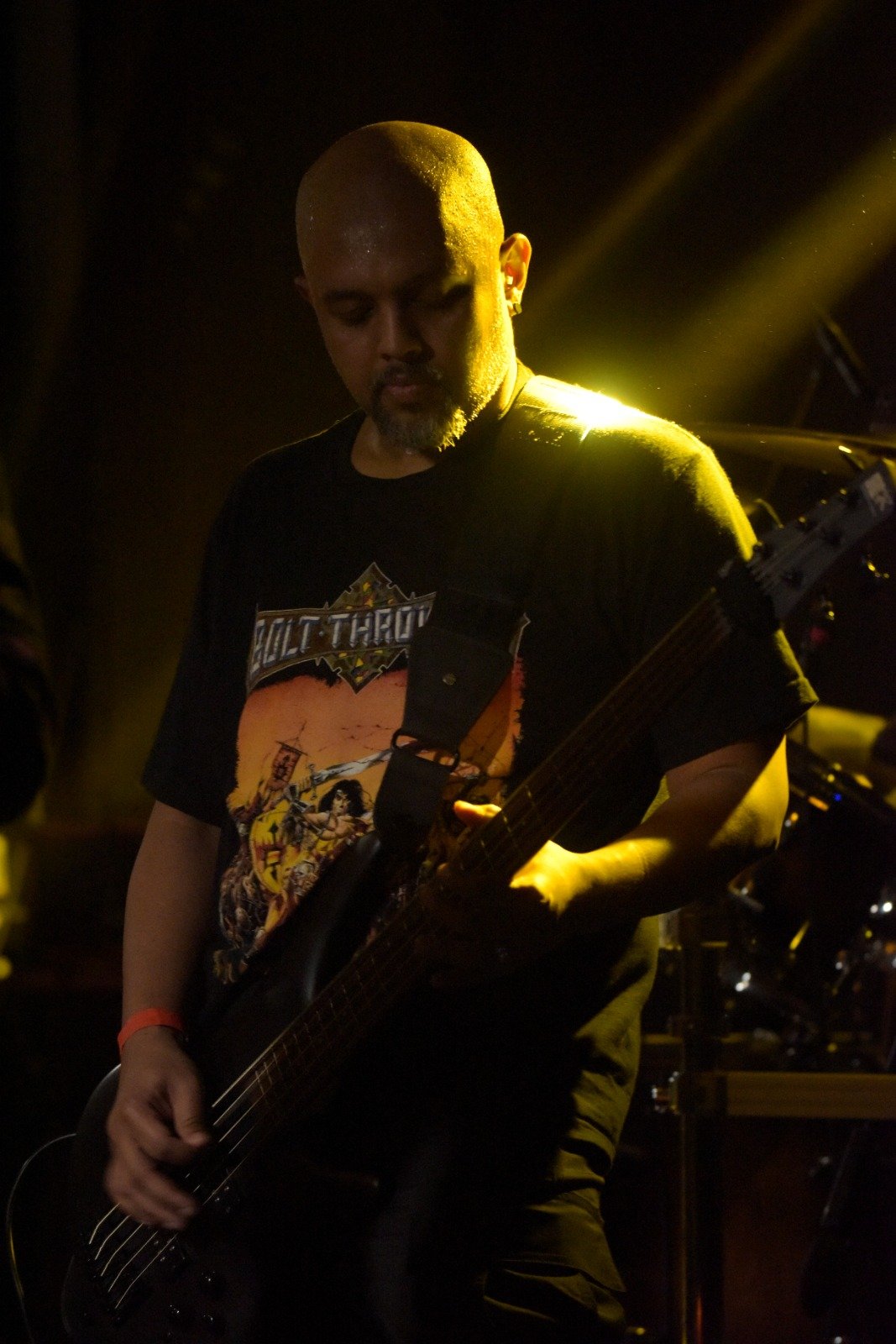
When you look back at the Singapore underground of that period, what stands out to you now? How were bands actually finding records, tapes and information, how did musicians connect with each other, and what was it like trying to build a Death Metal band here before the internet changed everything?
To summarise everything that I observed and experienced back then, there was more urgency in whatever projects the Metalheads started, be it forming bands, recording demos or editing fanzines. Although recording full-length albums was a rare endeavour (the first-ever Metal albums were released only in 1996 by Abhorer and Impiety), every band at least recorded and released rehearsal demos and/or demos with original songs. I noticed two ways Metalheads would reach out to each other to form bands. One was through close relationships: neighbours (e.g. the Ghim Moh scene, which produced bands such as Cemetery, Sadist and Rectum); school friends (e.g. Bestial Colony and Messerschmitt); relatives (e.g. Panitrator); and musical venues (e.g. TNT Studio, where bands such as Leviathan, Silent Sorrow, Mutation, etc., met up and started the formative aspects of bands). The second was through written correspondence, mainly in the non-mainstream magazine BIG-O, in the advertisement pages where readers could find contact details of musicians looking for band members to form bands.
Since there was no internet back then, Metalheads had to rely on reading and listening. Reading: Metalheads would purchase Metal fanzines from all over the world to learn about scenes in various countries, taking the risk of writing to bands and sending cash inside envelopes to purchase demo tapes, and then vinyl and CDs. Listening: There were a few record shops selling tapes and vinyl. There was a shop in the now-defunct Tanjong Katong Complex selling duplicated tapes of demos. The shop owner would make mixtapes of demos compiled onto either 60- or 90-minute blank tapes. He didn’t even bother to make photocopies of the demo covers, just a piece of paper with handwritten song titles from the compiled demos. That was how most of the Metalheads discovered new bands. A few of the more hardworking ones would write letters and send them to the bands they were curious about, hoping to receive a reply in a week or two. It worked both ways, as international bands would also initiate correspondence with Singaporean bands for trades or Metal friendship.
Let me share an interesting comparison: surprisingly, despite the distance and rather tedious work, we would receive replies from almost all the bands and fanzines we wrote to back then, except for a few lazy ones. Those who replied to our letters would include printed flyers for other bands and fanzines they were in contact with. And so, the next cycle of writing would begin, as we started making contact with new bands and new fanzines.
You’ve now watched more than three decades of Singapore Metal come and go. What changes have impressed you, what changes have disappointed you, and do you think something important from that old underground has been lost along the way?
What impressed me the most was how the original versions of Death Metal, Thrash Metal and Black Metal, and Grindcore, prevailed until today. I believe the internet helped in maintaining the main ideas of these genres. We have to thank those Metalheads who adapted to the changing landscape and decided, against all odds, to archive the music and paraphernalia of the old scene on internet platforms such as YouTube and Blogspot for the current generation to have access to. That is why we still see new and young bands choosing to play in the old style.
What I find most disappointing is the evolution of the judgemental mindset among Metalheads, whether young or old. Back then, it started with the labelling of Metalheads who looked and thought differently from others as ‘posers’. To me, this is a very unproductive habit. A lot of those judgemental Metalheads spend more time looking for people they could label as posers instead of starting a band or editing a fanzine. That judgemental mentality has evolved into something much worse. Nowadays, Metalheads spend a lot of time finding meaningless flaws in a band, a label, a promoter or an individual. With the internet, these Metalheads devote their time and energy to spreading rumours via digital means.
Here in Singapore, what I find most disappointing is the SPG mindset among the Metalheads here. ‘SPG’ is the acronym for the term ‘Sarong Party Girl’, a derogatory slang term for Singaporean girls who have their eyes, hearts and vaginas set on Caucasians and/or foreigners from the western part of the world. We have a lot of Metalheads here who praise and worship international bands, claiming quality as their reason for choosing them.
I was fortunate to enter the scene when it was developing. A lot of Singaporean Metalheads do not realise the struggle the first generation of bands had to go through. Many Singaporean Metalheads worship Abhorer and Impiety without knowing what these bands had to go through. We probably jumped on the bandwagon in supporting these two bands because Abhorer was mentioned by the international community, and we see Impiety touring the world every other year. Similarly, most likely, many people mention Wormrot because they are always touring around the world and are currently with Earache. Most of the Singaporean Metalheads fear being left out of whatever circles they think exist, so they ensure they get to say, ‘Yes, I know Abhorer!’, ‘Yes, I listen to Impiety!’ and ‘Yes, I have memorised every one of Wormrot’s song titles!’
And yes, I do expect and can accept it when these Metalheads say, ‘Your band is not even up to the standard of (insert name of band from outside Singapore)!’ or ‘The sound production of your latest album sounds cheap!’ While I would shout, ‘Support local bands!’, I do not expect any Singaporean Metalhead to support Vrykolakas or Bestial Colony at all. Just like in the 1990s. Singaporean Metalheads can save their money for the next Behemoth album or Nergal’s fashion line.
Today, a young Metalhead can discover almost any band in the world instantly through the internet and streaming platforms. Having experienced both sides of that divide, do you think having everything available so easily has made people more knowledgeable about Metal, or has it changed the way people actually dig into music?
As this interview continues, I fear that I will end up revealing more and more flaws and negative traits of the Metalheads (or followers of any extreme musical genre, for that matter) here in Singapore. But, what the heck! It is just my opinion, hahahahaha!
Metalheads included, every Singaporean goes through the same Singaporean education system. The Singaporean education system has been, and probably always will be, led by politicians who have no clear idea of what education should be. This is why we have an education system, a Ministry of Education and a Minister for Education instead of an Advocate for Learning, an Advocacy of Learning and a Learning Ecosystem. Education is structured; learning is nurtured.
The product of the Singaporean education system is therefore a person who expects results in every endeavour they participate in. In the case of Metal music, a typical Singaporean Metalhead would invest in something that offers a quick return. If a Metalhead had $15 in their wallet or purse right now, they would expect to use that $15 to stand in the front row at a Metallica concert, own an originally pressed CD, vinyl or tape by the most popular Thrash Metal, Death Metal, Black Metal or Grindcore band known and acknowledged by everybody, or buy any other Metal product considered to be of high quality. Anything different from what was just described is considered an unacceptable result. The other side of this is a Metalhead who insists that whatever product they own is the rarest, most kvlt, forbidden, anti-establishment, Satan-approved item, which everybody must agree is novel. Here in Singapore, we will encounter very few Metalheads who happily mind their own Metal.
I acknowledge the existence and presence of both discovery patterns. This is simply because the old ways of doing things have diminished, slowly and inevitably being replaced by internet-oriented methods. I appreciated the emergence of Blogspot pages where I could download old demos in their entirety. These blogs have slowly disappeared because there was a sudden surge in the number of labels that decided to invest in reissue projects. I respect such labels, despite their insistence that they are doing it for the ‘passion’ for old bands and releases, because they still have to put their own money into such projects (and then make money without anyone noticing).
I do notice that very few Metalheads really want knowledge. If they do, it is mainly for egoistic endeavours. We can see this behaviour in Metalheads who are now over the age of 50. They enjoy using the phrase, ‘Back in the days…’ The younger generation of Metalheads are not interested in knowledge. The younger generation probably prefer less information. The younger generation prefer information that doesn’t go beyond one minute of their attention. This is why here in Singapore, Hardcore and Punk music are more acceptable than Metal music. All the Hardcore and Punk bands release short releases, with songs lasting less than two minutes. They compensate for the short songs with revolutionary lyrics. They proclaim their love for nature: ‘Do not circumcise the macaques of Bukit Timah Nature Reserve!’ Or they proclaim their hatred for corruption: ‘Prata kosong must be sold at $0.50 per piece; any more than that and the politicians would grow a beer belly!’ The younger generation prefer singles rather than EPs or full-length albums. Stickers and pins are better than original songs. Playing shows with a set list full of covers is better than spending hours recording original songs in a studio.
Which goes back to my initial point of view: quick results.
Coming back to Vrykolakas, the band has gone through different eras, line-ups and changes in sound while keeping that Death Metal foundation. How do you personally define what makes something sound like Vrykolakas after all these years?
To be honest, while a lot of bands bravely claim that they have ‘a sound’, I have never understood that notion. I come from the era when every band said, ‘Love us or hate us, we will play however the fuck we want to play!’ And then you realise that ‘however the fuck we want to play’ means they play and sound like shit. Vrykolakas has always wanted to sound like our favourite bands since the beginning. We have been compared to our idols, such as Incantation, Immolation, Morbid Angel, Hellhammer, Cannibal Corpse, Deicide, Grave and (God forbid) Nile! We felt proud because we never believed that, since 1992, we could be an original band. There are only so many frets on the guitar and therefore, most probably, all original riff patterns have been covered and used by bands like Morbid Angel, Atheist, Nocturnus and Demilich.
Therefore, when we write songs, we usually have a favourite song from one of our many favourite bands as a reference point. For example, one fine morning, I wake up and take a good shit. Just before I flush, I take one look at the content and maybe it looks like the brown version of the ‘Altars Of Madness’ album cover. I leave the toilet telling myself, ‘Today will be the day I write a song that will sound like some of the songs on ‘Altars Of Madness’.’ And that’s how ‘Kaf-Fa-Ra’ was written.
To conclude, I do not make that definition of what sounds like Vrykolakas. It was and will always be about answering questions such as, ‘Will this song make Vrykolakas sound like Massacra? Yes? That’s great! Keep this song!’ Or, ‘This sounds like Immolation’s ‘Nailed In Gold’ for a good two minutes, isn’t it? Yes! Keep this part!’
Take us into your songwriting process. When you start working on new Vrykolakas material, where does a song usually begin for you, and how much does that original idea change once the rest of the band gets involved?
Unfortunately, as the years go by, I write songs with all the instruments in mind. Just as I explained in the previous question, I write songs with reference to a song or songs from our favourite bands. However, all such ideas would only remain the same until the rest of the band got involved in developing the songs from start to finish. Especially for the drummer, things may take a different turn based on his interpretation of the riffs. I may insist on a generic reference point. For example, I may say things like, ‘This is supposed to follow the style of Grave’s ‘Extremely Rotten Flesh’.’ And when I say that, I may actually be referring to the slow intro part. However, the drummer may be thinking of the slow break in the middle of that song. Miscommunications like these eventually play out perfectly well for our songs because they give them a different turn or outcome. Usually, during recording, more plot twists would occur. The drummer may forget the drum pattern at a particular part of the song. We will take note of such ‘mistakes’ and try to turn them into variations.
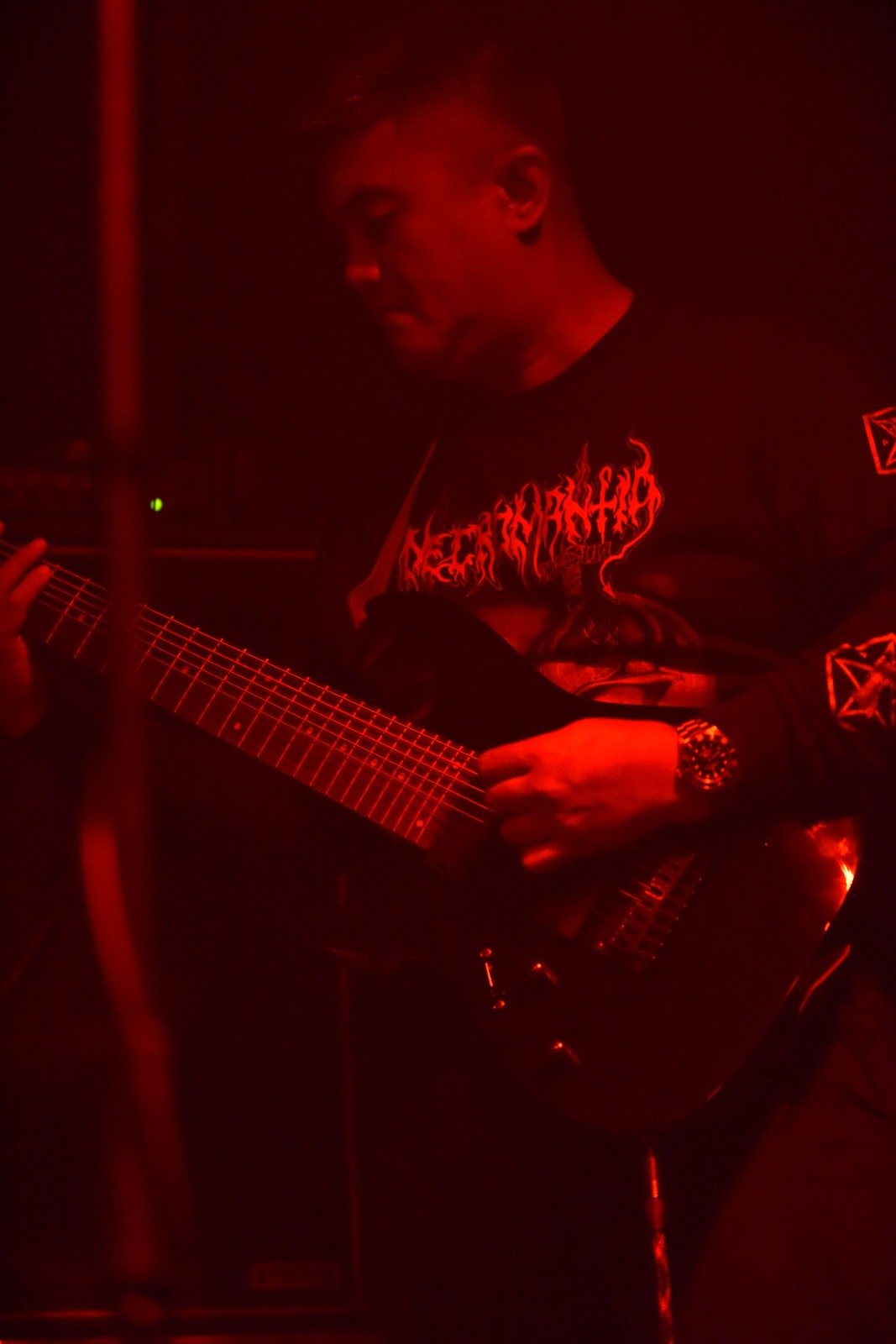
Speaking of beginnings, all Vrykolakas songs start on my acoustic guitar, without effects. I would record a riff or a set of riffs using the voice memo app on my mobile phone. When I feel like completing the riff or the set of riffs, I would scroll through all the recordings and try to put them together into a logical sequence. Then everything else happens at the recording studio. Yes! Those who are observant enough would find that Vrykolakas do not rehearse the songs for the album. We will run through the songs twice. The first round is for me to convey my ideas for the songs; the second round is for the drummer to add ideas and get a feel for the songs before we press the ‘record’ button.
Your guitar work has become a major part of the Vrykolakas sound, particularly on the newer material. What are you actually looking for when you write a riff, and has your approach to guitar and songwriting changed significantly since those early Vrykolakas recordings?
I would disagree with that conclusion. As the primary songwriter and the only person who has survived the whole existence of the band, I believe that the identity of the band lies in Andy’s vocals and Edi’s drums. I believe many people will agree that Andy has the lowest vocal sound in the Singapore Death Metal scene. He also has a weird style of articulating the words, which makes his vocal style unique and distinct from other Singaporean Death Metal vocalists. Edi has powerful and consistent kicks. Nowadays, we avoid using blast beats in our songs and emphasise the pounding beats. This makes the melodies stand out more. All it takes is to change the drum patterns, and listeners now label us as ‘Old School Death Metal’!
Vrykolakas songs can move between fast sections, slower and heavier parts and more intricate guitar passages without sounding like those changes were added just for the sake of showing off. How important is that movement when you’re arranging a song, and do you usually hear the whole structure in your head before recording it?
As a songwriter, I believe that a song tells a story. Even before the lyrics, the riffs, which riffs come before or after, the inclusion of a breakdown at a slower tempo, the leads and solos, and the pauses all help to tell the story, which is eventually told through the lyrics. If listeners pay attention to Andy’s vocals between the first and latest albums, there is a great difference. Andy’s singing helps to complete the stories being told in the songs. As the songwriter for Vrykolakas, I am proud of the fact that I could somehow write songs that sound different from each other. Sometimes, during recording, we would do a lot of retakes simply because we remembered that a particular drum pattern, singing style or guitar layer sounded very similar to something from another song.
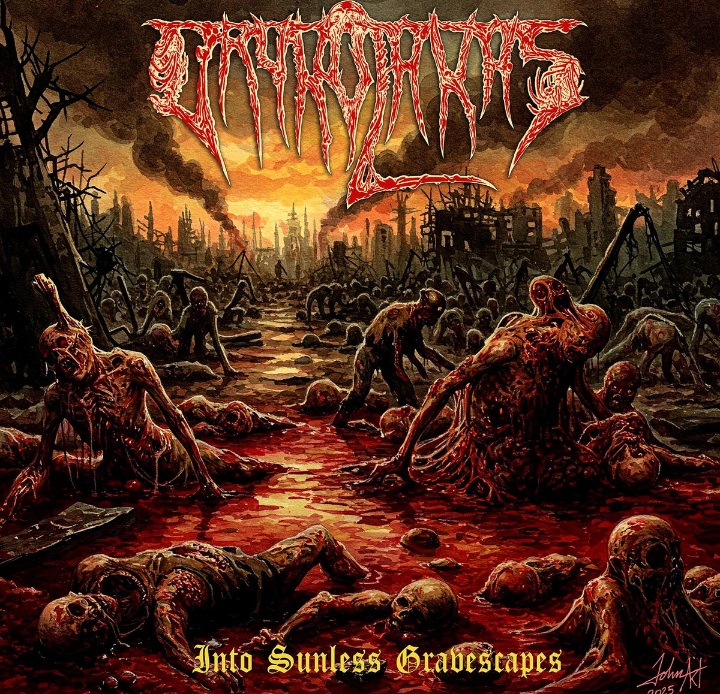
Let’s talk about ‘Into Sunless Gravescapes’. How long were these songs developing before you finally started recording them, and did the material change much during the recording period at TNT Studio?
As mentioned earlier, all of Vrykolakas’ songs began in the voice memo application on my mobile phone. Whenever I have a riff in my head, I reach for my acoustic guitar and record that riff as a voice memo. Sometimes it is just one single riff; at other times, I could get a sequence of three or four riffs. All these riffs would stay hidden in my mobile phone until I felt like preparing material for a release. Sometimes, I had to prepare material for split releases in which Vrykolakas was invited to participate. I would try to put the various separate riffs into a song, keep adding the old riffs and some new ones inspired by the existing group of riffs until I reached a point where I felt the song had enough musical ‘arc’. Some songs need to be short and direct, while most turn out epic.
Once I have a full song, I practise it to see whether the different parts make sense together. I aim to have eight or nine songs on an album and book studio time to lay down my guitars, guided by a metronome. Then I hand over the guitar tracks to the other band members to study the songs and arrange their parts. I would also suggest the vocal parts and melodies, as well as drum patterns. Things get interesting when Edi, the drummer, records his drums. We try to combine ideas so that there is variety within a riff or at some point in the song. The adrenaline rush would also force Edi to make mistakes, and with technology, we could keep the parts with mistakes to see whether those ‘mistakes’ made more sense than the intended pattern. Listeners would be able to spot some drum fills in some songs that appear to be out of place but were included and became the changed drum pattern.
For ‘Into Sunless Gravescapes’, we are very sure listeners would be able to quickly spot the references to Grave, particularly their debut album ‘Into The Grave’. ‘Sunless Gravescapes’ was the title of one of the songs on our second album, ‘Unleashing Vrykolakas Upon Mankind’, an album where we decided to expand our songwriting, include more riffs and inevitably lengthen the songs. The title of the album probably gives the vision of a grim landscape filled with death. ‘Gravescapes’ is a play on words combining ‘grave’ and ‘landscapes’. We tried to emulate the Death Metal bands we listened to while growing up: Grave, Entombed, Dismember, Phlegethon and Funebre. We hope listeners can spot those references.
I would say the riffs were written from 2020 onwards. Therefore, ‘Into Sunless Gravescapes’ was an album that was developed between 2020 and 2024, when we completed the recording of whatever parts we felt necessary, including guitar layers, vocal harmonies and leads.
What was your approach to the guitars on this album? Did you already know exactly what kind of tone and sound you wanted before entering the studio, and were there any particular songs or guitar parts that pushed you harder than expected?
I am proud to share that, since 2012, when we recorded the three songs for the ‘Fire Death Chaos’ split CD (with Beast Petrify and Absence Of The Sacred), all Vrykolakas releases have been placed in the capable hands of the producers (recording engineers). Once all the parts are tracked, we leave the studio and give the producers whatever time they require to nail down the mixing and mastering. Most of the time, we accept the producers’ vision because somehow the final mix matches our vision for the release.
When we record at TNT Studio, Mr Wong KK would suggest which guitar, amp heads and guitar effects to use, even when he had not heard the songs, because he had recently heard the combination and liked the sound. And this usually works! At the end of the mixing, we would usually request adjustments to the instrument levels to ensure they came out well.
The ‘pushing’ usually happens because, when I record my guitars at the studio, I force the riffs to fit the metronome tempo. The original riff may be slower or faster when I write it, but when I record it with the metronome, it may go the other way. So, it was a tough decision whether to maintain the original tempo or fit the metronome tempo used during recording. I also had to visualise whether the intended drum pattern would work well with the reduced or increased tempo. Sometimes, I had to rearrange the notes in the riff to make more sense at the new tempo. One example of such a situation would be a song titled ‘Yajuj Majuj Versus The World’ from the album ‘And Vrykolakas Brings Chaos And Destruction’. The original version of the song, recorded in 2010, had more notes in the opening riff. But when it was re-recorded in 2020, I decided to reduce the number of notes to make the riff stand out. From there, I learnt to nail down the tempo of the song before bringing it to the recording studio.
Another challenge I usually face during writing and recording is deciding on the picking. The picking would also determine the drum patterns, then the bass lines and vocal melodies. Sometimes, double-speed picking makes the riffs more intense. However, it may not support or complement the drum patterns. And then the gloriously planned bass lines may not fit. Sometimes, the way I pick the guitar strings may not do justice to the riff. This is where Mr Nizam Aziz, the Studio 47 engineer, would offer his advice. This is an example of how the producers get involved in developing the album until its completion.
The album was recorded with K.K. Wong and later mixed and mastered by Nizam Aziz. After so many years of recording Vrykolakas, how involved are you personally with the production side of things, and how important is it for you that the final recording still retains the character of the band rather than sounding overly polished?
Since the recording of the ‘Fire Death Chaos’ split CD back in 2012, the band has entrusted all mixing tasks to the engineers at the studios we have worked with. Once all the instruments and vocals are laid down, we simply inform the engineer to follow the production of a particular album by a particular band. For example, we asked Mr Nizam Aziz to mix ‘And Vrykolakas Brings Chaos And Destruction’ following the production of Immolation’s ‘Dawn Of Possession’.
Our experience with past recordings, mixing the songs on the ‘Vrykolakas 2000’ MCD, the ‘Supreme Brutal Legions’ split CD and the ‘Spawned From Hellfire And Brimstones’ album, taught us that we had no idea what mixing was all about. We wanted the guitars to sound like this, we wanted the second guitars to sound like that, we wanted the drums to be more intense, etc., etc., and at the end of all those requests, we still didn’t like the result. We decided, in 2012, to leave the mixing tasks in the hands of the experts. We just provided a basic idea of what we wanted the overall result to be. Most of the time, the engineers nailed it.

When you listen to ‘Into Sunless Gravescapes’ now, do you hear it as a continuation of everything Vrykolakas has done before, or do you feel there are aspects of the album that show a different side of the band that wasn’t there on the earlier records?
When we completed the recording of ‘Vrykolakas 2000’ and felt ready to do a full-length album, Iman and I planned out the Vrykolakas story, to be told through five full-length albums. The five albums would tell the Vrykolakas story from inception to ending. The album titles were ‘Spawned From Hellfire And Brimstones’, ‘Unleashing Vrykolakas Upon Mankind’, ‘And Vrykolakas Brings Chaos And Destruction’, ‘World Vryko-Domination’ and ‘Supreme Brutal Vrykolakas’. Once we completed these five albums, we would slow down to recording demos again, or splits or contributions to compilation projects.
We were moving quite fast from one album to the next initially. Upon completing the recording of ‘Spawned From Hellfire And Brimstones’, we started working on ‘Unleashing Vrykolakas Upon Mankind’. In between these two albums, we had some live shows. I personally felt that preparing for live shows distracted us from focusing on songwriting and finalising the songs for the next album. We started recording ‘And Vrykolakas Brings Chaos And Destruction’ even before confirming the release of ‘Unleashing Vrykolakas Upon Mankind’.
The recording of ‘And Vrykolakas Brings Chaos And Destruction’ began in 2009. We managed to record the guitars, bass and drums for nine songs. Unfortunately, Andy couldn’t commit to slots for his vocal recordings. He had some personal issues to manage and had to stay away from band and label (Vrykoblast Productions) activities. I recorded vocal guides in the hope that Andy would be able to record the vocals. The studio closed and handed over the nine unfinished songs to me with very basic mixing. You can listen to that recording on our YouTube channel.
When we returned after Covid-19 in 2020, we had a different plan. The band would turn 30 in 2021. We planned to record 30 songs and start releasing them in shorter releases (demos or EPs), from July 2021 until all 30 songs had been recorded and released. We started with the ‘The Cult Of Nocturnal Death’ demo, containing two old songs written back in 1995. We also recorded the song ‘Infinite Sirat’ to be released on ‘Sengatan Selatan Volume II’, which was coordinated by the late Mr Fadhil of Muzik Box Productions and the kvlt Mintalkuburuj Fanzine. Unfortunately, we forgot to send him the song. He passed away, and the people continuing the project pressed the CDs with whatever songs from the participating bands had been sent to Mr Fadhil.
Our plans, fortunately or unfortunately, took a different turn. We had a few reissues of our previous releases. One of the reissues, ‘Into The Shadow Of Death’, caught the attention of a label, which offered to release a full-length album for us. At that time, I gave it some thought and decided that maybe it was a sign to complete our five-album plan. We decided to re-record the ‘And Vrykolakas Brings Chaos And Destruction’ album, this time rearranging the songs, excluding some songs and including newly written ones.
Now, our revived five-album plan took a different turn again! After the release of ‘And Vrykolakas Brings Chaos And Destruction’, we decided to revisit our Demo 1992 and the four songs written back in the mid-1990s during those years of uncertainty and re-record them with the current line-up. Our songs back then had a very Black Metal nuance to them. We thought it would be interesting if Edi were to add his Death Metal touches to the songs. We recorded the ‘The Necromantic Revocation’ album without any plans to release it. Andy got some labels to listen to it, and it caught the attention of The Gate Records from the USA. So, ‘The Necromantic Revocation’ became the fourth album, which does not fit the five-album story.
It is important to mention that, immediately after ‘And Vrykolakas Brings Chaos And Destruction’, we started recording the next album, ‘World Vryko-Domination’, which was retitled ‘Nocturnal Dominion Of Death’. We had laid down the guitar tracks for ‘Nocturnal Dominion Of Death’ at Studio 47 before beginning work on ‘The Necromantic Revocation’ at TNT Studios.
Listeners would agree with us that ‘The Necromantic Revocation’ sounds very different from the rest of our albums. After ‘The Necromantic Revocation’, we also quickly recorded the ‘The Anatomy Of The Ungodly’ split CD with Nuclear Christ. This is where we began to entertain the thought that ‘The Necromantic Revocation’, ‘The Anatomy Of The Ungodly’ and ‘Into Sunless Gravescapes’ could demonstrate a different side to Vrykolakas’ songwriting. The other albums reflect our songwriting in its natural state. The three mentioned albums show our intention to write differently. ‘The Necromantic Revocation’ leans more towards Blackened Death Metal; ‘The Anatomy Of The Ungodly’ sounded more like the 1990s Floridian bands such as Massacre, Obituary and Deicide, while ‘Into Sunless Gravescapes’ sounded like Grave and Funebre.
While the other albums showed us putting all our influences into one song, the three mentioned releases demonstrated our attempt to pay tribute to a few bands in a recording.
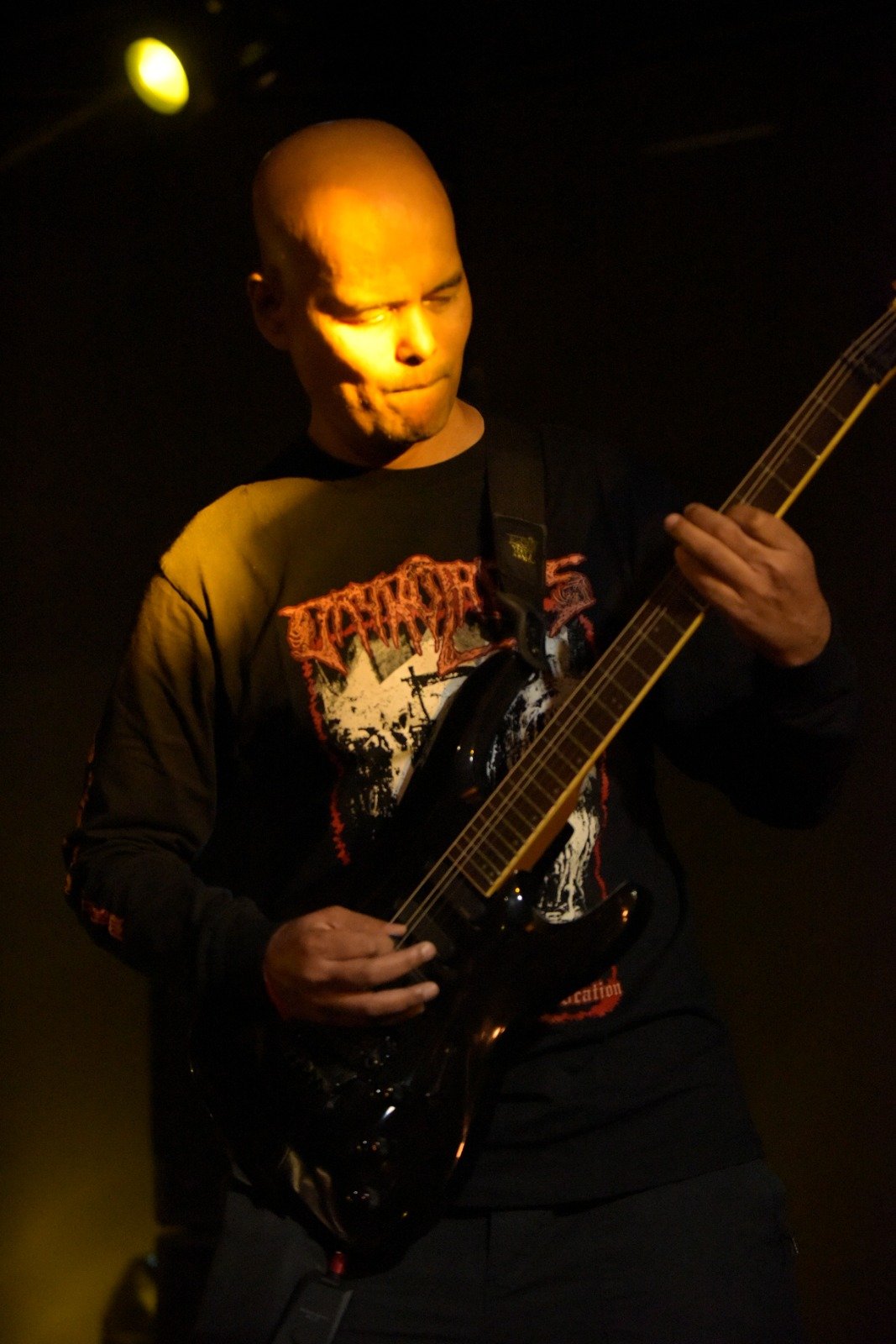
You started this journey as a young musician in Bestial Colony and have continued with Vrykolakas through completely different generations of Metalheads, technology and underground culture. What has kept that desire to write, record and play Death Metal alive for you for all these years?
What really helped back then was the simplicity of life. We discovered this Metal music, we discovered Metal bands in Singapore, and we discovered that there were many other people with a common interest in Metal music. We didn’t realise we were starting a journey, a scene or something new. We just went with the flow. There seemed to be a sudden explosion of Metal bands in the late 1980s and early 1990s, without egoistic philosophies tying us down.
For me personally, it is purely due to suppressed creativity. I say suppressed because I can feel my inner desire to express myself in many ways that may be perceived as illegal or perverse. Thankfully, the only mode of expression used consistently is Death Metal music. In a perverse way, I am usually not able to fully express myself within one song or even one album. Once a song is completed, there will always be another version lingering in my mind. I have to tell myself to keep that alternate version for the next song or the next album. It is probably an issue of unsatiated desire.
When you look at Vrykolakas today, with ‘Into Sunless Gravescapes’ now added to the discography, what does the band mean to you personally after everything you’ve experienced since those Bestial Colony days?
In truth, Vrykolakas had grown to become my alter ego back in 1998, when we reformed with Iman, Andy and Zainal. I remember responding to a question back in 1993–1994, when I went to Ipoh, Perak, to attend a gig. The late Bearkey (Krenmaut Zine and Langsuir session bassist) actually asked about the survival of Vrykolakas then, with me being the only member left. And I said, ‘As long as I’m alive, Vrykolakas lives!’ Whatever Vrykolakas music and lyrics you experience, those were expressions of my cognitive perversions.
I write lyrics based on the stories in the Quran. I put myself in the personal space of the mentioned character(s) and try to understand and interpret the stories from their point of view. In the song ‘Kaf-Fa-Ra’, I tried to speak for the Dajjal based on as much of the description and as many anecdotes about him as are mentioned in the Quran and Hadith. I believe I succeeded in that approach because the song was identified by the local media authorities as a song that could cause religious disharmony among Singaporeans due to its explicit lyrics, and they forbade us from performing that song in Singapore.
Finally, thank you for your time for this interview with me on behalf of VM-Underground and our readers. Any parting words for us and Brother Darkness?
Thank you, Brother Darkness, for giving Vrykolakas the opportunity to be featured in VM-Underground Fanzine! We always enjoyed responding to interviews back in the day and looked forward to seeing the final printed version, curious about the other bands featured alongside us. I think today, Metal bands may not appreciate the importance and impact of interviews on a band’s presence and existence in the Metal scene. We are grateful that Vrykolakas receives such opportunities even in this digital age.
For those who have never listened to Vrykolakas, start with this:
