There are heavy records, and then there are records that seem to have actual mass.
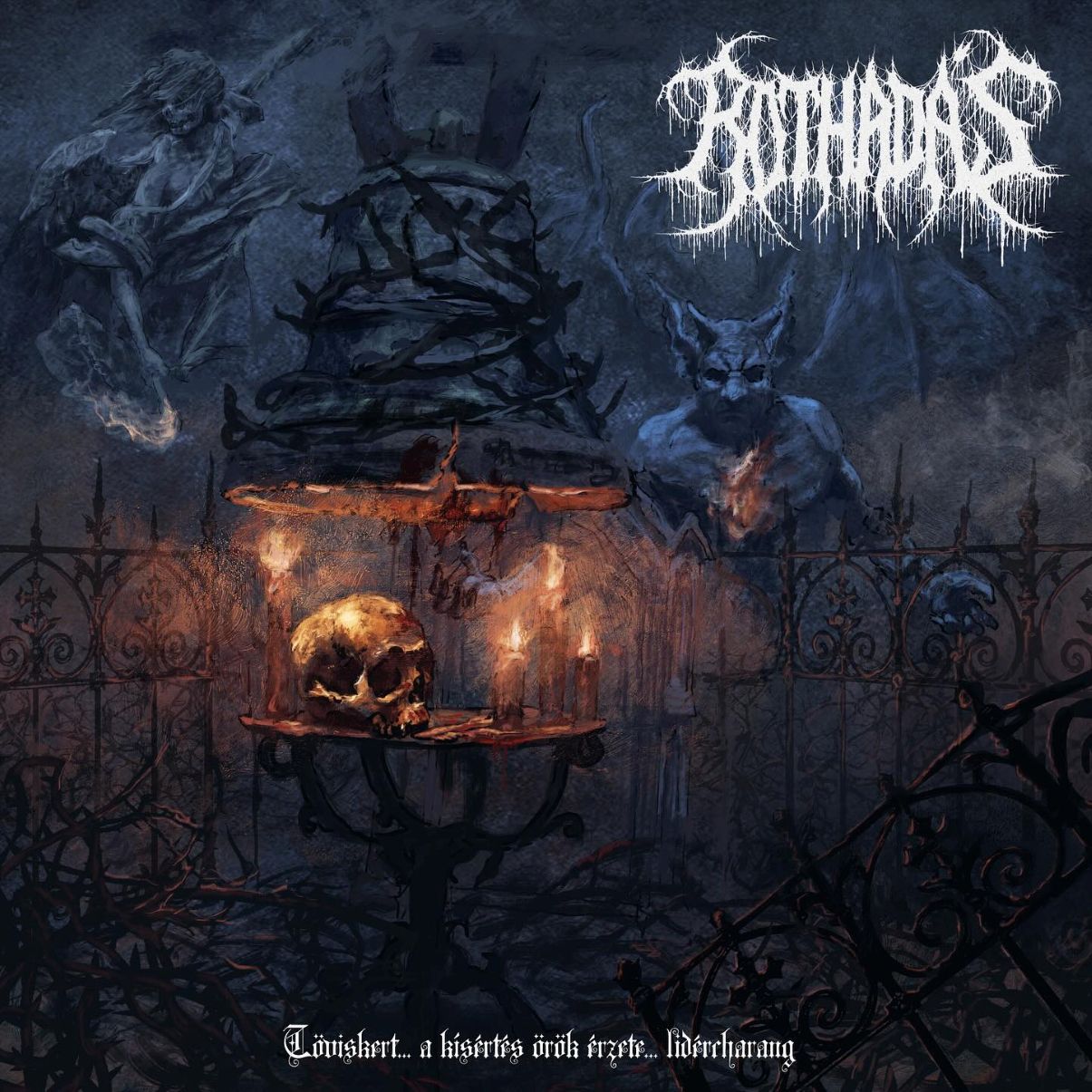
‘Töviskert… a kísértés örök érzete… lidércharang’, the second full-length from Hungary’s Rothadás, clearly belongs to the second category. Six songs built as if they were meant to occupy every inch of available space: enormous guitars, cavernous drums, sepulchral vocals, and a production that achieves something especially difficult in this kind of Death/Doom, sounding gigantic without turning everything into an indistinguishable wall of sound.
That was probably the first thing that caught my attention. The production is fantastic. Despite all the filth, darkness, and brutality surrounding the album, every element remains perfectly defined. The guitars have depth and body, the drums retain an impressive physical impact, and the voice rises from the center of the mix as if someone were screaming from inside a grave. The agonized screams are particularly effective.
Rothadás is usually labeled Death/Doom, and that classification obviously makes sense, but after listening to a good part of the album, I feel Death Metal carries considerably more weight in the equation.
The Doom appears. And when it appears, it matters. But the band does not need to remain permanently slow in order to feel crushing.
There are fast sections, double bass, aggressive riffs, and moments where Rothadás feels much closer to a massive Death Metal machine than to a band concerned only with creating funeral atmospheres. Then they slow things down again and the space starts to feel different, as if the music suddenly acquires even more gravity.
Perhaps that is one of the album’s greatest strengths. Rothadás does not use Doom simply to play slowly. They use it to increase the weight.
At the same time, they do not abuse long atmospheric passages. There is atmosphere, of course, but it is usually buried inside the guitars themselves, the vocals, and that monumental production. The album seems far more interested in crushing than contemplating.
Even the language helps. All the song titles are in Hungarian, which naturally creates an additional distance for those of us who do not speak the language. We do not immediately know what each phrase means, but phonetically Hungarian fits perfectly within the ancient, strange, and dark feeling surrounding Rothadás. They do not need to be translated to sound threatening.
The artwork moves in exactly the same direction. Nothing seems designed to make the record more accessible. From the endless title to the artwork and visual identity, everything conveys a deeply Central European kind of funerary mystery. I like that. Because within an increasingly crowded Death/Doom scene, developing a recognizable personality is essential.
Rothadás clearly shares territory with bands such as Spectral Voice, Mortiferum, Fossilization, or even certain moments of Funebrarum, but I do not feel Töviskert… exists simply to reproduce the sound of any of them. What stands out is precisely that balance between abrasive Death Metal, massive riffs, cavernous Doom, and an exceptionally huge production.
And then comes ‘Az örök isten Lucifer’. More than nine minutes that never feel excessive. On the contrary, it is good that the band allows itself that much time, because the song works as a genuine catharsis and as the perfect ending to the album.
It begins in a more restrained way, almost aligned with the voice, and gradually builds into something I would no longer describe as merely atmospheric or ceremonial. This is a ritual. An epic, dark, absolutely dominant ritual.
While listening to it, the image that came into my mind was of ruined churches, fire consuming destroyed spaces, and shadows moving through that scenery. Rothadás transforms its cavernous brutality into a complete ceremony, and suddenly the entire album seems to have been leading toward this moment.
The clean vocals that appear toward the end are not necessarily the element I enjoy most personally. But here they work, because they become part of a kind of scenic conspiracy. They are not there to soften the song. They are there to complete the ritual. And the result is impressive.
‘Az örök isten Lucifer’ is, for me, a dream of a song. One of the best tracks I have heard in a very long time. Chaotic, diabolical, monumental, and perfectly placed as the closing piece of an album that was already extremely heavy before reaching its final nine minutes.
By that point, the overall impression is absolutely clear. Rothadás has built an extremely heavy, aggressive, and dark record, but also a very well-conceived one. It does not need to hide its riffs behind tons of reverb or turn every song into twenty minutes of slowness to prove that it belongs to Death/Doom.
The brutality is there from the beginning. The Doom simply opens the grave a little wider.
And personally, I cannot wait to find out how all this weight works onstage when I see them at Kill-Town Death Fest 2026.
For now, ‘Töviskert… a kísértés örök érzete… lidércharang’ feels like one of those records that does not necessarily need to surprise you every minute, although its closing track ends up doing exactly that.
It only needs to keep moving forward. Slow when it needs to be. Violent when it wants to be. And always tremendously heavy.
My congratulations to Rothadás. After listening to this album, I not only want to see how this brutality translates to the stage, I also hope to contact them soon and, hopefully, take this conversation a little further in a future interview.