Majusiah are one of those Singapore names that deserve to be looked at beyond whatever happens to be their newest release at the time. Their history reaches back to the early years of the local Black Metal underground, with ‘Goddess of Darkness’ appearing in 2003 and establishing the band as part of that generation of Singapore Extreme Metal that was developing its own identity through small labels, cassettes, compilations and underground trading. The band’s own catalogue places ‘Goddess of Darkness’ in August 2003, while later documentation also records the band’s appearances on the Singanesia compilations.
The original Majusiah lineup featured Leviathan on vocals, Sithrawll and Rimmon on guitars, Sabazios on bass and Cimeries behind the drums, with Balak Marggyah contributing session keyboards. That old lineup is important because Sabazios remains the direct thread between the early Majusiah and what the band became after returning to activity. His original credit was bass on ‘Goddess of Darkness’, while his later work on ‘Bearer ov the Dark Seal’ involved rhythm guitar, lyrics and songwriting.
‘Goddess of Darkness’ was a four-song cassette EP and it came from a period when Singapore Black Metal was still operating very much within the underground tape-trading culture. The recording subsequently appeared through compilation releases as well, giving the band’s name a little more reach beyond the original cassette. Majusiah’s own catalogue describes the 2003 EP as the starting point before the band eventually disappeared from active circulation for a considerable period.
There is some conflicting information surrounding the band’s earliest formation date, with later material giving 1998 while Metal Archives records 2003 as the formation year. Rather than getting too hung up on which date should be considered official, what matters musically is that Majusiah’s first documented release belongs firmly to the early 2000s Singapore underground and that the band eventually went inactive before returning many years later. A contemporary review of ‘Bearer ov the Dark Seal’ describes the band as having broken up around 2008 before resurrecting in 2019.
That resurrection produced ‘Bearer ov the Dark Seal’ in 2019, and this was where a new generation of Majusiah became properly visible again. Demogorgon took over vocals, Ifrit handled lead guitar, Astaroth played drums and Sabazios returned to the musical core of the band through rhythm guitar, lyrics and songwriting. Demogorgon has been credited with vocals since 2018, Ifrit with lead guitar since 2018 and Astaroth with drums since 2019.
‘Bearer ov the Dark Seal’ showed that the return was not simply a nostalgic attempt to reproduce an old name. Majusiah had developed into a Melodic Black Metal band with an old-school foundation, sharp guitar melodies and a more developed sense of arrangement. The record’s material moved between darker passages and more aggressive sections without losing the underlying Black Metal character. That balance between melody and hostility became an important part of the band’s identity after their return.
What makes the present incarnation particularly interesting is that Majusiah have continued rather than treating the 2019 return as a one-off reunion. Personnel have changed around the core over the years, including Asmodeus Majusiah666, who is documented as having played bass between 2019 and 2024. Sabazios is now listed on bass again, bringing the connection with the original 2003 period full circle.
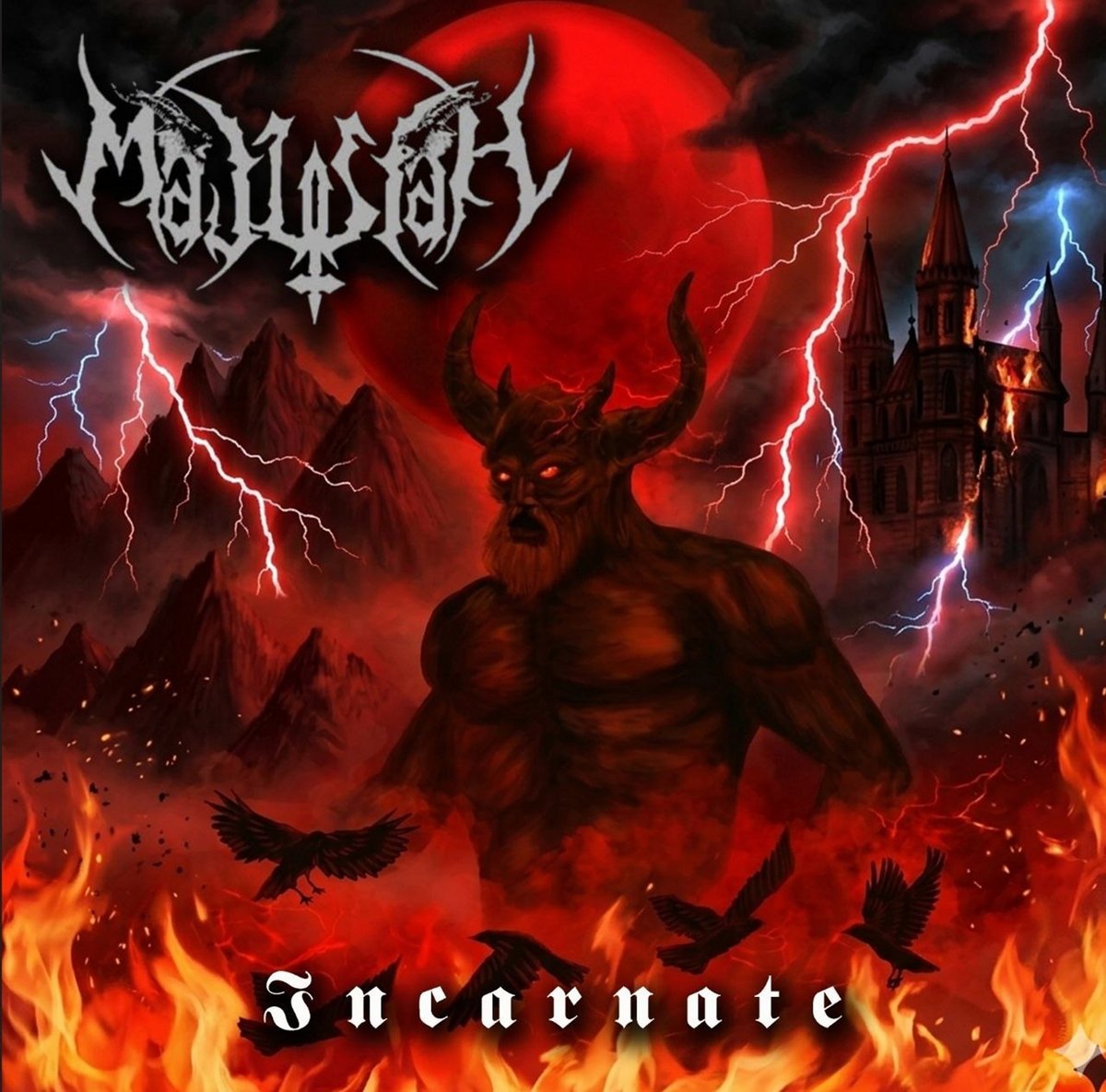
That brings us to ‘Incarnate’, released through Goatlordth Records on 25 July 2026 as GOAT-91. It is a four-track release running around eighteen minutes, with ‘Circle Ov Occult’, ‘Vault Ov Dusk’, ‘Spawn Infernal Wind’ and ‘Nocturnal Covenant Ov Ash’ making up the tracklist.
There is something fitting about Majusiah returning with a short release rather than trying to make some enormous statement. ‘Incarnate’ gets straight into the material and keeps the whole thing compact. The four tracks give the band enough space to establish the atmosphere and melodic character without stretching the material beyond what it needs to be.
‘Circle Ov Occult’ opens the release with that distinctly Majusiah approach to Black Metal, where the guitars carry much of the identity. The riffs have enough melody to remain memorable without turning the music into polished modern melodic metal, and there is still a grimness underneath the arrangements. This is where the experience of the musicians becomes noticeable because the songs are structured around movement rather than simply piling riffs together.
‘Vault Ov Dusk’ continues that direction and gives the release a stronger sense of darkness. The guitars remain central, with the melodic elements working alongside the harsher passages instead of becoming decoration. There is an old-school Black Metal sensibility running through the material, but ‘Incarnate’ does not sound like a band simply trying to recreate its 2003 recording.
‘Spawn Infernal Wind’ keeps the momentum going and shows the band comfortable working inside a relatively compact format. The song has enough variation to keep the release moving while retaining the atmosphere that ties the four pieces together. By this point it becomes clear that Majusiah’s strength is in combining the harsher side of Black Metal with guitar work that gives the songs an identifiable character.
‘Nocturnal Covenant Ov Ash’ closes the release without turning into some grand theatrical finale. It feels more like the final part of the same musical journey, keeping the focus on the riffs and overall atmosphere. That consistency works in the band’s favour because ‘Incarnate’ feels like a complete release rather than four unrelated tracks placed together.
What I find most interesting about ‘Incarnate’ is the position it occupies in Majusiah’s history. This is not the same band that recorded ‘Goddess of Darkness’ in 2003, but neither does it feel disconnected from that beginning. Sabazios’ presence provides a genuine link between the early incarnation and the current one, while Demogorgon, Ifrit and Astaroth represent the musicians who have helped shape the band’s second chapter.
For anyone who has followed Singapore Black Metal for years, that continuity is probably the most interesting part of the story. Majusiah disappeared, returned, recorded a full-length after their resurrection and have now followed it with ‘Incarnate’. The band has therefore moved beyond being remembered simply as an early-2000s name on a cassette. They have become an active part of the Singapore underground again, with a catalogue that now spans more than two decades.
‘Incarnate’ may only run for eighteen minutes, but that works well for what Majusiah are doing here. It is a compact release built around Melodic Black Metal, dark atmosphere and guitar-driven songwriting, carrying enough of the band’s older identity to make the history relevant while clearly belonging to the present incarnation. After all these years, Majusiah are still writing Black Metal under the same name, and that alone gives this release a significance that goes beyond four tracks on a new Goatlordth release.