Agalloch once wrote, “Here I gaze at a pantheon of oak, a citadel of stone, If this grand panorama before me is what you call God… Then God is not dead”, a statement that has rung true since its inception and has transcended the words that were etched. For we often become so indulged in the question of existence or non-existence that the eyes may fail to realize the beauty that is present in physical form. We choose to worship idols of stone, a moon and a star, or the naked body upon a wooden cross, yet in equal breath and strength, we also choose to oppose them. If the soul were to take the time to truly discern the wonders that exist, from every tree that ascends to the grass that adorns its roots, and to the waters that run alongside it, we may see the arteries of art and feel their pulsation all around us, and realize how truly sublime it is to be a part of this intricate design.
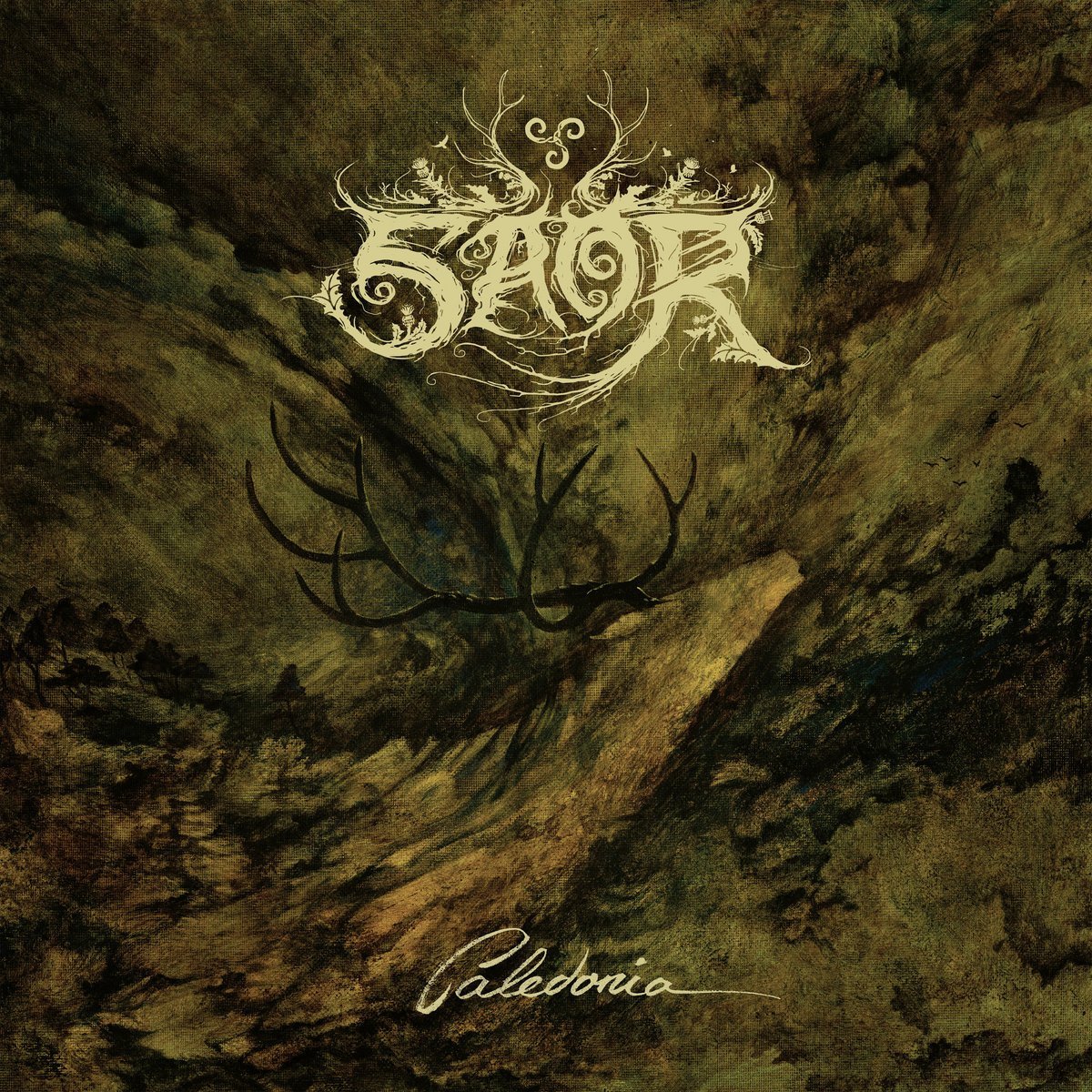
‘Caledonia’ by Saor can be looked upon as a retelling of old stories, naught with the aim of diminishing them through the loss of detail as they are passed on by new tongues, but rather seeking to add color where its absence is known. Though a compilation album by description, I would argue that it is its own entity, taking recordings from past albums and granting certain tracks a new breath of life. The tranquility and the paths that are carved within Saor’s art still remain. Its roots stay firm and deep within the soil, yet the air that permeates becomes more potent, its spirit much clearer to discern. It is through this clarity that these re-recordings display their cadence, letting the mind embark upon a familiar voyage. However, that which was discovered before now becomes a rediscovery, where new details are uncovered within its essence.
Creating the framework for these songs takes the form of the strings, becoming the very roots and branches, cascading and twisting, but not in a harsh way. Rather, they ensconce the senses, where their resonance and reverberation become the bed of leaves where repose is found. However, the beauty of the guitar playing comes forth in its ability to expand, where each note, each melody, feels as though it is stretching outward, like that of a sunrise whose beams cast their light upon a room, where shadows become elongated and darkness recedes. So too do the chords feel, as though they fork across the atmosphere in every direction.
‘Aura MMXXVI’ showcases this throughout the soloing sections, but also within the portions where the guitars exist alongside ambient elements such as the flute. Their ability to shift from controlling and leading the flow of melody to lending support to the acoustic energies is one that is carried throughout the songs, but also represents a pinnacle of their playing. Now, where the guitars are no longer veiled in the haze-like production, a clear, pristine sound is instead inherited through the melodies, cloaking the riffs in a robust, metallic resonance, punchy at times as well as dissonant. Where one may think that the crystalline sound may neuter the natural ambience, the mist instead dissolves, and the beauty that was once veiled now becomes naked for the eyes to behold.
An obvious difference that exists within these new recordings takes form in the vocals. On the older releases, the voice that permeated the atmosphere was slightly obscured by the hazy production, for at times it felt as though the vocals blended into the mist-like aura, dissolving into the air with a bark-like echo. This is not meant to be a negative, as the older recordings possessed a charm that engaged the senses, inviting them to become lost in this Lethean mist, to hone in and latch onto every consonant being bellowed. ‘Caledonia’ instead opts for a more coarse, raspy register, akin to traditional Black Metal vocals, albeit more atmospheric in range. As opposed to the vocals before, which were like the vapour that curls from frost, now the cold has desisted, and that which remains is a warm texture, yet one still abrasive in its ambience.
‘The Awakening MMXXVI’ demonstrates this, where its original recording possessed a live resonance due to its rawness, with the vocal delivery feeling like ice that grips the paramount of a mountain, where the coldness groans and rolls off into the air. However, on the re-recording, the essence still holds true, but the voice instead becomes more prominent and bold, no longer shrouded. The use of clean vocals that adorn this track and others is also shaded in a lighter tone, matching the harsh variation while adding a glimmering cadence to the songs.
Through one’s traversal of Saor’s discography, especially albums such as ‘Roots’ and ‘Aura,’ one’s senses become cloaked in its nature-like atmosphere, where every sound recorded feels as though it is occurring right in front of you, from every chord and every beat to the subtle crashing of the cymbals. The drumming on the older songs also shared a similar quality with the guitars and vocals, where its tone became intertwined with the fog-like ambience, exhibiting a coarseness in its texture. However, here, a different perspective of its rawness is unveiled. Instead, the precision, every undulating beat, and every thunderous strike are heard. ‘Carved in Stone’ is a track where the percussion’s bombardment takes precedence through this clarity, where the rhythmic structure renders itself in a warmer yet feverish tone.
Saor’s ‘Caledonia’ allows the soul to pause, and when time stands still, when the world stops turning, a new one is unveiled, for the eyes that see no longer view it through a stained window. Instead, we feel rather than observe. No longer do we gaze upon the tranquility of beauty. Rather, its river flows within our very core, cleansing that which is languid, soothing the weeping wounds that we bear. For it is like the body that sits upon the rock, eyes closed, where the whisper of the wind and the rustling of leaves become so potent in sound that we become transfixed by the air that permeates. No longer do we feel that we are separate from the rock, but rather, the rock and body are both connected to the very soil from whence that which grows emerges, allowing us to become truly immersed in the physical art of the landscape.