Some albums try to capture you through immediate violence, while others prefer to do it slowly, building an atmosphere until you are completely enclosed within it. ‘After Chaos: Nocturnal Vigil’ clearly belongs to the second category.
Runemagick develops much of the album through mid-tempo and slower passages, using them almost like a constant form of breathing. There are moments of greater intensity, of course, but the dominant feeling is one of slow, heavy, and deeply atmospheric progression.
And surprisingly, it works extremely well.
These are long compositions. The opening track runs for around thirteen minutes, and despite that length, it maintains a cadence that never became boring to me. There are enough changes, rhythmic variations, and small internal movements to hold your attention. The music moves slowly, but it never feels completely static.
Runemagick also understands something essential for this kind of composition: not every space needs to be filled. There are long instrumental sections where the vocals disappear, allowing the riffs, rhythm, and atmosphere to carry the narrative. When the vocals do appear, they sound excellent to me: deep, heavy, and perfectly integrated into the sonic landscape, without needing to dominate it constantly.
But there is another dimension that, for me, ends up truly defining this album. There are moments where the music seems to leave Earth behind. Traditional structures begin to dissolve and we enter more experimental territory, at times even somewhat psychedelic. Repetition, silence, and certain textures create an almost cosmic sensation. More than conventional songs, some passages feel like landscapes.
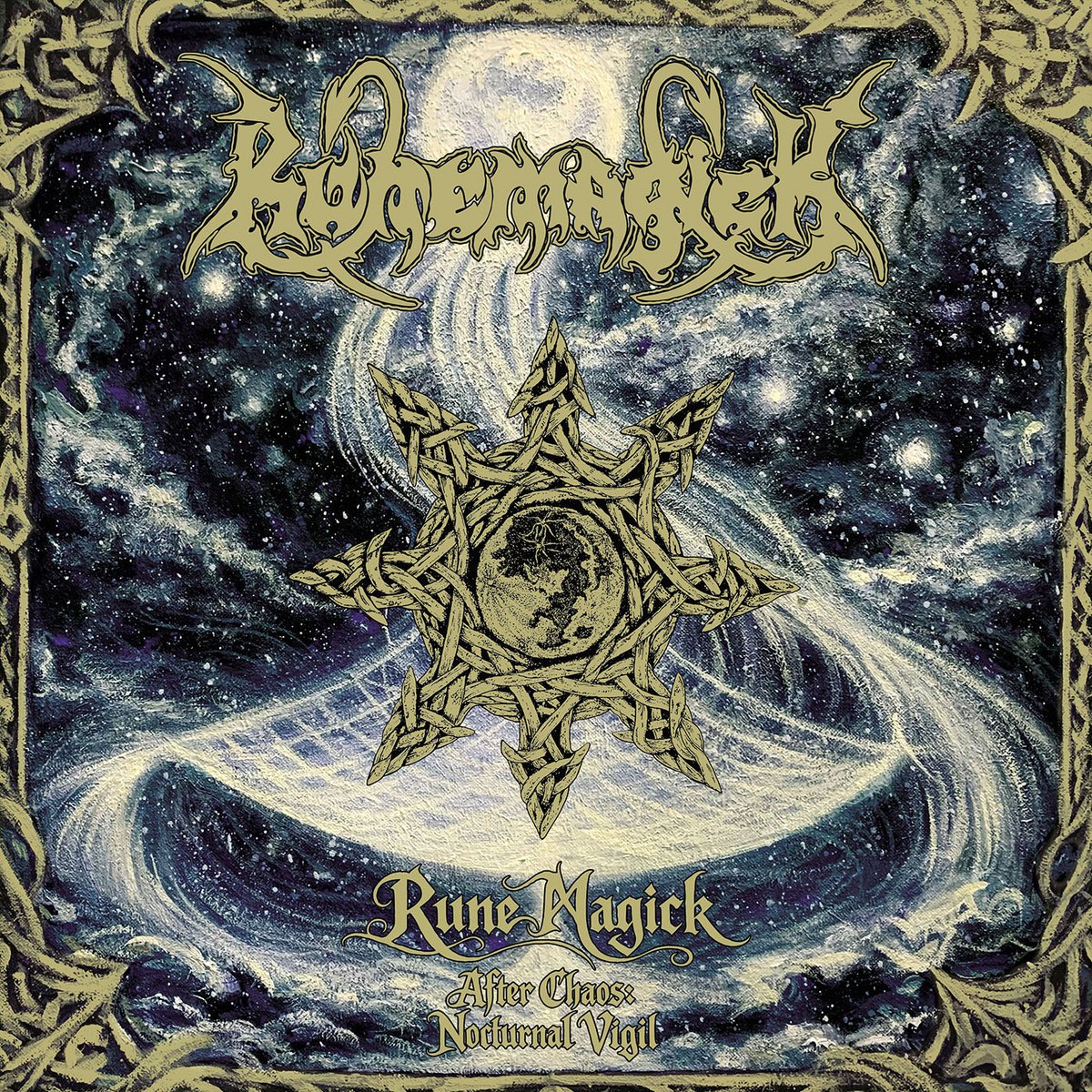
If I had to conceptualize ‘After Chaos: Nocturnal Vigil’ through a single image, I would imagine myself sitting inside a spacecraft, slowly moving toward one of those tunnels of light we have seen so many times in films.
Everything around me is dark.
The stars remain suspended, almost dormant in an immeasurable infinity.
The spacecraft keeps moving.
First toward a bridge of light.
Then, slowly, toward something we can no longer understand.
Toward infinite chaos.
That is the feeling this album gives me.
Some songs simply accompany you during the journey, while others unexpectedly crush you. There are moments when all that contemplation suddenly collides with massive riffs and an intensity that seems to emerge from somewhere lost in space.
It is a kind of divine and chaotic poetry. And behind all this architecture stands Nicklas Rudolfsson, the true creative core of Runemagick and the person responsible for the album’s composition and arrangements. That fact seems particularly important to me because it helps explain the remarkable cohesion of the record.
Although the album moves through Death Metal, Doom, experimental passages, atmospheric sections, and almost psychedelic moments, it never seems to lose its direction completely. There is one mind guiding the spacecraft.
Rudolfsson is not simply building long songs here. He is building landscapes. And that is probably one of the album’s greatest strengths.
Personally, I have never been a deep follower of Runemagick. I have known the band’s name for many years and had obviously heard some of their material, but they were never among the bands that regularly appeared in my listening rotation. Perhaps that is exactly why this album surprised me so much.
Approaching it without being overly conditioned by the band’s previous discography allowed me to encounter a work that is dark, expansive, esoteric, and deeply atmospheric. There is Doom here. There is Death Metal. There is experimentation. There are almost ritualistic passages. There is darkness. There is cosmos. And, obviously, there is chaos.
Even the song titles seem to reinforce this idea. There is a conceptual and esoteric search running alongside the music, giving some indication of where Rudolfsson wants to take us. Of course, I do not think this is an album for every moment. Nor do I think it is an especially easy record.
To really enjoy a work like this, you need to engage with the musical perception of it, allowing the mid-tempo passages, repetition, silence, and long developments to slowly do their work.
You have to give it space. You have to enter its frequency. Because once that happens, the experience changes completely. ‘After Chaos: Nocturnal Vigil’ is not simply trying to crush you with Death/Doom. It is trying to transport you.
And once you finally find yourself sitting inside that spacecraft, watching motionless stars while moving toward that immense bridge of light, it no longer matters exactly where the death metal ends, where the doom begins, or at what point the music entered experimental territory.
The spacecraft keeps moving.
The stars disappear behind you.
The light gets closer.
And on the other side, only one thing remains:
infinite chaos.