
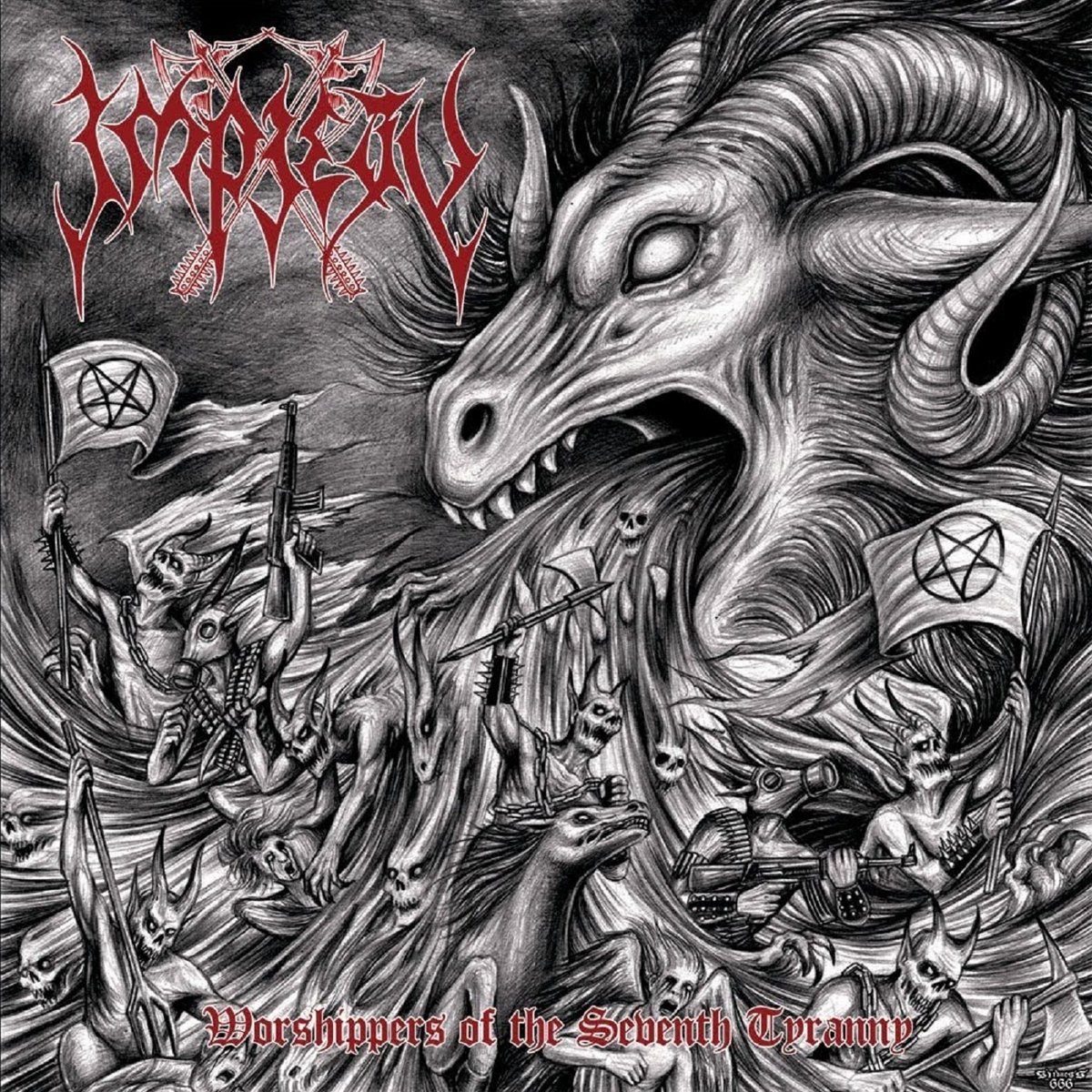
‘Worshippers Of The Seventh Tyranny’ deserves more than the usual ‘Impiety made a 38 minute song and it was weird’ treatment.
The album was released in January 2011 on Agonia Records and is a single 38:32 composition divided into seven sections. Shyaithan handled vocals and bass, with Eskathon and Kekko on guitars, Andrea Janko on drums and Fábio Zperandio contributing the lead guitars.
There actually was contemporary coverage, but the reception was mixed. For example, some reviews complained about repetition and the single-track format, while others specifically praised the slower, darker sections and the change in direction.
There is a funny thing about Impiety’s catalogue. Mention the band and most people immediately reach for ‘Asateerul Awaleen’, ‘Skullfucking Armageddon’ or ‘Kaos Kommand 696’. The usual conversation then goes straight into speed, brutality and how Shyaithan spent years trying to make everything move at maximum velocity. Somewhere along the way, ‘Worshippers Of The Seventh Tyranny’ tends to get pushed aside as the odd album, the one with the 38 minute song, the one where Impiety suddenly decided that slowing down was a good idea.
I think it certainly deserves… considerably more attention than it gets.
Released in 2011 through Agonia Records, this was Impiety’s seventh full-length and the first time they presented an entire album as one continuous composition. The 38:32 piece is divided into seven sections, but there are no separate tracks to break it up. That decision obviously put a lot of pressure on the songwriting. When you’ve got a four-minute track, a weaker passage can be over before anyone has time to complain. When the whole album is one piece lasting nearly forty minutes, every riff has to earn its place.
That is probably where some of the original criticism came from. There are sections that hang around too long and the central ideas return several times. One contemporary review felt the album did not have enough material to justify the length, while another pointed out that the slower sections and recurring melodies made the record much more interesting than another straight hellfire Impiety speed attack.
Both observations are fair.
The difference is that the repetition doesn’t bother me nearly as much as it seems to have bothered some listeners. The whole point of this record is the change in pacing. Impiety had already spent years establishing that they could play Black/Death/Thrash at face-ripping speed. By 2011, another album consisting mainly of blast beats and short violent songs would have been familiar ground. ‘Worshippers Of The Seventh Tyranny’ takes those same instincts and stretches them out. There is a strong Hellhammer and Celtic Frost influence running through the heavier passages. The guitars become thicker, the drums sit back and Shyaithan changes the way he delivers the vocals. This isn’t the same vocal attack heard on the older Impiety records. He still has that familiar harshness when the faster parts arrive, but there is much more weight in the lower register and more variation in the delivery. A contemporary review also picked up on the change, noting the Celtic Frost influence and the more varied vocal approach. This is one of the things I think gets overlooked when people discuss the album.
Shyaithan’s vocals had already developed considerably by this point, and ‘Worshippers Of The Seventh Tyranny’ gives him room to use them differently. On the faster Impiety material, the voice is another weapon thrown into the attack. Here it becomes part of the atmosphere. The deeper delivery fits the slower riffs naturally, and there are moments where he sounds far more comfortable in this Doom-laden territory than you would expect from the man behind some of Impiety’s most frenetic and violent records.
And I don’t mean Doom in the sense of endless funeral riffs and somebody taking fifteen minutes to decide whether the next chord should be played. This is much closer to the primitive heaviness of Hellhammer and early Celtic Frost, with the Black Metal and Death Metal elements still sitting underneath it. The album does not abandon the old Impiety sound. It puts it on a slower setting.
When the band eventually accelerates, the contrast becomes much more effective because you’ve spent time in those heavier passages. The blast beats don’t have to carry the entire album anymore. They become part of the arrangement rather than the arrangement itself. The guitar work also benefits from the extra room. Eskathon and Kekko handle the main guitars, while Fábio Zperandio of Ophiolatry contributes the lead work. His solos give the longer composition some variation without turning it into a technical showcase. There is still plenty of ugly riffing underneath them, which is exactly what the record needs.
The middle portion is particularly strong. The tempo drops, the riffs become more melancholic and the atmosphere changes without the album suddenly turning soft. This is probably the clearest example of what Impiety were trying to achieve with the record. One contemporary review specifically highlighted the melancholic melodies over the doomed rhythm guitars around the middle of the composition.
The production has divided opinion as well. The drums are very prominent and some of the guitar detail gets pushed back when everything is happening at once. That criticism is reasonable. A heavier guitar sound would have helped some of the slower riffs, particularly because those sections depend so much on the weight of the guitars.
But I don’t hear the production as a disaster. It has enough clarity to follow what the band is doing, and the drums give the faster passages the necessary push.
The seven-part structure gives the album a sense of movement. You get the fast material, the slower Celtic Frost-inspired sections, the darker melodic passages, the leads and then the return to the heavier attack. It isn’t one riff repeated for thirty-eight minutes. One contemporary reviewer actually described the album as varied enough that it could have been split into several shorter songs, while still finding the single-track presentation acceptable. That is probably the fairest way of looking at it.
The other interesting thing is where this album sits in Shyaithan’s development.
Impiety had already gone through several changes before this record. The line-up was different, the band had become increasingly international in its membership and Shyaithan had moved into the bass role while continuing to handle the vocals. ‘Worshippers Of The Seventh Tyranny’ sounds like someone who had already exhausted the obvious route and wanted to see what else could be done with the Impiety name. Contemporary coverage also noted that this was a more mature and varied Impiety than on the preceding records.
And then, almost immediately afterwards, he went back toward the familiar attack.
The ‘Advent Of…’ EP followed later in 2011 and returned to the faster Black/Death War Metal approach. Metal Archives describes it as a return to the band’s more familiar style after the experimental single-track album.
That makes ‘Worshippers Of The Seventh Tyranny’ even more interesting in retrospect.
It wasn’t the beginning of some permanent Doom Metal version of Impiety. It was a detour. Shyaithan tried something different, explored a slower and heavier side of his songwriting and then went back to the violence people expected from the band.
I actually think that makes the album more valuable.
If Impiety had continued making records like this for the next ten years, it might simply have become another phase of the band. Instead, it remains this strange point in the catalogue where Shyaithan gave himself permission to slow everything down.
And he sounds absolutely good doing it.
The vocal evolution is especially obvious when you put this beside the older material. The young Shyaithan’s voice was sharp, furious and very much rooted in the early Black Metal attack. By ‘Worshippers Of The Seventh Tyranny’, the delivery is broader and heavier. The lower, rougher passages sound natural rather than forced, and when he switches back to the harsher style the contrast is much more noticeable.
That is one reason I would argue against treating this album as some failed experiment.
It is an experiment, certainly. Some parts are longer than they need to be and some transitions could have been handled better. But the musical ideas themselves are worthwhile. The Doom Metal influence isn’t just there to make the album different for the sake of being different. It gives the riffs another dimension.
The album also makes more sense if you stop comparing every minute of it to ‘Skullfucking Armageddon’. That record is not the standard every Impiety album has to meet. If it were, most of the catalogue would be doomed before the first riff even started.
‘Worshippers Of The Seventh Tyranny’ has a different job.
It shows what happened when one of Singapore’s most notorious extreme metal musicians decided that speed wasn’t enough anymore.
The result isn’t flawless, but it is far more substantial than the reputation of being ‘that one 38 minute Impiety song’ would suggest. The slower passages are some of the best material on the record, Shyaithan’s vocals are more varied than on the earlier releases and the whole thing has a darker, heavier character that separates it from the records around it.
As mentioned earlier, the reviews ranged from fairly critical to strongly positive. That mixed reception probably explains why the album never became one of the first titles people mention when discussing Impiety.
I think it deserves to be mentioned more often.
Not above the classics, and not because it is some misunderstood masterpiece. It simply happens to be one of the more unusual records in the band’s catalogue, and the unusual parts are often the best parts.
For anyone who knows Impiety mainly for the early Black/Death/Thrash material, ‘Worshippers Of The Seventh Tyranny’ is worth revisiting with a different set of ears. The speed is still there, but the real strength of the album is what happens when Shyaithan takes his foot off the accelerator, lets the riffs breathe and uses that deeper voice to drag the whole thing into much darker territory.
It is also the record where Mr Shyaithan discovers the brake pedal.
