My introduction to Dawn actually came through a compilation. In 1998, I picked up ‘Feuersturm Volume II: The Ultimate Storm’ from Tower Records in Singapore, and among the many names featured on it was Dawn with ‘The Knell and the World’. That song immediately caught my attention, and it was one of those moments where a compilation did exactly what it was supposed to do: open the door to a band you might otherwise have missed. There were plenty of other groups on that compilation that I was discovering around the same time, but Dawn was one of the names that stayed with me. I will leave the full ‘Feuersturm’ story for a separate review because there is plenty to talk about there.
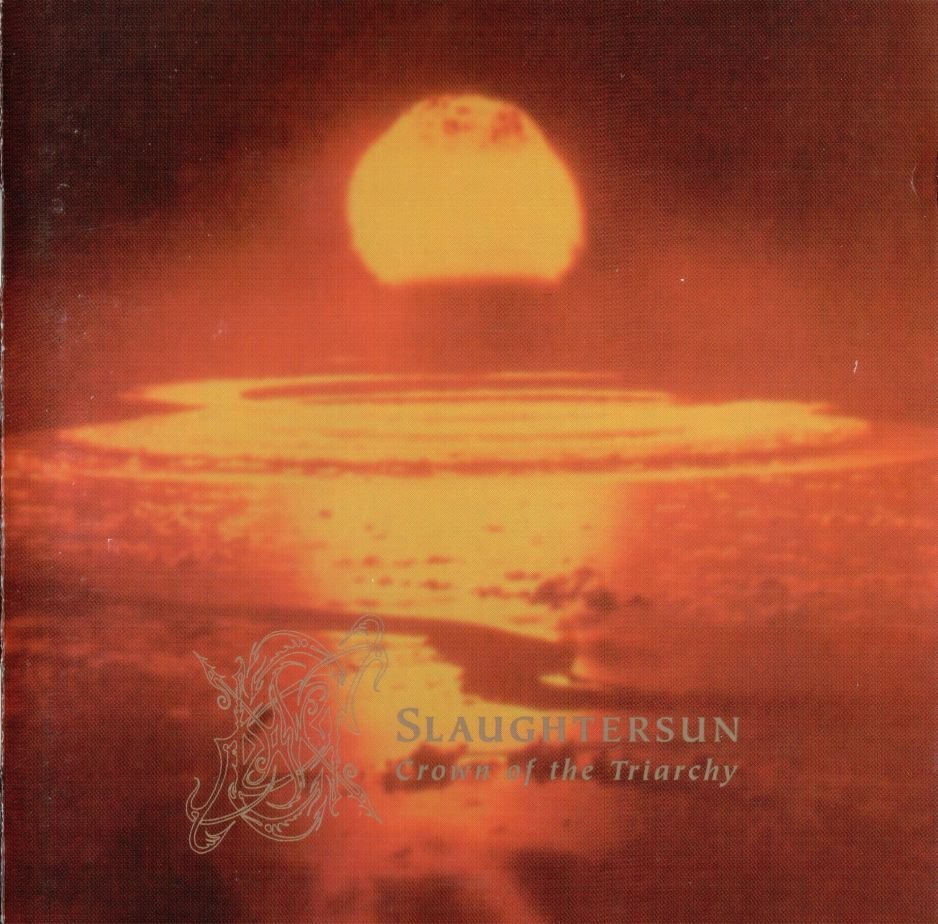
By the time ‘Slaughtersun (Crown of the Triarchy)’ arrived through Necropolis Records in 1998, Dawn had already developed a very distinct identity within the Swedish Black Metal scene. The lineup featured Fredrik Söderberg on guitar, Andreas Fullmestad on guitar, Lars Tängmark on bass, Jocke Pettersson on drums and Henke Forss on vocals. Söderberg was responsible for all the music, and his guitar work is really the centre of the album. The twin guitar arrangement gives the songs tremendous depth, with melodies constantly moving around the harsher and more aggressive sections.
The album was recorded at Abyss Studios in April 1997, with Peter Tägtgren handling the engineering and mixing while Dawn itself took care of the production. There is an important detail behind the recording that helps explain why the performances feel so strong. The band rehearsed intensely before entering the studio and recorded the album live without relying on extensive editing. You can hear that commitment in the way the musicians lock together, particularly when the songs suddenly accelerate or shift into their more expansive passages.
Henke Forss gives the music its unmistakable vocal character. His harsh delivery cuts through the guitars without overpowering the melodies, and that balance is important because Dawn’s music depends heavily on the relationship between aggression and melody. Jocke Pettersson’s drumming is equally important, pushing the faster sections with tremendous force while giving the longer compositions room to breathe.
‘The Knell and the World’, the song that first introduced me to Dawn through ‘Feuersturm’, is still one of the strongest examples of what the band was doing. The guitars have that unmistakable Swedish coldness, but there is a much grander sense of movement in the songwriting. ‘Falcula’ continues that approach, while ‘To Achieve the Ancestral Powers’ provides a short instrumental passage before ‘Ride the Wings of Pestilence’ brings the full attack back into focus.
The second half of the album takes things even further. ‘The Aphelion Deserts’ has a huge, expansive quality, while ‘Stalker’s Blessing’ brings together some of the album’s most memorable guitar melodies. ‘Malediction Murder’, stretching beyond eleven minutes, is the longest composition and gives Söderberg plenty of space to develop the ideas that run throughout the record. Rather than simply repeating one riff after another, Dawn builds its songs around movements and changes that make the longer pieces feel naturally composed.
What I particularly like about Dawn is how much of the band’s identity comes from the guitars. There are no keyboards needed to create that grand atmosphere. Söderberg and Fullmestad achieve it through layered melodies, harmonised passages and carefully arranged riffs, while the rhythm section gives everything the necessary weight. This is one of those albums where you can return to the guitars alone and still find plenty happening.
Looking back at how I first encountered them makes ‘Slaughtersun (Crown of the Triarchy)’ even more special for me. I bought ‘Feuersturm’ at Tower Records in 1998 without knowing that one of its tracks would lead me towards a full Dawn album. That was the beauty of compilations back then. You could walk into a shop, pick up a release because the artwork or list of bands caught your attention, and suddenly one unfamiliar name would become something you wanted to hear more from. Dawn was one of those discoveries for me.
‘Slaughtersun (Crown of the Triarchy)’ remains a powerful example of late-90s Swedish Black Metal where melody, speed and songwriting were all given equal importance. Fredrik Söderberg’s compositions provide the foundation, Henke Forss gives them their voice, and the rest of the band turn those ideas into something genuinely imposing. For me, the album will always carry that extra connection to 1998, when ‘The Knell and the World’ first came blasting out of a compilation I picked up at Tower Records and introduced me to one of Sweden’s most memorable Black Metal bands.
