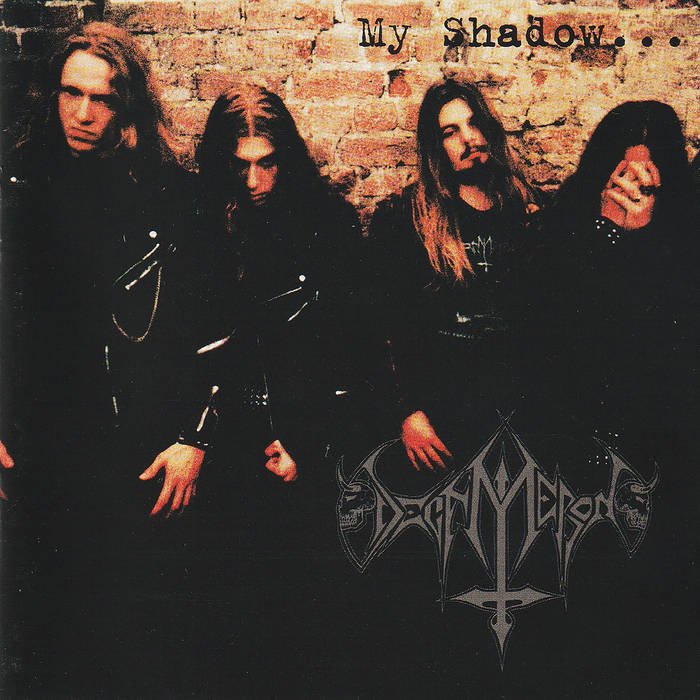
I first discovered Decameron’s ‘My Shadow…’ in 1997, and at that time I was still beginning to understand just how ridiculously interconnected the Swedish underground really was. You would pick up an album, look through the lineup and suddenly recognise a name from another band, then discover that another member had played somewhere else, and before long you were tracing this whole network of musicians between Dissection, Nödtveidt’s projects and the various bands coming out of the Swedish underground. Decameron was one of those records that helped me start putting those pieces together. The music itself was already interesting, but understanding who these people were and how they were connected made the whole thing even more fascinating.
Decameron grew out of Nocrofobic in 1991, with brothers Johannes and Alexander Losbäck, Johan Norman and Tobias Kellgren forming the early lineup. Norman eventually left for Dissection, while Kellgren had also been involved with Dissection. Johnny Lehto later joined on guitar, completing the lineup that recorded ‘My Shadow…’ for No Fashion Records. Looking back at it now, the connections are obvious, but discovering all of this back in 1997 was a different experience. There was no instant search engine giving you the complete history of every obscure Swedish musician. You had to dig through records, demos, interviews and whatever information you could find, slowly connecting one name to another.
And then there was the music. ‘My Shadow…’ does not sit comfortably in one particular box. There is plenty of Swedish Black Metal and Death Metal here, but the guitars also carry strong melodic and Heavy Metal influences, while the songwriting constantly shifts direction. The album feels like a band that had plenty of ideas and was willing to throw them into the same pot to see what happened.
‘Carpe Nocem’ is a good example. It is a long track, but it does not feel like an unnecessarily extended piece. The guitars move between aggressive passages, melodic sections and slower atmospheric moments, while the drumming keeps changing the momentum. There is a lot happening, but Decameron generally manage to keep the songs moving rather than turning them into a technical exercise.
‘Satanized’ is another interesting piece, particularly because of the songwriting connection with Jon Nödtveidt. The Thrash Metal influence becomes more apparent here, mixed with the darker melodic guitar work that was becoming such an important part of Swedish Extreme Metal. ‘Le Roi Triste’ takes another turn, bringing in more traditional Heavy Metal flavour, while ‘Our Time Has Come’ is considerably more direct and aggressive.
The rhythm section also deserves attention. Tobias Kellgren’s drumming gives the songs plenty of movement, shifting between fast passages, blasts and heavier mid-tempo sections without sounding mechanical. Alexander Losbäck’s bass is not simply buried underneath the guitars either, and Johannes Losbäck handles both guitar and vocals, giving the band a sound that feels much more adventurous than the standard melodic Swedish template.
It is not a perfect album. Some of the ideas in the second half do not hit with the same force as the stronger earlier material, and there are moments where the experimentation feels slightly uneven. A few of the cleaner vocal sections also take some getting used to. But I would much rather hear a young band taking chances than one simply reproducing whatever was already popular around them.
