Tombstalker does not build a clean mixture. They build a corrupted amalgam.
That is probably the first thing that became clear to me while listening to ‘Chaos Monolith’. There is Death Metal, Doom, Thrash, Crust, harmonies, galloping rhythms and a significant amount of old roots, but none of it appears perfectly separated. Everything contaminates everything else. And it works.
The album enters with a complex structure, as if it wants to invade different territories at the same time without worrying too much about keeping every element inside its own box. The result has something deeply old school about it, something that immediately reminded me of those tapes that used to arrive during the nineties, when you did not have all the information available and simply put the tape on to discover what the hell was coming out of the speakers.
Hellbastard. Bolt Thrower. Amebix. Not necessarily because Tombstalker directly copies any of those bands, but because they recover something from that feeling. The feeling that boundaries could still get dirty. That is one of the strongest aspects of ‘Chaos Monolith’. There are many influences here, but trying to catalog every riff according to which band it resembles would completely miss the point.
What matters is the configuration. The way all those old sounds are assembled until they create something genuinely powerful and, surprisingly, refreshing. Crust has a lot to do with that. It does not appear as a simple decoration inside a Death Metal structure. It is buried deep inside the attitude, the way the songs are pushed forward, the galloping rhythms, and that dirty sense of speed that prevents the album from becoming another exercise in nostalgia.
The drums constantly drive everything forward. The guitars move between heavy riffs and harmonies that help keep the songs alive. And the vocals can initially seem more restrained, without trying to dominate everything, but as the album moves forward they gain presence and become another important part of that permanent sense of momentum. The speed rarely stops either. But this is not simply about playing fast. There is dynamics.
There are moments where the guitars build genuinely interesting harmonies over that constant gallop, and others where everything becomes heavier, darker and closer to Doom. That prevents the album from turning into one uniform mass.
‘Chaos Monolith’ is a very enjoyable record to listen to from beginning to end. And that may sound like a simple statement, but it is not. There are far too many albums where three songs are enough to understand everything that will happen afterward. Here there is enough movement, enough variation and enough personality to keep the listener interested.
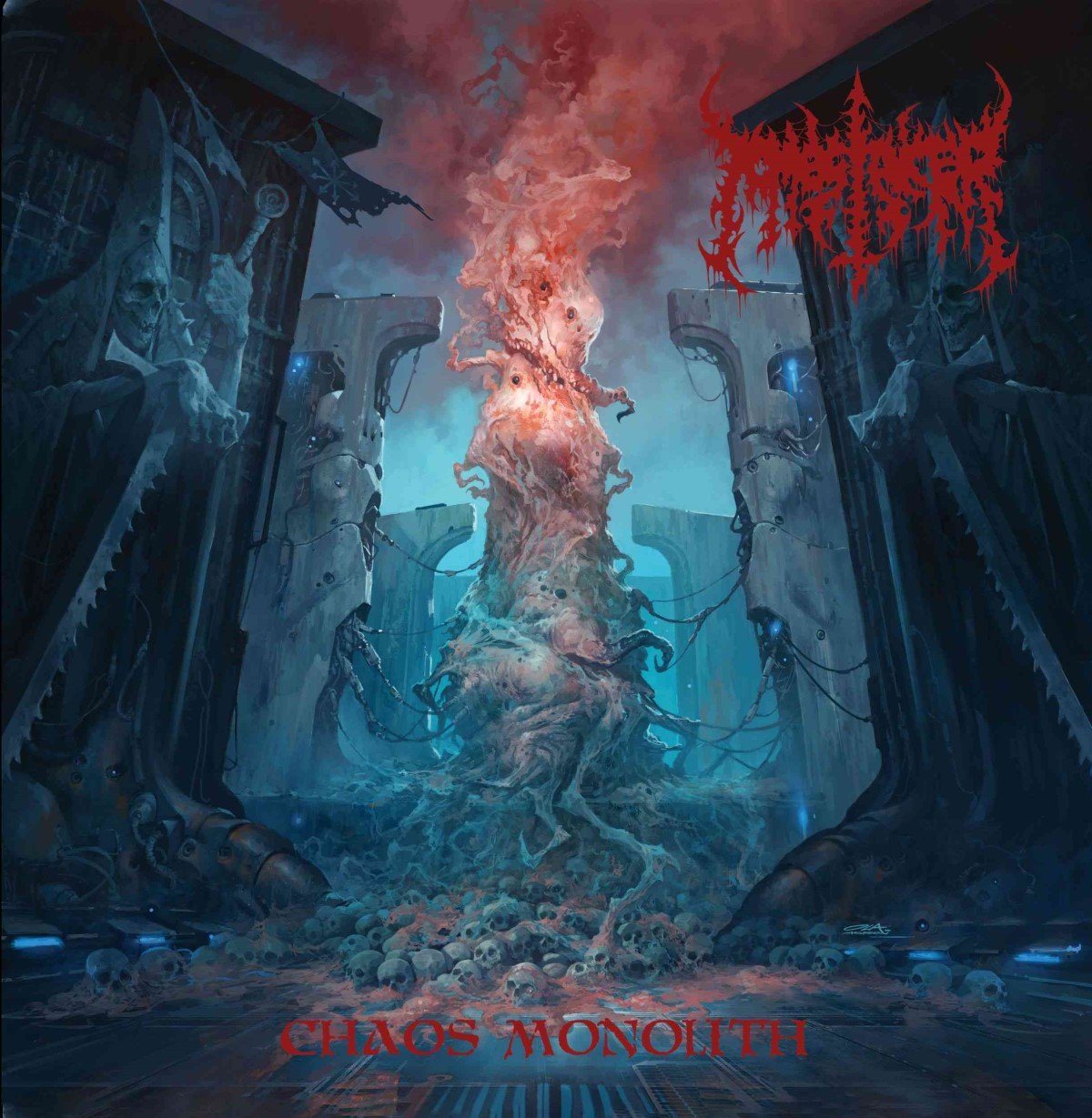
The artwork by Ola Larsson also deserves a special mention. The cover is incredible. It does not work simply as packaging, but as a natural extension of the music. There is chaos, darkness, weight and a monumental feeling that fits perfectly with what happens inside the record. It almost seems to visually represent that same corrupted amalgam. A huge structure built from elements that should clash with each other, but somehow end up forming something coherent. That is exactly what Tombstalker does.
The album is deeply connected to the past, but it does not feel dead. In fact, at several points it feels remarkably refreshing. Perhaps because the band does not try to hide its roots. They use them. They mix them. They smash them against each other. And they allow the result to keep all the dirt.
For someone who lived through that era of tapes, flyers and bands that could mix Death Metal, Crust, Doom and Thrash without needing to explain too much about what they were doing, there is something particularly attractive here. It is not pure nostalgia. It is recognition. Recognizing certain sounds, certain ways of playing, certain old vibrations, but hearing them rearranged inside a current proposal. I like that. A lot.
‘Chaos Monolith’ does not need to reinvent anything in order to work. It has character. It has speed. It has weight. It has an impressive Crust presence. And above all, it has something increasingly difficult to find: the ability to make you want to keep listening to the whole record.
It is worth looking for. It is worth listening to. And it is probably worth owning. Because Tombstalker proves that you can still look backwards without getting trapped there.