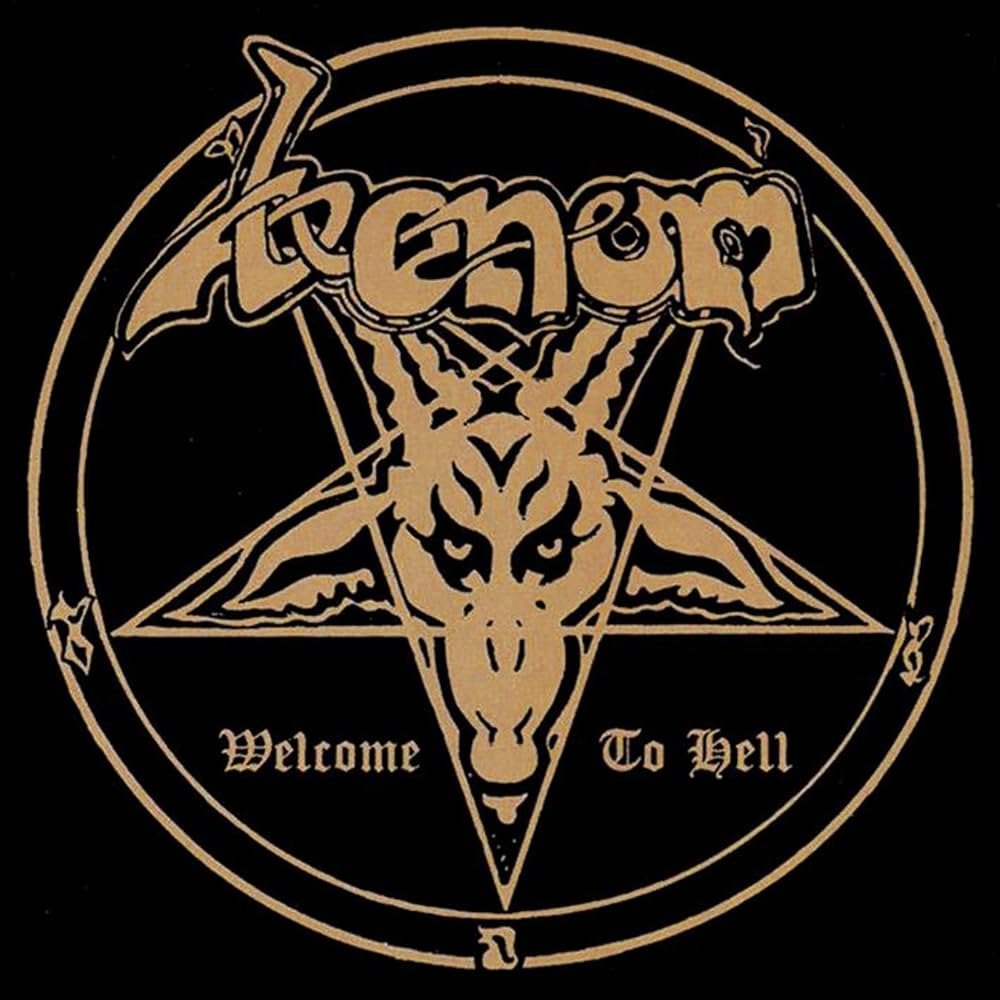
There is no getting around it. Without ‘Welcome to Hell’, the first Bathory album would have sounded very different. People can argue about influences until the cows come home, and Quorthon was hardly the only musician to take ideas from Venom, but once you put these records next to each other, the similarities become difficult to dismiss as some vague case of ‘influence’. The titles, the imagery, the vocal approach, the primitive production and, more importantly, some of the actual riffing point straight back to Venom.
‘Welcome to Hell’ is where Venom established the ugly foundation that would later be labelled Black Metal, although listening to it today also makes clear that the band members themselves were not really playing what we would later understand as Black Metal. There is still a huge amount of Motörhead, punk and traditional Heavy Metal in the music. The difference was the way Venom threw all of it together. Mantas’ guitars were dirty and simple, Cronos sounded like he was barking through a blown amplifier, and Abaddon’s drumming showed little interest in precision. The whole thing had the feeling of a band that had discovered that being rough could actually make the music more threatening.
The opening title track is one of the places where the connection with early Bathory becomes interesting. That repeated, primitive riffing and the way the guitars grind underneath the vocals are exactly the sort of building blocks Quorthon would later use. There is no need to pretend Venom invented every riff they played because they obviously did not. They were themselves pulling from Motörhead, Black Sabbath, punk and the New Wave of British Heavy Metal. But they created a particular combination that became immediately recognisable, and that combination found its way into Sweden very quickly.
‘Witching Hour’ is even more important. The frantic guitar work, the repeated riffing and the way the song throws itself forward without much concern for conventional polish contain several of the characteristics that would later become standard Extreme Metal vocabulary. It is one of the strongest songs on the album and probably one of the most important Venom songs ever recorded. Even later bands outside Black Metal were taking pieces from it. The song’s influence reached far beyond Bathory, which makes it even more important to separate what Venom actually created from the mythology that later grew around them.
Then you get to ‘In League With Satan’, and this is where the Bathory connection starts becoming almost embarrassing if you are trying to argue that Quorthon was working in complete isolation. Bathory recorded ‘In Conspiracy With Satan’. Venom had already recorded ‘In League With Satan’. The titles are not identical, obviously, but they are far too close in concept to ignore when you are also hearing the same fascination with primitive riffs, Satanic imagery and deliberately ugly vocal delivery. The similarity alone does not prove that Quorthon copied a riff, but when it sits alongside everything else, it becomes another piece of the same puzzle.
The same goes for ‘Sacrifice’. Venom’s Black Metal album contains a song called ‘Sacrifice’, while Bathory’s debut contains ‘Sacrifice’ as well. Bathory had actually recorded their version for Scandinavian Metal Attack in 1983 before the debut, so this is not simply a case of Quorthon copying a Venom album title after hearing it. But it is another example of how deeply Venom’s vocabulary had entered the early Bathory world. The interesting part is that Quorthon’s version sounds much more primitive and hostile, showing what he was doing with those influences rather than merely reproducing Venom. The song had already appeared on the compilation before Bathory’s debut.
And this is where I think ‘Welcome to Hell’ deserves more respect than simply calling it ‘proto Black Metal’. Venom were not sitting around trying to invent Black Metal. They were making a filthy, fast, Satanic form of Heavy Metal with punk energy and a complete disregard for studio polish. The fact that later musicians heard something much bigger inside it is what matters. ‘Welcome to Hell’ became a source book for Extreme Metal, and Bathory were among the musicians who went through that book very carefully.
Quorthon took the Venom approach and made it more serious. Venom could be theatrical, outrageous and even deliberately ridiculous. Cronos was playing a character and the band understood the shock value of what they were doing. Bathory took much of the same musical vocabulary and removed a lot of the humour. The result was colder, more sinister and much less connected to the traditional Heavy Metal world. That is where Quorthon’s real contribution begins.
But it is worth being honest about where the raw material came from.
Listen to the first Bathory album immediately after ‘Welcome to Hell’ and you start hearing the connections everywhere. The primitive riff structures, the speed, the filthy guitar tone, the Satanic subject matter and the way the songs are built around relatively simple repeating figures are all sitting in Venom’s music first. Even the idea that a record could sound better because it sounded worse was already there. Venom’s production was crude, but instead of treating that as a problem, they made it part of the band’s identity. Bathory took that idea and pushed it much further into the abyss.
This does not make Bathory a Venom tribute band. That would be far too easy and would also ignore what Quorthon actually achieved. The first Bathory album has a different emotional character. Venom sound like dangerous lads having the time of their lives making a racket. Bathory sounds much more isolated and genuinely hostile. Quorthon’s vocals are another major departure. Cronos had a rough, snarling delivery, but Quorthon turned his voice into that high-pitched scream which would later become one of the defining sounds of Black Metal.
The distinction is important because this is where the argument over ‘copying’ becomes more complicated. Quorthon clearly took a lot from Venom, but he did not leave it where he found it. He took the riffs, the attitude, the imagery and the production philosophy and made them sound far more primitive and serious. In doing so, he moved the music into territory Venom themselves never really occupied.
That is why ‘Welcome to Hell’ remains such a strange record historically. It is not the fully formed Black Metal album that some people now want it to be. It is messier than that, and there is still too much Motörhead and traditional Metal running through it. But the ingredients are here, and they are powerful enough that an entire generation of musicians could take them and build something else.
Bathory did exactly that.
So when ‘Under the Sign of the Black Mark’ eventually arrives six years later, the distance between the two bands is enormous. By then Quorthon had taken those early Venom ideas, stripped away even more of the Heavy Metal structure and developed a sound that became the real template for Black Metal. But you cannot understand that progression honestly without coming back to ‘Welcome to Hell’ and admitting what is sitting here in the first place.
Venom laid down a lot of the furniture. Quorthon rearranged the entire fucking house.
