I first came across Bathory in 1993, when I was still a schoolboy in Singapore and had only been seriously listening to Heavy Metal for a few years. I had started around 1988 with Rainbow, Deep Purple, Scorpions and Michael Schenker Group before getting deeper into Mercyful Fate, King Diamond, Iron Maiden, Helloween, Metallica, Yngwie Malmsteen and the other bands that were opening my ears to heavier and faster music. (And FUCKING HELL I thought Metallica was the loudest and fastest shit… what did I know…) That was the world I knew then and, although I was already looking for heavier sounds, I had never really encountered anything that sounded genuinely extreme. My first three Extreme Metal tapes in 1993 changed that very quickly. Sepultura’s ‘Morbid Visions / Bestial Devastation’ was a complete shock, followed by Terrorizer’s ‘World Downfall’, which sounded even more violent and chaotic to my young ears. Then I found Bathory’s self-titled cassette on my own. The hype sticker simply described it as “Thrash”, so I assumed I was going to hear another fast and aggressive Metal record. I had no idea what was waiting for me.
The opening of ‘Storm Of Damnation’ already felt strange. There was the sound of wind and thunder and that enormous bell hanging over everything before the music even started. When the guitar finally came in and Quorthon opened his mouth, I remember thinking that this voice was ugly. Not ugly in the sense of being badly done, but genuinely ugly, harsh and almost unpleasant compared with the Metal singers I was used to hearing. It sounded like somebody had taken the idea of a Metal vocal and stripped away everything remotely clean about it. The guitar had that horrible buzzing quality, the drums sounded primitive and the whole recording seemed to be surrounded by this dirty layer of noise. I was shocked because I had never heard anything like it before. Coming from Iron Maiden, Helloween and Yngwie, this sounded like somebody had taken Heavy Metal down into a filthy basement and removed whatever was left of its polish. I did not know what Black Metal was supposed to sound like and I certainly did not know Bathory were going to become one of its most important names. I was just a young metalhead in Singapore sitting there with a cassette that sounded completely wrong to my ears, and I loved it.
What makes that first experience interesting now is knowing what was actually happening around Bathory when this album was recorded. The band were hardly some established Swedish Metal outfit sitting comfortably in a proper studio preparing their debut. Their appearance on Scandinavian Metal Attack had happened after another band dropped out, and the two Bathory tracks, ‘Sacrifice’ and ‘The Return Of The Darkness And Evil’, attracted a reaction that apparently surprised Tyfon Grammofon. Later accounts have stated that more than 95 percent of the mail received by the label after the compilation came out concerned Bathory, and suddenly Quorthon was being asked to make a full album. The musicians involved in those earlier recordings were no longer available, so Rickard “Ribban” Bergman came in on bass and Stefan Larsson took over the drums. Ribban was someone Quorthon already knew from his earlier Oi! band Stridskuk, while Larsson came from the Stockholm punk scene and had played in Obsklass. The really strange part is that this new lineup had only one rehearsal together before the album was recorded, on 22 May 1984, and during that same rehearsal they recorded ‘Satan My Master’ and ‘Witchcraft’, songs that would only become widely known later.
The album sessions began on 14 June at Heavenshore Studio in Stuvsta, south of Stockholm, and this was about as far removed from a professional Metal recording environment as you could imagine. Quorthon later described Heavenshore as a basement recording facility in a house with old equipment dating back to the late 1960s. It was basically somewhere cheap where bands could record. Bathory had very little money to spend, with the recording budget being reported at around 5,000 Swedish kronor, and the album was recorded and mixed in a remarkably short period. The studio only had an eight-channel setup and there were plenty of compromises involved. They did not even have enough recording tape, so the tape machine was run at half speed to make the available tape last longer. The humming and roughness that became such an important part of the sound were therefore not some carefully planned attempt at creating a fashionable lo-fi production. They were simply recording an album with whatever they could get their hands on.
Some of the recording methods sound almost ridiculous when you read about them today. The bass was recorded through the switchboard and then sent through a small amplifier, while the drum setup was extremely basic and there were attempts to create a double bass effect using a single bass drum. This was not a band sitting in a studio with a producer telling them how to recreate the sound of Hell. They were young musicians working with primitive equipment and trying to get the songs down. That is probably why the record still sounds so filthy. The production is not just rough around the edges. The limitations are actually inside the music, and they give the riffs and vocals a character that would be difficult to recreate by simply throwing a modern band into an old studio and telling them to sound dirty.
‘Storm Of Damnation’ is a perfect introduction because Quorthon was already thinking about atmosphere before the first proper riff arrived. The wind, thunder and bell create an unsettling opening, with the bell coming from a slowed recording of Big Ben. The idea was influenced by Black Sabbath’s ‘Black Sabbath’, but Bathory took that kind of opening atmosphere and pushed it into their own primitive territory. When ‘Hades’ comes crashing in, the difference is immediate. The guitar is thin, abrasive and buzzing rather than powerful in the polished Heavy Metal sense, and Quorthon’s voice is probably the ugliest thing on the entire record. It does not sound like he is trying to sing beautifully or even traditionally. It is a harsh, rasping attack that sits somewhere between a scream and a snarl, and for someone like me hearing this for the first time after years of listening to much cleaner Heavy Metal, it was genuinely shocking.
The strange thing is that the ugliness works. ‘Reaper’, ‘Necromansy’, ‘Sacrifice’, ‘In Conspiracy With Satan’, ‘Armageddon’, ‘Raise The Dead’ and ‘War’ are not complicated songs and Bathory were not trying to impress anyone with technical musicianship. The riffs are simple, repetitive and direct, but the way they are played and recorded gives them a sinister character. There is early Speed Metal in there, darker Heavy Metal, Punk and the influence of Motörhead and Venom, but Bathory were taking these things somewhere much rougher. The music still had its roots in the Metal underground of the early eighties, yet there was already something colder and more hostile about it, especially in the way Quorthon used his voice and the way the guitars were allowed to sound completely unrefined.
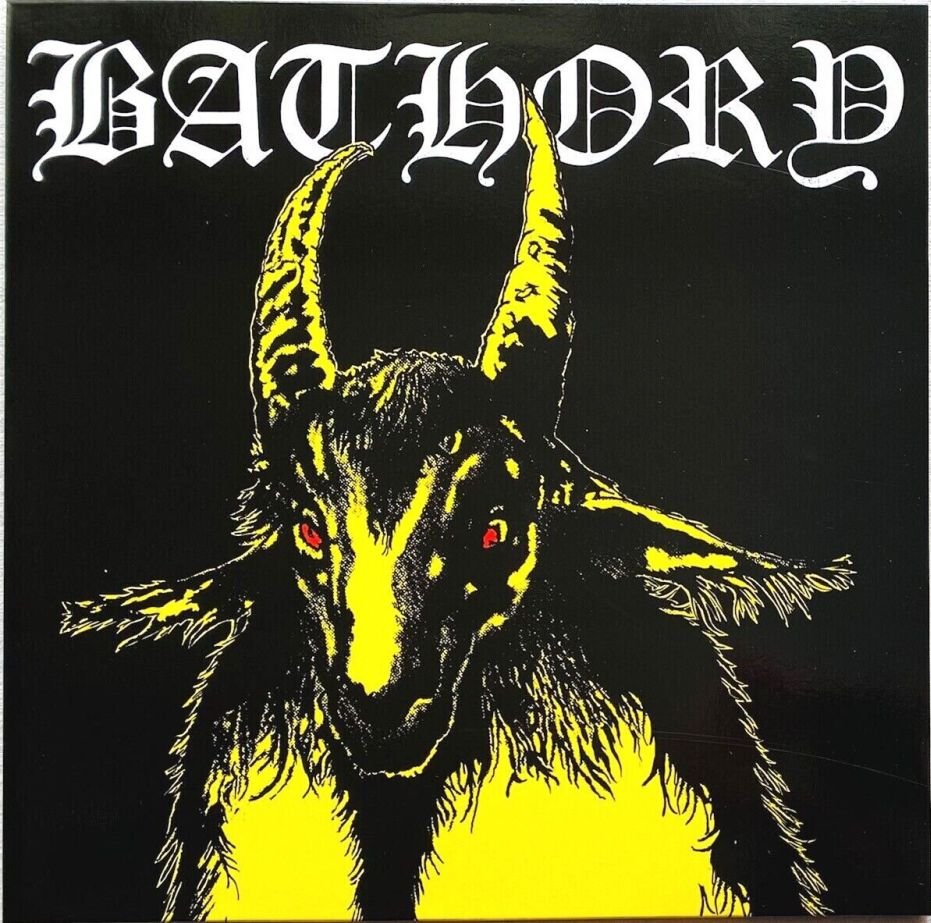
The artwork was almost as improvised as the recording. The original title was supposed to be Pentagrammaton, but that was abandoned because people kept reading it as “Pentagon”. The pentagram eventually appeared on the back while the goat became the image associated with the front cover. The goat itself was taken from a retouched section of an illustration by Joseph A. Smith that had originally appeared in Erica Jong’s 1981 book Witches. The famous yellow colour was another result of money. The goat was apparently intended to be gold, but gold printing cost too much, so the printer substituted yellow. Quorthon was unhappy with the result and later pressings used the black and white version that became much more familiar.
The first pressing was only around 1,000 copies, which gives you some idea of how small this whole operation really was. There was nothing resembling the huge Bathory mythology that would develop later. The sleeve even contained mistakes that would be unthinkable on a major label release. Elektra Studios was credited as the recording location although the album had actually been recorded at Heavenshore, apparently because the earlier Bathory tracks for Scandinavian Metal Attack had been recorded at Elektra. ‘Storm Of Damnation’ and ‘The Winds Of Mayhem’ were left out of the original printed track listing, and ‘Necromansy’ became one of those famous Metal spelling mistakes because Quorthon had apparently run out of the letter C while assembling the sleeve with individual rub-on letters. The artwork had been completed extremely late and there was no time to replace it, so the S was used instead. ‘In Conspirasy With Satan’ suffered a similar problem. There was no elaborate meaning behind it, just a young band and a rushed sleeve.
The more you learn about the album, the more obvious it becomes that Bathory were operating outside anything resembling a normal Metal recording process. There was very little money, hardly any rehearsal time, primitive equipment and a lineup that had barely played together, yet Quorthon somehow managed to turn those restrictions into an identity. I think that is why the record sounded so shocking to me in 1993. It was not simply faster than Iron Maiden or heavier than Rainbow. It had a completely different attitude towards sound. The ugly guitar, the rough drums and that horrible vocal were not things to be cleaned up. They were the reason the record sounded like Bathory.
By 1995, I was already completely sold on this kind of music, and I remember taking the Bathory tape along to a school gathering at East Coast. At some point I put ‘Die In Fire’ on the boombox and blasted it out at the beach. Watching the reactions around me was priceless. The looks of horror and disgust from people who had absolutely no idea what I was listening to told me everything. To them it was noise, screaming and something completely unpleasant. To me it was exactly what I wanted to hear. That day actually made me realise that I had chosen the right music. I had moved another step away from the traditional Heavy Metal that had introduced me to the whole thing and deeper into something far more extreme and underground, and Bathory was right there at the centre of that discovery.
Listening to the debut now, I can still understand why it had that effect on me. It is not a record that tries to make itself easy to appreciate. The sound is ugly, the vocals are abrasive, the drums are primitive and the whole production feels like it is constantly threatening to collapse into noise, but underneath all of that Quorthon had a very clear instinct for riffs and atmosphere. That combination is what separated Bathory from simply being another raw underground band. There was a personality in the music that could not be mistaken for anyone else.
At the time, of course, none of us knew what Bathory would eventually become. We did not know about the later epic records, the Viking Metal direction or the enormous influence Quorthon would have on generations of musicians. In 1993, I was simply a young metalhead in Singapore who had come from Rainbow, Deep Purple, Scorpions, MSG, Mercyful Fate, King Diamond, Iron Maiden, Helloween, Metallica and Yngwie, then discovered Sepultura and Terrorizer and finally stumbled across a Swedish cassette carrying a “Thrash” hype sticker. What came out of that tape sounded ugly enough to shock me and strange enough to make me want to hear it again immediately. More than thirty years later, I still hear the same thing in it. Bathory was not polished, safe or remotely interested in pleasing everyone, and for a young kid looking for something beyond traditional Heavy Metal, that was exactly what made it so important.