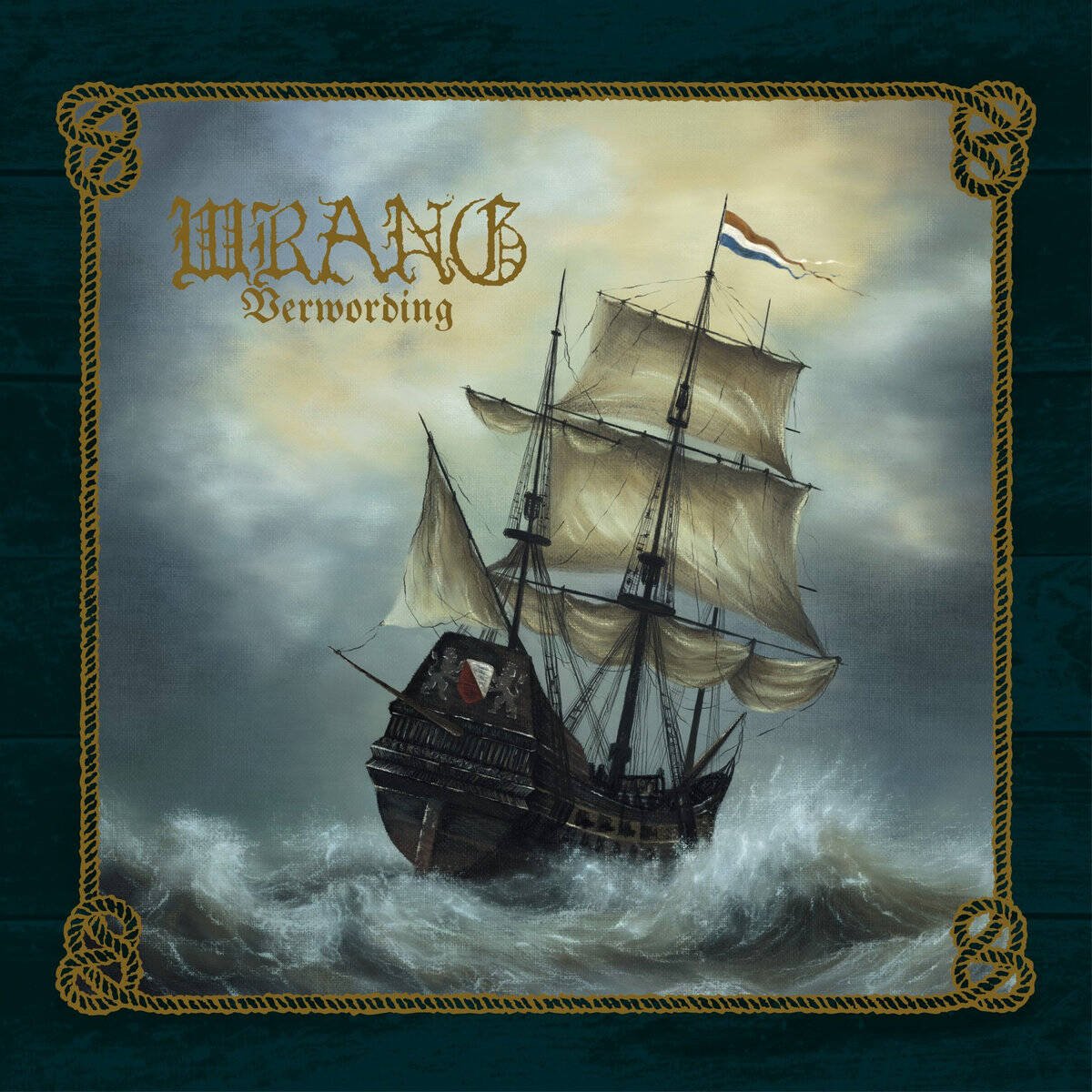
Dutch Black Metal duo Wrang release their third full-length album, ‘Verwording’ via Dominance of Darkness Records (CD and LP editions), with a cassette edition issued by Korpituli Productions.
‘Verwording’ continues the never stagnating evolution heard on 2022’s ‘De vaendrig’. While earlier Wrang material drew inspiration from bands such as Horna, Taake, and Slavia, the new album emphasizes a more melodic and atmospheric approach without abandoning the band’s forceful, rock-driven aggression. This album can be seen as a “windswept journey” through ancient-styled Black Metal, combining triumphant riffing, urgency, and emotional depth. Overall, ‘Verwording’ appears to be regarded as a significant step forward for Wrang, blending the band’s raw Dutch Black Metal roots with far stronger melodies, broader atmospherics, and more introspective lyrical content.
Guest musicians on this album are Revenant (Order of Nosferat, Sarkrista), guest vocals on ‘Nachten in Wahlheim’, Carchost (Helleruin), guest vocals on ‘Bijtebauw’, R. Schmidt, cello on ‘Bijtebauw’; backing vocals on ‘Entartete Kunst’ and ‘Voor ons de zee’.
The album departs somewhat from the themes of previous releases. Topics include societal criticism, personal struggle and unrest, leaving home behind, longing for something beyond one’s current existence, the contradiction between searching and never finding contentment.
For more than a decade, Wrang have occupied a distinctive position within the Dutch Black Metal underground. Never fully beholden to the frostbitten orthodoxy of Scandinavian Black Metal and never quite crossing into black ‘n’ roll territory, the duo have steadily forged a sound rooted in tradition while retaining a recognizably Dutch character. On their third full-length, ‘Verwording’, they deliver what may well be their most complete artistic statement to date.
Where 2022’s ‘De vaendrig’ emphasized momentum and swagger, ‘Verwording’ broadens the scope considerably. The record retains the driving pulse and rugged conviction that have become Wrang trademarks, but these elements are now framed by richer melodies, more expansive atmospheres, and a stronger sense of narrative development. Rather than presenting six isolated compositions, the album unfolds as a continuous journey, bound together by themes of unrest, departure, longing, and the inability to find lasting contentment.
The opening track, ‘Stilstand’, immediately introduces the album’s central contradiction. Despite its title, which translates roughly as “standstill,” the music is in constant motion. Waves of tremolo-picked melodies surge forward atop relentless drumming, creating a sensation of movement against emotional paralysis. From the outset, Wrang seem less interested in aggression for its own sake than in capturing the uneasy state of a mind that cannot remain where it is, yet has nowhere to arrive.
That tension becomes more confrontational on ‘Entartete Kunst’. Built around some of the record’s sharpest riffing, the song channels the band’s longstanding rebellious spirit while revealing a growing sophistication in arrangement. The melodies are strikingly memorable without sacrificing Black Metal intensity, and the track demonstrates how Wrang have learned to let atmosphere amplify aggression rather than soften it.
The album’s emotional center begins to emerge with ‘Nachten in Wahlheim’. Guest vocals from Revenant add texture to one of the record’s most evocative compositions. Here the band embrace melancholy without succumbing to sentimentality. The song feels nocturnal, reflective, and deeply rooted in romantic imagery, opening a wider emotional horizon than anything on the band’s earlier records.
That horizon reaches its fullest expression on ‘Voor ons de zee’, perhaps the defining piece of the album. The recurring maritime imagery found in the artwork and promotional material comes alive through soaring melodies and a palpable sense of distance. Few contemporary Black Metal bands manage to evoke open landscapes and uncertain journeys with such conviction. The song captures the essence of ‘Verwording’: the irresistible urge to leave, despite having no guarantee of what lies ahead.
If the first half of the album is outward-looking, ‘De duivel is de ander’ turns inward. Its title, “The Devil Is the Other,” introduces a darker philosophical dimension. The music becomes more introspective and uneasy, questioning the nature of confrontation itself. Is the enemy external, internal, or merely imagined? Wrang offer no simple answers, instead allowing ambiguity to deepen the album’s emotional resonance.
The closing epic ‘Bijtebauw’ gathers all these threads into a magnificent finale. At nearly ten minutes, it is both the album’s longest and most ambitious track. Guest vocals from Carchost and the unexpected addition of cello enrich the arrangement without feeling ornamental. Drawing upon Dutch folklore while simultaneously functioning as a meditation on fear, memory, and persistence, the song serves as a culmination rather than a conclusion. The journey remains unfinished. The sea still stretches beyond the horizon.
One of the album’s greatest strengths lies in its balance. ‘Verwording’ is atmospheric without becoming dreamy, melodic without becoming soft, and aggressive without resorting to brute-force repetition. The top notch production allows the guitars to breathe, emphasizing the bright, windswept character repeatedly noted by the label, while preserving enough grit to maintain authenticity. The result is a sound that feels simultaneously classic and contemporary.
Lyrically, the record appears more mature and nuanced than its predecessors. Themes of societal critique remain present, but they are joined by reflections on displacement, personal struggle, and the perpetual search for meaning. There is a recurring sense that every destination ultimately reveals itself as another point of departure. In this respect, the album’s title proves remarkably fitting: a process of becoming, deteriorating, transforming, and wandering all at once.
What ultimately makes ‘Verwording’ so compelling is its refusal to resolve its tensions. Many Black Metal albums seek transcendence through triumph or annihilation. Wrang instead embrace uncertainty. Their restless protagonists continue sailing through stormy waters, driven not by certainty but by the necessity of movement itself.
For a band already respected within the Dutch underground, ‘Verwording’ feels like a significant creative leap forward. It preserves everything that made Wrang distinctive while expanding their emotional and compositional vocabulary.
Whether it ultimately proves to be their definitive work remains to be seen, but it unquestionably stands among the strongest Dutch Black Metal releases of its year.