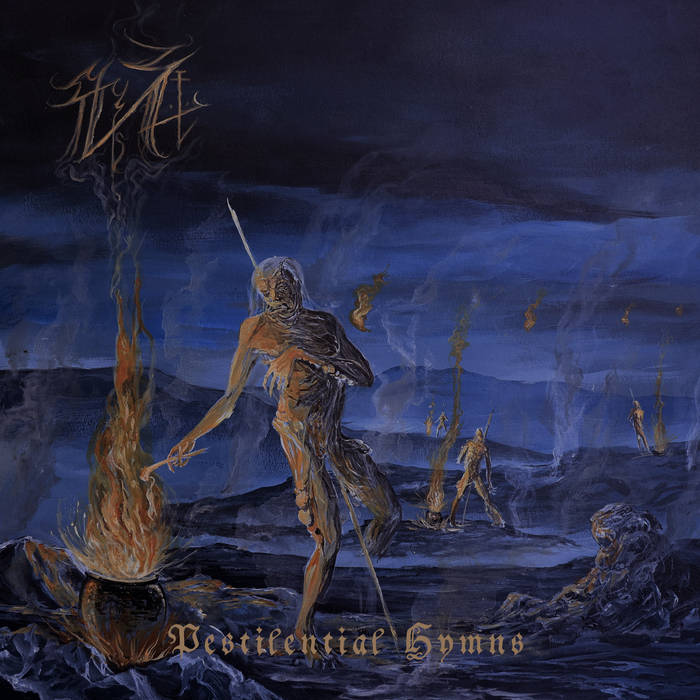
There are albums that do not enter like an immediate explosion, but like a disease slowly spreading across the walls. ‘Pestilential Hymns’, the second full-length album by Thaumaturgy, works precisely in that way. This is not an album made only to strike directly, nor is it a simple demonstration of cavernous darkness. It is rather a pestilent offering where Death Metal becomes contaminated with blackened elements, doom, ritual atmospheres and a constant feeling of cosmic collapse.
What makes this new work interesting is that Thaumaturgy no longer seems like just a dark promise coming from some corner of the American underground. Here, the band feels more complete, more focused and with greater dimension. The transition from a more solitary vision into a trio seems to have given more body to the sound. The songs breathe differently, the vocals have more character, the arrangements feel deeper, and the music no longer depends only on the cavern, but on how that cavern moves, opens and finally swallows the listener.
‘Pestilential Hymns’ has an evident cosmic chaos, but it does not feel thrown together at random. Everything is interwoven in a very effective way: riffs that open like cracks, fast passages that seem to lose control, slow sections that fall like a heavy body inside a dark ceremony, and an atmosphere that unites all those elements within a pestilent liturgy. The album can be dense, twisted and full of details, but it never becomes confusing or boring. On the contrary, every movement pushes the experience into a deeper zone.
The album works in a place where atmospheric Death Metal crosses paths with Black/Death, Death/Doom and a more primitive violence. But the important point is that these influences do not clash in a disorderly way. The band maintains a clear direction even when the songs move through twisted paths. There are riffs that crawl, passages that dissolve into an almost ritual darkness, changes that feel more like invocations than simple transitions, and moments where brutality appears not as a gratuitous explosion, but as a natural part of the fall.
The guitar work is one of the most attractive points of the record. Thaumaturgy does not use atmosphere to hide a lack of riffs; it uses the riffs to make the atmosphere rot from within. That difference is key. Here, the darkness does not come only from keyboards, layers or cavernous production. It comes from the way the riffs drag themselves, mutate, open into more blackened passages and then sink again into a heavy, sick and threatening Death Metal.
There is something in this album that may recall certain areas of Aeternus, Grave Miasma, The Chasm, or even that early 90s Death Metal where brutality still had a strange, mystical and dangerous aura. But Thaumaturgy does not limit itself to reproducing a list of references. What stands out the most is that the album seems to search for its own language within that mixture: a form of blackened, pestilent and ceremonial Death Metal, where each song pushes the listener towards a deeper crack.
One of the album’s greatest merits is that, despite its density, it never disappoints or becomes boring. There are many elements happening at once, but they are intelligently condensed. The fast parts strike with violence, the slow parts expand the sense of threat, and the transitions allow the album to breathe without losing its sick character. For those who listen from a more musical perspective, even from the point of view of a musician, there is a lot to appreciate: tempo changes, riffs that mutate, well-built atmospheres and an originality that appears not as technical exhibition, but as a way of deforming Death Metal from within.
The voice deserves special mention, because it is one of the elements that contributes the most to that feeling of agony. It does not sound simply like an extreme voice placed over the riffs; it feels like a throat trapped inside the ritual itself, spitting sickness, desperation and delirium. There are moments where a more old school growl crosses with deeper and more guttural registers, and that alternation not only brings variety, but also a real sense of suffering. The voice does not narrate the plague from the outside: it seems consumed by it.
The album also works because it understands the value of contrasts very well. There are moments where the Death Metal attack appears in a more direct, almost frontal way, but it never fully separates itself from the atmosphere. In other passages, the band sinks into slower, denser and more blackened areas, where the movement feels less like a traditional song structure and more like a march towards collapse. That alternation between speed, weight, tension and ceremony allows the album to maintain interest without depending on obvious formulas or a song-by-song reading.
Of course, some passages may feel a little extended, and at certain points there is some tonal repetition that could have been reduced to make the impact more direct. But those observations do not destroy the experience. Rather, they are part of the kind of record ‘Pestilential Hymns’ is: a work that prefers to sink, crawl and expand instead of offering short and easily digestible songs. It does not always seek surgical precision; many times, it seeks slow poisoning.
In the end, ‘Pestilential Hymns’ seems to be the point where Thaumaturgy begins to find a more personal identity. If their previous works already showed an interesting band within atmospheric and cavernous Death Metal, this second album feels more solid, more expressive and more memorable. There is still room to adjust certain extensions, but the direction is clear: the band is growing, and it does so without losing that feeling of death, magic, plague and delirium that defines its proposal.
Thaumaturgy does not organize chaos to make it pleasant. It interweaves it so the plague can take shape.