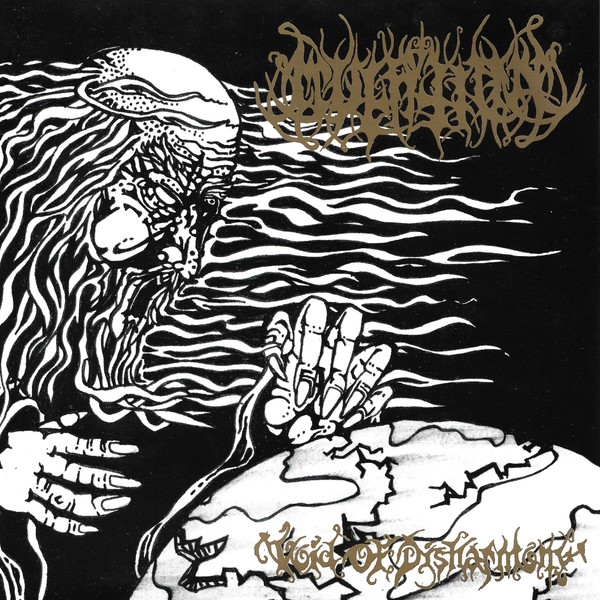
So first and foremost, thank you to Nuclear War Now! for finally giving ‘Void of Disharmony’ the treatment it deserved. Originally released in 2006 as a limited 7″ vinyl by Nuclear War Now! Productions, the record came in both a standard edition and a highly limited die-hard version, the kind of release that immediately disappeared into collectors’ hands. It was never a “new” release in the traditional sense even back then, but more a preservation of Mutation’s final recorded material from the early 90s, finally pressed onto vinyl after years of tape circulation and underground trading. That alone makes it more than just an archival piece. It’s a physical document of a band that should never have been lost in the first place.
This is a long time coming…. way, way overdue. I have owned the original 7″ vinyl (standard version) for years and with the die-hard edition is currently making its way to me from the sacred hands of Calvin Chiang (as we speak), Head Operations at Pulverised Records and resident Offset, Obliterate Man. This review has been sitting in the queue far longer than it should have.
For decades, Mutation existed as one of those names older Singaporean metalheads spoke about with genuine respect, but outside our shores very few people ever got the chance to hear why. By the time the rest of the world started paying attention to Asian Death Metal, Mutation had already disappeared, leaving behind little more than fading tapes, old flyers and stories passed around by tape traders. That always felt wrong. This wasn’t just another forgotten demo band.
This was one of the foundations of Singapore Death Metal.
Long before Roy Yeo co-founded Pulverised Records and turned it into one of the world’s most respected underground Extreme Metal labels, he was standing in front of Mutation with Ah Yong and Ah Liang, trying to make the heaviest music they possibly could. Pulverised would eventually introduce countless underground bands (mostly Swedish?) to the world, but Mutation was where that obsession began. Their influence on the local scene cannot be measured by the number of releases they left behind. It lives in the bands they inspired and in the standards, they set at a time when Singapore’s underground was still taking shape.
Roy’s contribution to underground metal stretches far beyond being the voice of Mutation. Together with Ah Yong, he built Pulverised Records from the ground up into one of the very few Asian labels respected by underground fans worldwide. At a time when most people in Europe and America probably couldn’t even point to Singapore on a map, Pulverised was already releasing bands that would later become household names in extreme metal. Their very first release was ‘Sorrow Throughout The Nine Worlds’ the debut EP by Amon Amarth, years before the Swedes would become “fashionable” festival headliners and one of Death Metal’s biggest success (… and trendy as fuck) stories. That wasn’t luck. It was Roy and Ah Yong’s ability to recognise quality long before everyone else caught on. Over the decades, Pulverised has remained fiercely committed to the underground, introducing countless bands to the world while proving that a label from Singapore could stand shoulder to shoulder with the best anywhere.
As a secondary school kid, I travelled every day on SBS bus service 155 from my home in Aljunied Crescent to my school in Toa Payoh. Part of that journey took me alongside old Bidadari Cemetery. Back then, Bidadari wasn’t the housing estate people know today. It was this vast forgotten cemetery hidden behind thick trees, and everyone seemed to have a story about it. You’d hear rumours of strange sightings, witching hour black magic sessions, Impiety band members hanging around among the graves and decapitating marble angels in the night.
Whether any of it was true never really mattered. Looking out of the bus window before school or on the ride home, Bidadari always seemed to exist in its own time. Looking back now, it’s almost fitting that Mutation made that place their haunting ground. Somewhere among those old graves, a few bewildered spirits were probably wondering why these long-haired lunatics kept showing up in the burial grounds with invisible oranges poses in front of those mystical gates into the beyond…
The biggest surprise revisiting these recordings today is just how immediate Mutation still sound. There is no sense of a band feeling their way forward or trying to figure out what they want to be. Yes, you can hear echoes of early Death, Autopsy and Morbid Angel, but Mutation will never come across as imitation. They absorbed those influences and turned them into something distinctly their own from this tiny island.
Ah Liang’s riffs don’t rely on speed or constant change to hold attention. They sit in a groove, dig in, and slowly drag everything into a downward spiral before snapping into something deadlier. Even decades later, many of them stick in the memory long after the record stops, which says more about the songwriting than any technical display ever could.
Roy’s vocals remain one of the defining elements here. Instead of chasing the ultra-low gutturals that would become standard later, he delivers a raw, strained, hostile voice that sounds physically pushed out rather than performed. That roughness gives every line a sense of conviction that constipation can’t be faked.
Ah Yong’s drumming is equally important. Nothing here feels overplayed or ornamental. He moves the songs with purpose, shifting between mid-paced pounding and faster bursts without breaking their flow. The restraint is what makes it work. Every hit serves the structure rather than distracting from it.
What stands out most about ‘Void of Disharmony’ is its sense of pacing and control. Mutation understood that heaviness isn’t just about density or speed. It’s about timing, repetition and knowing when to hold back. The slower sections feel weighty because they are allowed to sit, while the faster parts hit harder because they are used sparingly. That balance gives the recordings a staying power many modern OSDM bands still struggle to achieve, even with far superior production.
The production itself sits exactly where it should. Raw, but not unreadable. Clear enough to follow every instrument with clenched fist, but still carrying enough grit to feel rooted in its time and place. Anything cleaner would have stripped away the underground spirit and most importantly the part of what makes this material work
Listening to ‘Void of Disharmony’ today feels less like uncovering something lost and more like finally completing a missing piece of Singapore’s underground history in my own head. It raises the usual questions about what could have happened if these recordings had reached a wider audience back then. Maybe nothing changes. Maybe everything does.
What remains certain is that Roy Yeo, Ah Yong and Ah Liang helped lay the groundwork for Singapore’s extreme metal scene in its earliest form alongside bands like Abhorer, Impiety and a handful of others… Mutation was the starting point for them and through Pulverised Records, that same spirit was carried forward into something far bigger and longer lasting.
This is surely not for those who don’t know and never knew what Bidadari was… Hail Mutation.