Sometimes the best compilations are not simply about remembering a band. They are about remembering an entire era.
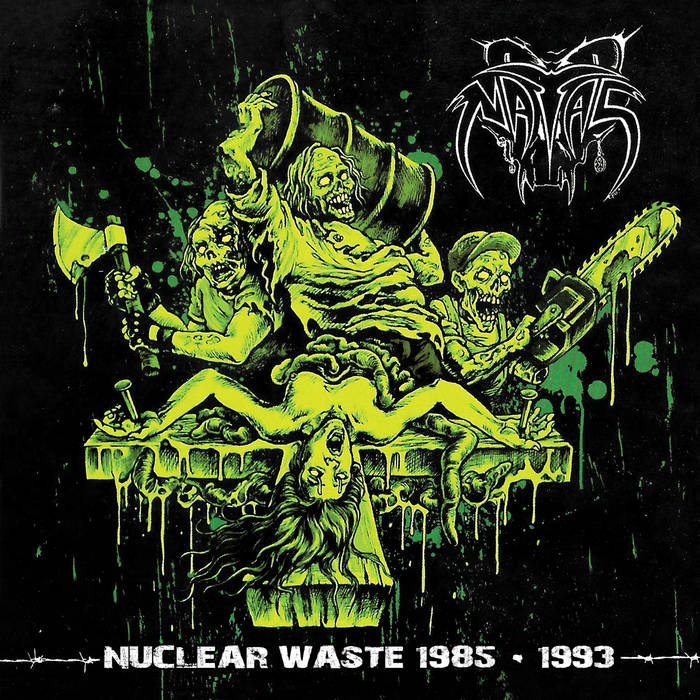
‘Nuclear Waste 1985–1993’ contains 33 songs that take us back to that strange, filthy, and absolutely fascinating period in the mid-eighties, when nobody seemed too concerned with deciding exactly where Hardcore ended, where Thrash began, or at what point that mass of noise, speed, and dirt could start being called Death Metal.
Listening to the earliest Natas recordings means stepping directly into that whirlwind.
Extremely savage and primitive Death/Thrash, double bass drumming, Thrash riffs, Hardcore grooves, heavily down-tuned guitars, and recordings covered in all the grime associated with demos passed around through tape trading. We are not talking about precision. We are talking about attitude.
And what an attitude.
While listening to these songs, I immediately thought of bands like Cryptic Slaughter. The kind of groups that sounded almost uncivilized, where Punk and Metal seemed to be crashing head-on without anyone worrying too much about picking up the pieces.
Names like D.R.I. naturally come to mind, along with traces of Cro-Mags, while the most extreme material also carries that same atmosphere in which bands such as Master or Hellhammer were helping to build musical languages that still had no final definition.
That is probably the most interesting thing about this compilation.
Today, looking back through thirty or forty years of musical history, we can identify every ingredient quite easily. Here is Hardcore. Here is Thrash. Here is primitive Death Metal. Here is Crossover. Here is Punk.
But in 1985, those divisions were not necessarily written down yet.
Everything was happening at the same time.
And from that chaos would emerge some of the most extreme music of the following decades.
It is impossible to listen to material like this without also thinking about what later happened with Grindcore. Napalm Death did not appear out of an isolated laboratory. There was an earlier generation of Hardcore and Punk bands pushing speed, noise, politics, and confrontation toward increasingly absurd levels. Other musicians later picked up those ideas, radicalized them again, and ended up creating something even more violent.
That family tree matters.
Especially because ‘Nuclear Waste 1985–1993’ shows a particularly curious evolution.
Many Hardcore bands from that period gradually started incorporating more Metal. Natas/Not-Us, at times, seems to move in the opposite direction.
The earliest demos are packed with primitive Death/Thrash, but as the chronology progresses, the sound starts leaning more clearly toward Hardcore and Punk. The lyrics also begin to move away from strictly metal-oriented imagery and toward more socially conscious themes, something completely natural within that Hardcore tradition.
D.R.I. begins to feel increasingly close.
And that turns this compilation into something far more interesting than a simple collection of demos.
We are listening to a band mutate.
Not necessarily evolving into something “better,” but changing direction while the entire extreme music movement around them was transforming as well.
There are clumsy riffs, filthy recordings, almost chaotic moments, and decisions that would probably never survive a modern production today.
That is precisely why they work.
Trying to clean this material up too much would be like restoring an old film until all of its grain disappeared. The imperfection is part of the document.
And after 33 songs, one thing becomes clear: many of the bands that later refined Thrash, Death Metal, Crossover, or Grindcore probably needed groups like this to exist first.
Bands that did not yet know exactly what they were creating.
Bands that simply played fast, loud, and angry.
Perhaps that is the real importance of ‘Nuclear Waste 1985–1993’.
It is not only nostalgia.
It is archaeology.
A chance to return to a time when Death Metal, Hardcore Punk, Thrash, Noise, and Crossover were still boiling together in the same container, before anyone started putting labels on every single thing.
Thirty-three songs of noise, grime, speed, and attitude.
Nuclear waste, indeed.
But some very important mutations came out of that radioactive garbage.