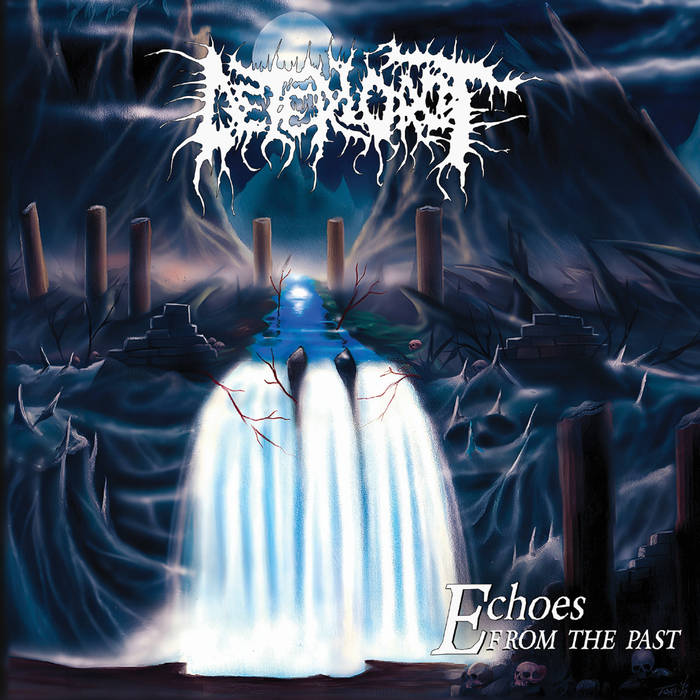
There are compilations that work as simple collections, and there are others that feel like exhumations. ‘Echoes From the Past’, by Deteriorot, clearly belongs to the second category. This is not a new album in the traditional sense, nor a work designed to sound uniform, modern or carefully balanced. It is rather the opening of a tomb: seventeen tracks gathering different stages of an entity deeply connected to some of the darkest, most cavernous and subterranean forms of American Death Metal.
Heard through Bandcamp in its seventeen-track version, ‘Echoes From the Past’ feels less like a linear record and more like a descent through different chambers of the same crypt. There are demos, EP material, live recordings, promo tracks, alternate versions and a more recent bonus track. That variety of sources could seem like a problem if approached with the expectations of a modern studio album, but in reality, it is one of the compilation’s main strengths. Each block sounds as if it had been rescued from a different depth of the underground.
The inclusion of live recordings and material from a television performance also adds a lot to the compilation. There is something very particular to the 80s and early 90s in hearing bands captured that way: raw, imperfect recordings, meant to circulate among maniacs as proof of existence rather than as finished products. In that sense, ‘Echoes From the Past’ does not only collect songs; it also rescues an older way of sharing Death Metal.
Deteriorot does not use the past as nostalgia; it uses it as a crypt that is still active. That may be the best way to understand this compilation. The band does not appear here trying to update its sound or adapt it to current Death Metal expectations. On the contrary, what dominates is the feeling of a dark document, a cursed archive, material that still carries the humidity, dust and primitive violence of its origin.
The cavernous sound is one of the key elements. This is not only about low guitars or deep vocals, but about a general atmosphere of enclosure. Many of these songs seem to come from an underground room where the air barely moves. There is a real crudeness here, a darkness that does not feel manufactured through modern nostalgia, but inherited directly from a time when Death Metal could still sound dangerous, imperfect and undomesticated.
In that sense, ‘Echoes From the Past’ should not be judged by its cleanliness or by its sonic continuity. The differences between recordings are not a central flaw, but part of the journey. One track may sound rawer, another deeper, another more direct or more damaged by time, but all of them belong to the same logic: dark, ceremonial, cavernous Death Metal with a strong connection to death as both a physical and spiritual presence.
Deteriorot has always had a particular way of working with darkness. Their Death Metal does not depend only on speed or frontal brutality. There is something denser in their sound, something closer to ritual, ancient horror and the feeling that every riff is being played inside a sealed chamber. The vocals seem to emerge from a low, humid and barely human place. They do not simply sing about death; they seem to come from it.
The influence of early 90s Death Metal can be felt throughout the compilation, but not as an exercise in imitation. Deteriorot belongs to that era and to that way of understanding the genre. That is why the material does not sound like a modern band trying to sound old. It sounds like a real fragment of that past, with all its irregularities, limitations and virtues. That difference matters. Here, crudeness is not a pose; it is origin.
There are moments where the music becomes more direct and aggressive, and others where a slower, almost Doom-like heaviness appears, increasing the sense of dark ceremony. When the band lowers the tempo, the material gains a particularly sepulchral presence. There is no search for beauty or obvious sophistication here. What exists is atmosphere, weight and a kind of cursed reverberation that runs through the whole compilation.
Of course, a collection like this also has its risks. Not every track has the same impact, and not every recording carries the same sonic strength. Some cuts may feel more like historical documents than definitive songs. But that irregularity is inseparable from the format. Asking ‘Echoes From the Past’ for the cohesion of a studio album would mean misunderstanding its nature. This is not a polished monument; it is an open grave.
And that is exactly where its interest lies. For those looking for a modern, clear and comfortable entrance into Death Metal, this compilation may feel too rough. But for those who enjoy hearing the real layers of the underground, with its demos, promos, live recordings and traces from different eras, ‘Echoes From the Past’ has enormous value. It does not only show songs; it shows persistence, context and a way of understanding Death Metal as something born from below.
The more recent bonus track also works as a small bridge, but it does not change the general reading of the material. Rather than closing the compilation with a sense of renewal, it seems to confirm that Deteriorot remains connected to the same dark energy that runs through its older recordings. Death here does not appear as a decorative concept, but as a continuous current linking past and present.
In the end, ‘Echoes From the Past’ is a necessary compilation for understanding Deteriorot from its own depths. It is not a conventional album, and it does not pretend to be one. It is an excavation, a subterranean archive, a gathering of traces that allows the listener to hear how the band left its mark within the darkest and most cavernous side of Death Metal.
Deteriorot does not sound here like a band remembering the past. It sounds as if the past had never stopped breathing inside the crypt. And each one of these seventeen tracks seems to come from a different depth of the same tomb.
