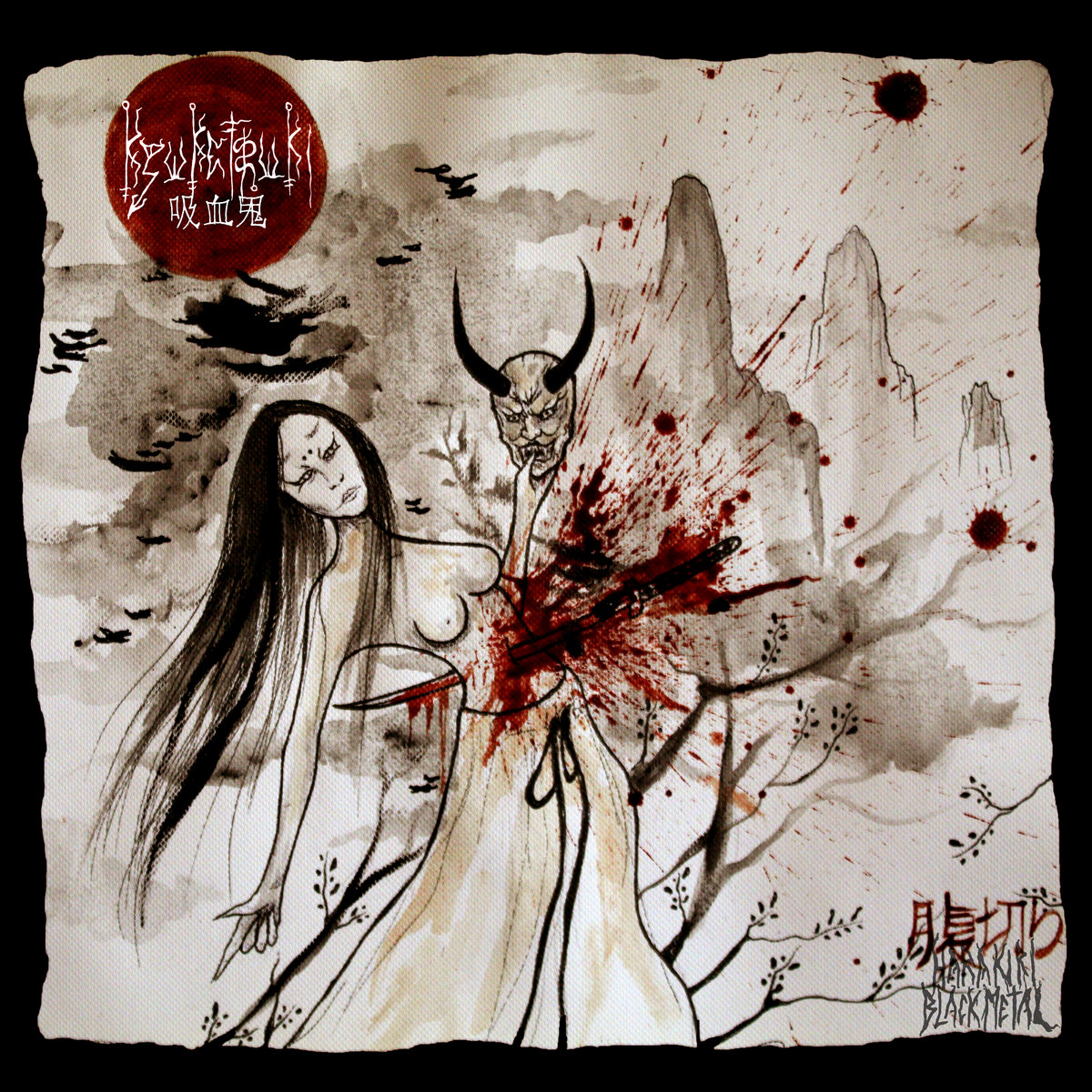
Maxime Taccardi (K.F.R., Osculum Serpentis, Griiim, etc.) or Yūrei unveils the new album from Kyūketsuki (Japanese for vampire), his Japanese-inspired horror Black Metal project. It’s called ‘Harakiri Black Metal’ and the follow up to ‘Nightmare Detective’.
“This new release revolves around two chapters exploring the figure of the twilight warrior facing death, war, and his own destiny. Between honour, sacrifice, and resilience, the lyrics obviously draw on imagery steeped in Japanese folklore but also on infernal visions and tales of vengeance. Overall, it shifts between violence, despair, and the search for meaning, while celebrating the strength of character of those who refuse to submit, even in the face of an inevitable fate.”
Or so the press release goes.
Tracks 1–4 represent The mortal world; ritual, war, pride, twilight and tracks 5–7 are about The supernatural world; death, hell, reflection.
The story begins at dusk.
A lone warrior kneels in a ruined shrine, surrounded by the remnants of a battlefield. His armor is cracked, his blade stained with the lives he has taken. Twilight settles like ash. He prepares for seppuku, not as punishment, but as a ritual escape from a world he no longer belongs to. He believes death will cleanse him, but he also senses something darker waiting beyond the veil. The ritual begins. Steel enters flesh. Blood falls onto ancient stone.The warrior dies, but his spirit does not leave. Instead, something pulls him forward.
As his soul detaches, he is forced to relive the horrors of the battlefield. He sees the faces of the fallen, the burning villages, the screams of the dying. War was not glory, it was a gateway to hell, a place where honor dissolved into madness.
These memories become chains, dragging him downward.
The warrior confronts the truth, he once reveled in violence. Steel gave him power, and power gave him pride. He believed himself chosen, unstoppable, destined for greatness.
But ambition corrupted him. Every victory carved another wound into his soul. Now, in death, he sees that his strength was a curse, the first step toward damnation.
Twilight returns, but now it is metaphysical. The warrior stands at the threshold between worlds, a liminal realm where the living fade and spirits wander. Here, he becomes half‑ghost. His mortal identity dissolves. His memories blur. He walks forward into the night, guided only by the faint echo of his former self.
Chapter I ends with the warrior stepping beyond the mortal world.
In the darkness, a figure appears. A woman; pale, silent, veiled, a yūrei, a ghost bride. She is not a lover, but a guide. Her presence is cold, mournful, yet strangely comforting. She takes the warrior’s hand and leads him deeper into the night. He realizes she is the embodiment of death itself, the one who welcomes all souls into the underworld.
Their union is symbolic: he accepts his fate. She accepts his soul.
Together they reach the entrance to Jigoku, the Japanese hell. A vast cavern of fire, shadows, and endless torment. The warrior is judged not by gods, but by the weight of his own deeds. He walks through the gate willingly.
He knows he deserves this place. Every sin, every death, every moment of pride becomes a flame licking at his spirit.
Hell is not punishment, it is truth.
In the final chamber, the warrior sits alone. The yūrei bride has vanished. The flames quiet. He is left with only his memories.
He sees his past clearly now. His ambition was the architect of his downfall. His pride led him to war. War led him to ritual death. Death led him to hell.
He accepts it.
There is no redemption, no escape, no resurrection. Only the eternal echo of what he once hoped to become.
The story ends with the warrior fully absorbed into the underworld, a soul defined not by glory, but by the ambition of the past.
Serious Japanese inspired themes, if you ask me.
Musically, ‘Harakiri Black Metal’ sits at the intersection of raw (vampyric) cinematic Black Metal, Japanese horror ambience and martial ritualism. Sonically, it is defined by treble‑forward dissonant guitars with a serrated, sandpaper texture, a minimalist yet innovative drum programming that feels more ritualistic rather than “Metal” Although not as oppressive/feral as K.F.R. or Osculum Serpentis.
Vocals are multi layered and drenched in reverb, positioned like a ghost in the mix. Melodic motifs inspired by Japanese folk scales, especially in ‘Tasogare’, also note the use of chimes and bells throughout the album.
The guitars form long, droning tremolo lines that feel like ceremonial chanting. The mix is wide, but hollow, the center is intentionally empty, giving the impression of a shrine or cavern. It’s saturated with mid‑tempo tremolo, slightly detuned, creating a wavering, unstable feel.
This time the agonizing vocals are distant, echoing, more like a spirit narrating than a frontman.
The whole atmosphere is slow suffocation; the sound of a ritual unfolding.
The album is full of variation on each track, more aggressive, sharper, and chaotic on the second track; ‘Hell of War’. Sometimes the music is triumphant yet corrupted, more melodic, almost heroic, but twisted by the raw production. There’s a sense of pride poisoned by decay.
On track 4, ‘Tasogare’, Kyūketsuki leans into Japanese folk tonalities, pentatonic motifs (The pentatonic scale – 5 tones per octave), twilight‑like chord progressions, and softer tremolo phrasing. By far, the most atmospheric track of Chapter 1.
Then, the production becomes colder, more reverb‑heavy. The guitars feel submerged, as if played inside a crypt. Drumming is slow, heartbeat‑like pulses. Vocals are echo‑drenched, feminine‑tinged shrieks layered subtly.
On ‘Hell’s Gate’, the sixth track, the guitars are thick, suffocating tremolo; dissonant intervals. Drums: are slow and pounding, ritualistic, like a gate opening. The vocals sound tortured, echoing, buried deep in the mix. The entire atmosphere is Crushing, cavernous, infernal.
This is the album’s most punishing track. ‘Kako no yabō’ (translation: Ambition of the past) is a short, reflective epilogue. The guitars are cleaner, almost mournful. The distortion is dialed back, revealing a fragile melodic core, melancholic tremolo; less noise, more clarity. Drums are minimal or absent. Vocals: soft, ghostly, resigned. Atmosphere reflects Memory, regret, quiet damnation.
The album ends not with violence, but with reflection. ‘Harakiri Black Metal’ boasts a deliberately unpolished master, emphasizing atmosphere over clarity. It is not lo‑fi in the “tape hiss” sense, it is intentional rawness, shaped to feel like a cursed object. The mastering across the album is deliberately uneven, not in a technical‑failure sense, but in a narrative sense. Yūrei shapes loudness, spectral balance, and distortion differently for each chapter, using mastering as a storytelling device. Brilliant.
‘Harakiri Black Metal’ uses mastering not as a technical polish but as narrative architecture. Every track’s loudness, distortion, stereo width, and spectral balance is shaped to reflect the protagonist’s journey. The mastering is intentionally raw, uneven, and emotionally coded. It rejects modern black‑metal clarity in favor of ritualistic storytelling through sound. The final track’s mastering; quiet, fragile and dynamic, reveals the truth of the album: beneath the violence, beneath the ritual, beneath the infernal descent, lies a single human emotion: Ambition that led to ruin.
This mastering arc makes ‘Harakiri Black Metal’ one of the rare raw Black Metal releases where the production itself is part of the narrative, not just a container for it. Still, it is a very enjoyable yet disturbing opus. Maxime Taccardi has outdone himself on this album.
Those who are willing to experience the ultimate in raw, cinematic Black Metal with Japanese motifs need to check it out. And the self-released CD is limited to a mere 50 copies. Someone really ought to bundle all these releases into a lavish box set. They deserve it.