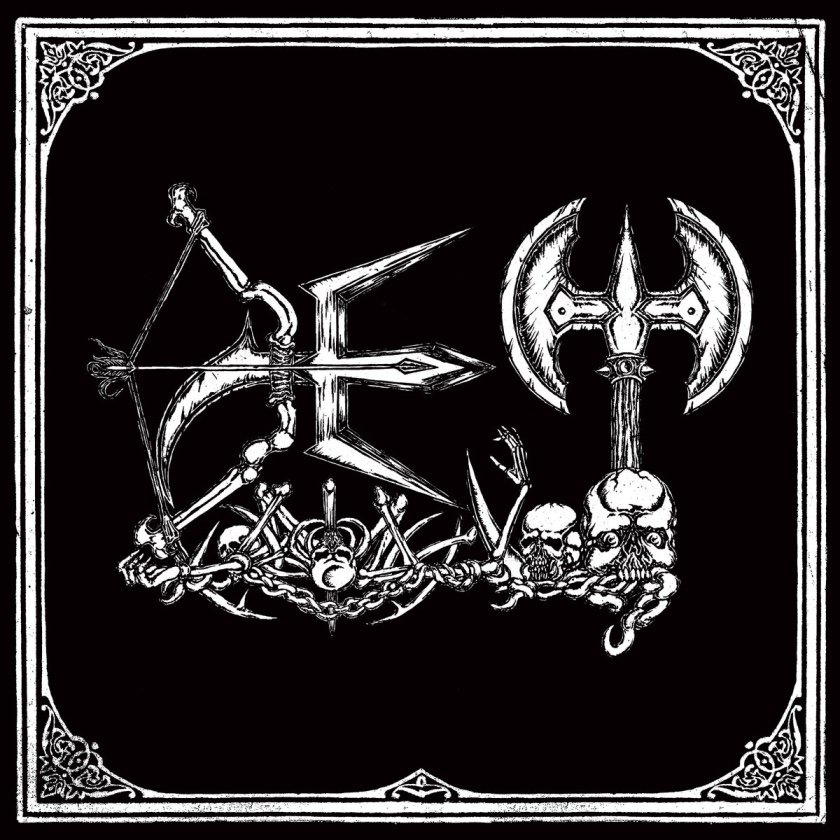
The Suomi death squad thrashers DET have unleashed upon this realm a sonic assault in the form of their first full-length album after two demos, a split and a compilation. It could easily be treated as a record released in the mid to late ’80s with its Razor’s Evil Invaders-esque, high-gain guitar tone.
In contrast to Razor, the guitars have been panned left and right to create a bigger, blacker atmosphere, which is one of my favorite aspects of this album, the whole thing is wrapped in a magical First Wave Black Metal spirit. Whether it’s the ancient riffs themselves, the highly reverberated screeches, or the malicious drums, they all contribute to making the listening experience feel like a trip to an old medieval dungeon.
Listening to this album feels like playing through an episode of Quake (1996), let me explain. One is an auditory trip through ancient dungeons and realms, while the other one is physical. Anyways, I express my eternal gratitude to this band for making all of the songs bite-sized, catchy hymns; there’s not a single track that goes over the 5-minute mark.
The solos are very much first-to-third-album Bathory style: high-register, no-extra-bullshit, echoed screams from the deepest reaches (e.g. the solo for the first version of ‘The Return of Darkness and Evil’), and they do wonders for the attitude of this record.
Honestly, my only complaints about this album would be to turn up the bass, god damn it. It’s there, it noticeably adds to the lower end, but it could have been so much more; It gets lost in the mix. Other than that, I’m not sure what kind of rites they perform up there in Finland, but they seem to always do Black/Thrash Metal so fucking well. (Hoxie)
— — — — — — — — — — —
There is something about the Finnish underground that keeps drawing me back to it. Over the years, I have come across plenty of bands from Finland that understand the connection between Heavy Metal’s traditional roots and the uglier sounds that developed when musicians began pushing things into more extreme territory. Some went deeper into Black Metal, others took the Death Metal route, while a few held on to the speed and rawness of the earliest Thrash Metal records. Every now and then, a band comes along that seems quite comfortable standing somewhere in the middle of all these styles without worrying too much about where one ends and another begins. Destructive Elite Terror, or DET, belong to that camp.
The Helsinki trio released their self-titled debut through Dying Victims Productions in October 2025, followed by a cassette edition through Headsplit Records in March 2026. The band formed in 2022, with Miikka handling drums and vocals, Jari on guitars and vocals, and Atte on bass. Their backgrounds include Ranger, Asphodelus, Cryogenic and Excuse, which gives some indication that these are musicians who have spent time exploring different corners of Metal rather than arriving at this sound by accident. The album was recorded at their own rehearsal space in Helsinki, with Anselmi Ahopalo working alongside the band on engineering and mixing. That setting makes sense when you hear the record, because the performances retain the feeling of musicians playing together instead of trying to construct some overly elaborate studio production.
What interests me about DET is the way they approach the older forms of Extreme Metal. There are traces of early Bathory, the primitive aggression associated with the first South American Extreme Metal bands, and the kind of riffing that connects Speed Metal with the more vicious side of Thrash Metal. Yet there is also a strong Heavy Metal foundation beneath the uglier parts. The guitar work does not depend entirely on blunt-force riffing, and the leads bring a sense of melody that gives the songs their own identity. It reminds me of a time when the boundaries between these styles were still being pushed around, before every band felt the need to fit neatly into a particular category.
The opening stretch, from the introductory passage into ‘Annihilation’, establishes the band’s intentions without wasting much time. The guitars carry the songs, shifting between fast, cutting riffs and darker passages that owe something to early Black Metal, while the drums keep the momentum moving without turning everything into a blur. Miikka and Jari share vocal duties, adding different shades to the delivery rather than relying on one voice throughout the record. There is a roughness to the performances that suits the material, but the music is not simply a matter of playing as fast and aggressively as possible. The riffs have shape, and the changes in tempo give the songs room to develop.
That balance between speed and songwriting is what keeps the album interesting. The Death Metal influence adds weight to the heavier passages, while the Black Metal element comes through in the colder melodies and the more sinister character of certain riffs. At the same time, the Speed Metal side prevents the songs from becoming too ponderous. DET seem to understand that the records which influenced this music were not memorable merely because they sounded primitive. They had riffs that stuck in your head, guitar leads that you could recognise after a few listens, and songs that carried their own personality even when the production was rough around the edges.
The recording suits that approach. Since the album was made in the band’s rehearsal space, the music has a directness that fits the material, and the instruments remain clear enough for the bass and guitar to contribute to the overall sound. There is no need to dress everything up with layers of production when the riffs and performances are doing the work. The result feels closer to a band working out its ideas together than a carefully assembled attempt to recreate an old record. For music rooted in the early days of Extreme Metal, that distinction matters.
Listening to the album, I find myself returning to the appeal of those early crossover years, when Speed Metal, Thrash Metal, Death Metal and Black Metal were not always separated by rigid definitions. DET draw from that period without limiting themselves to a single influence, and the traditional Heavy Metal element gives the record some welcome character. Their self-titled debut is a convincing introduction to a band that knows what it wants from this music, and it leaves me interested in hearing where they take these ideas next. (Deen “Brother Darkness” Gabriel)
