
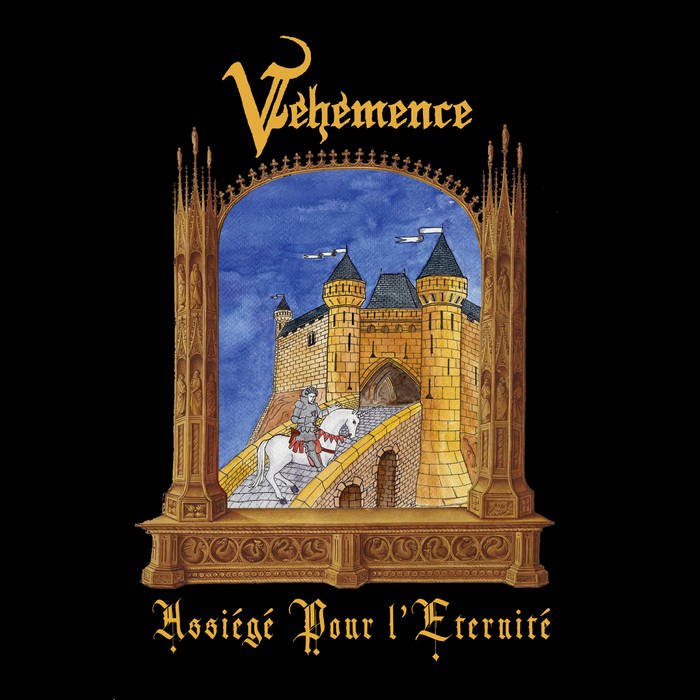
The Véhémence – ‘Assiégé pour l’éternité’ album is a re-recording of their first album, ‘Assiégé’, from 2014. Véhémence is an Epic/Melodic Black Metal band from Paris, Île-de-France (France), active since 2014, whose album ‘Par le sang versé’ made big waves in 2019 and is heralded as a true epic masterpiece of medieval Black Metal.
The group has become one of the most acclaimed representatives of the modern French Black Metal scene, distinguished by its combination of fierce Black Metal with richly atmospheric medieval and fantasy-inspired themes.
The project was originally founded and driven by the multi-instrumentalist Tulzcha, who handled nearly all instrumentation on the debut material. Véhémence’s first album, ‘Assiégé’, was initially self-released and introduced a style rooted in traditional second-wave Black Metal while drawing heavily on imagery of medieval warfare, heroic sagas, castles, and ancient legends.
After a period of relative silence, the band re-emerged in 2018 with a strengthened line-up that included vocalist Hyvermor and drummer Thomas Leitner. This incarnation expanded Véhémence’s sound considerably, incorporating folk instruments, acoustic passages, choirs, and grandiose arrangements. The resulting album, ‘Par le sang versé’ (2019), was released through Antiq Records and received widespread praise for its sweeping compositions, memorable melodies, and evocative medieval atmosphere.
The band’s third full-length, ‘Ordalies’ (2022), further developed its signature blend of Epic Black Metal and historical fantasy. Long-form songs, triumphant choruses, folk interludes, and vivid storytelling became even more prominent, solidifying Véhémence’s reputation as one of the leading acts in the contemporary French Black Metal underground.
Lyrically, Véhémence focuses on medieval sagas, fantasy, war, honor, sorcery, and heroic adventure, creating a romanticized vision of a long-lost Europe. Musically, the band combines aggressive tremolo-picked Black Metal, soaring melodic leads, traditional folk instrumentation, and cinematic atmospheres, often drawing comparisons to other French pagan and medieval-influenced Black Metal acts such as Aorlhac or Grylle.
For many listeners, Véhémence’s defining characteristic is its ability to merge the ferocity of Black Metal with the grandeur of medieval epic storytelling, creating music that feels both battle-worn and majestic.
Although ‘Assiégé pour l’éternité’ is not generating the same volume of coverage that ‘Par le sang versé’ or ‘Ordalies’ did, there has been a notable cluster of reviews and commentary since its June 2026 release. Nearly every source emphasizes that it is far more than a simple remaster, acting as a complete reconstruction or reimagining of the 2014 debut.
‘Assiégé pour l’éternité’ is “a full retelling and reconstitution” of the debut, and the album therefore serves both as a tribute to the original and as a modernized presentation of Véhémence’s early vision; however, this version does much more than simply fix production flaws. The album should be viewed as a reinterpretation rather than a restoration project, as the band revisits the material through the lens of twelve years of musical development, with organic drums, a stronger bass presence, and more integrated folk instrumentation fundamentally altering the character of the songs.
One could define this re-recording as “a long-lost memory reclaimed and reborn with renewed strength,” noting that expectations of a straightforward remaster are quickly dispelled by more ambitious arrangements and expanded atmospheres.
Twelve years after the release of their debut album ‘Assiégé’, Parisian medieval Black Metal standard-bearers Véhémence return to the source of their legend. Yet ‘Assiégé pour l’éternité’ is not a remaster, nor merely a nostalgic revisit. It is a complete re-recording and artistic reconstruction of the 2014 album, undertaken by a band that has since matured through the celebrated ‘Par le sang versé’ and ‘Ordalies’. The album feels less like a restoration and more like a rebirth.
The most striking aspect of the record is how seamlessly it bridges past and present. The original ‘Assiégé’ possessed charm, ambition, and a strong melodic identity, but it also carried the limitations of an underground debut. On ‘Assiégé pour l’éternité’, those compositions are granted the scope they always seemed to deserve. Organic drumming has replaced the stiffness of programmed percussion, the bass occupies a meaningful role in the arrangements, and the production allows the band’s intricate interplay of guitars, folk instruments, and medieval atmospherics to breathe naturally. Reviewers repeatedly remarked that the songs no longer sound like promising sketches, but fully realized epics.
What has always separated Véhémence from many folk-infused Black Metal acts is their instinct for melody. Rather than using medieval instrumentation as decorative ornamentation, they weave it directly into the fabric of the compositions. Flutes, traditional melodies, and acoustic passages function as narrative voices within the music itself. On this recording, that integration feels richer and more confident than ever. The listener is transported into a world of banners, cavalry charges, sacred quests, and crumbling fortresses without the music descending into theatrical excess.
Tracks such as ‘En quête du Graal’, ‘Chant d’honneur’, and the monumental title track exemplify the album’s strengths. There is a sense of movement throughout the record, with melodies unfolding like chapters in a medieval tale. The guitars retain their Black Metal ferocity while embracing the heroic grandeur that has become the band’s trademark. French-language vocals, delivered with conviction and clarity, further reinforce the atmosphere and distinguish Véhémence from many of their contemporaries.
Perhaps the album’s greatest achievement lies in its justification for existing. Re-recordings often raise questions about artistic necessity, yet ‘Assiégé pour l’éternité’ avoids the trap of redundancy. Rather than replacing the original, it illuminates it. The youthful spirit and enthusiasm of the 2014 material remain intact, but the execution reflects a decade of artistic growth. It can be described as “the completion of an unfinished vision,” a characterization that feels particularly apt.
For longtime followers, the album offers the pleasure of hearing familiar hymns elevated to a level once beyond the band’s reach. For newcomers, it functions as an ideal entry point into Véhémence’s catalogue, presenting the foundation of their medieval Black Metal aesthetic in its most refined form. While it may not possess the revelatory impact of ‘Par le sang versé’, it demonstrates why Véhémence remains one of the most respected names within the modern French Black Metal scene.
Fans of this genre, Véhémence, similar artists, and their French-Canadian colleagues won’t hesitate to add this album to their collection. ‘Assiégé pour l’éternité’ is a rare example of a re-recording that successfully transcends nostalgia. It honors the spirit of the original while transforming it into something grander, richer, and ultimately more enduring. For admirers of medieval Black Metal, it stands as both a celebration of Véhémence’s origins and a testament to how far the band has travelled since first laying siege in 2014.
