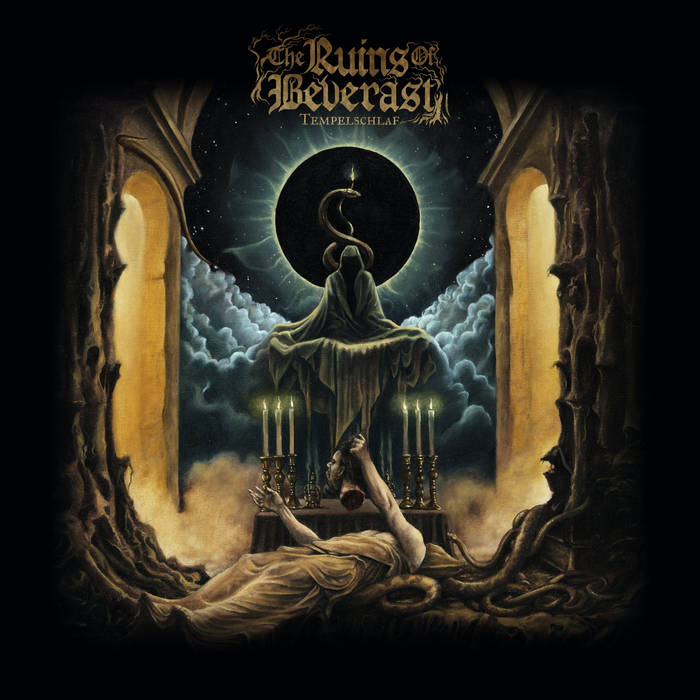
One of the earliest full-album releases by a prominent Metal artist in 2026 arrived by way of the new The Ruins of Beverast album ‘Tempelschlaf’. This record is the seventh studio album from this trailblazing German force. Having debuted shortly after the dawn of the new Millenium, Ruins is a project masterminded by musician Alexander von Meilenwald. This artist has unveiled numerous totemic works that mostly have garnered mammoth amounts of praise from reviewers and fans alike. The music of Ruins embodies a particularly distinctive concoction of Progressive Black Metal and Doom Metal, embossed with frequent explorations into mysterious psychedelia. The expansive tracks that this artist is renowned for often tackle themes of divine transcendence, voyages into mythical realms, and which frequently feature soundscapes that are akin to being guided into a trance at the instructions of a wizened shaman. With a fairly solid and consistent quality bar amongst releases, a new Ruins album is typically an exciting occasion.
Tempelschlaf begins with the nine minutes and thirty seconds of its opening title track, which pass by in a flash. The entertainment factor of this first taste is bolstered by an excellent drum performance, some ascendant-sounding guitar work, and Meilenwald’s crooning. The track lyrically centres around a conversation with a ‘god of light’ and also a desire to remain hidden from a present ‘stranger darkness’. Track two, ‘Day Of The Poacher’ opens to some energetic guitar riffing and the familiar growled vocals of a Ruins track. I enjoy the added delay effect to the vox here, and in particular, how the song shifts between its blackened intensity and its more meditative sections. The instrumentation is impressive on all fronts compositionally on this track, particularly the extended guitar soloing and, once again, the drums.
The meditative ‘Cathedral of Bleeding Statues’ features guitar riffs that amount to an entrancing drone. I enjoy the transition into a dual guitar harmony during the second half of the track, and the gear-shift into heavier territory towards its closing moments is also a pleasant pay-off. Besides this, however, the song seems to offer little more than a fairly routine performance. ‘Babel, You Scarlet Queen!’ is one of the busiest cuts on the record and spends its first three quarters gathering steam with a rumbling full-band wall of sound. From there, the track closes out to a somewhat underwhelming climax, adorned with some subtle melodicism and cleaner vocals. Unfortunately, by this point in the tracklist, it seems as if the album has reached a state of compositional auto-pilot and rarely drifts into any new exploratory intrigue.
The thirteen minute closer ‘The Carrion Cocoon’ opens to a shadowy and hushed progression with ghostly, near-monastic chant sounding vocals. Some subtle electronic synth sounds lurk within the background of the track, whilst the lyrics tackle questions pertaining to divine power and immortality. There is a certain degree of epic dynamism to the instrumentation during the song’s final three minutes, and this is one of the more exciting sections on the album.
‘Tempelschlaf’ succeeds in offering the usual high quality of production, curious song concepts, and thematic mystique that is expected from a The Ruins of Beverast record. However, the album is bogged down all too often by some of the least exciting compositions that I’ve heard from this artist. Compared to the raw edge and icy tonality of its predecessor, 2021’s ‘The Thule Grimoires’, ‘Tempelschlaf’ is a meandering and dreamy affair that feels half asleep at times. It isn’t an inherently bad album per se, but when judging by this artist’s prior standards, it does seem quite bland.