
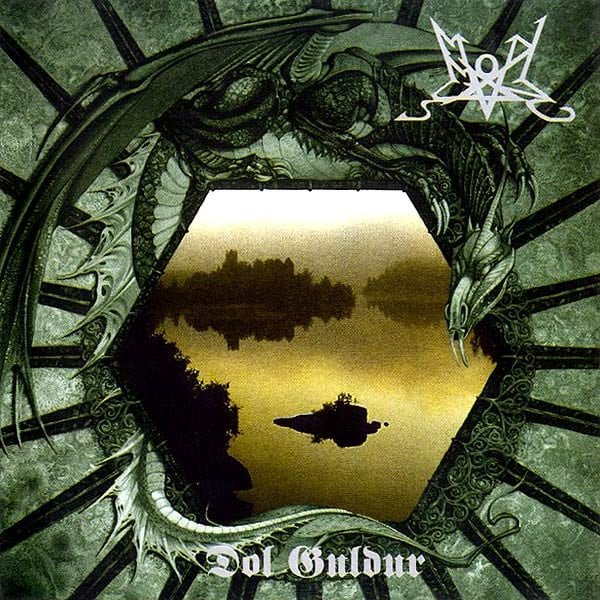
By the time Summoning released their third full-length album, ‘Dol Guldur’, in 1997, Silenius and Protector had developed a sound that stood apart from much of the Black Metal scene. Recorded at Hörnix Studio in October 1996, the eight compositions stretch across roughly sixty-nine minutes, taking the listener through Tolkien-inspired landscapes shaped by programmed percussion, rough guitar work, layered keyboards and vocals that blend into the arrangements. The music moves at its own pace, with melodies returning and developing rather than relying on constant changes in tempo or a succession of riffs. It takes commitment to build an album around this approach, but Summoning had found their direction and knew exactly what they wanted to achieve.
I was introduced to ‘Dol Guldur’ and ‘Oath Bound’ by Shyaithan of Impiety in 2005, and both albums sent me backwards through Summoning’s discography. ‘Dol Guldur’ became one of my favourites, not simply because of its fantasy themes but because of the strength of its compositions. There is a distinctive balance between the roughness inherited from Black Metal and the grand, melancholy melodies that define the album. The keyboards are central to that identity, but the guitars and vocals keep the music connected to the underground rather than allowing it to drift into something that could belong to any fantasy soundtrack.
‘Angbands Schmieden’ establishes the mood instrumentally before ‘Nightshade Forests’ develops the album’s characteristic combination of repeating keyboard themes, steady percussion and coarse guitar textures. Summoning understood that a melody did not need to be constantly replaced to remain compelling. A recurring theme can gather weight through the way it is arranged and the sounds surrounding it. ‘Elfstone’ demonstrates this particularly well, allowing its melodic ideas to settle into the listener’s memory without dressing them up with unnecessary technical flourishes.
‘Khazad-Dûm’ brings Tolkien’s underground Dwarven kingdom into the album’s musical landscape, while ‘Kôr’ moves towards a more reflective and melancholy character. These compositions demonstrate how Silenius and Protector used atmosphere as part of the songwriting rather than as decoration. The keyboards establish the broader melodic direction, the guitars provide a darker foundation and the programmed drums maintain a deliberate pulse beneath everything. The result is recognisably Black Metal, although anyone expecting the relentless riffing and drumming of a conventional Extreme Metal record would have to adjust their expectations.
The Tolkien connection runs throughout ‘Dol Guldur’, but the lyrical credits reveal an interesting link to another corner of the Austrian underground. Alongside J.R.R. Tolkien, the album credits P.K. of Abigor for lyrics. Abigor and Summoning occupied different musical territories, making the connection a worthwhile detail for listeners interested in the people and relationships behind the Austrian Black Metal scene. The cover is equally interesting, combining Roger Garland’s Middle-earth artwork with a photograph of the ruins of Lichtenfels Castle near Austria’s Ottenstein reservoir. The meeting of fantasy artwork and a real historical ruin fits the character of an album that draws from both Tolkien’s mythology and the atmosphere of ancient places.
‘Wyrmvater Glaurung’ continues the album’s Tolkien-inspired journey, leading into ‘Unto a Long Glory…’ and the closing ‘Over Old Hills’. That final track has an especially interesting background because it draws on ‘Trapped and Scared’ by Ice Ages, Protector’s electronic project. The connection offers a glimpse into his wider musical interests and shows how material could cross between projects with very different sounds. Within ‘Dol Guldur’, the piece sits naturally alongside the album’s other compositions, bringing the record to a close without abandoning its established musical character.
The ‘Nightshade Forests’ EP, released later in 1997, also belongs to this period. Three of its tracks came from the ‘Dol Guldur’ sessions, while ‘Habbanan Beneath the Stars’ was newly written. Listening to the two releases together gives a fuller picture of what Silenius and Protector were working on around this time, rather than treating the EP as an entirely separate chapter.
What makes ‘Dol Guldur’ endure is the strength of its melodies and the conviction behind its arrangements. Summoning did not need to make the music technically complicated or constantly aggressive to create something unmistakably their own. Their combination of Black Metal foundations, keyboards and Tolkien-inspired themes became a musical identity that other bands could imitate but never quite reproduce in the same way.
I have returned to this album many times since Shyaithan introduced me to it in 2005, and it remains one of the essential records in my Summoning collection. ‘Dol Guldur’ captures the duo at a point when their musical vision was fully taking shape, creating a work that rewards repeated listening without needing to explain itself. For me, it stands among the defining albums of Summoning’s catalogue and remains a lasting example of how far Black Metal can reach when a band has the confidence to follow its own path.
