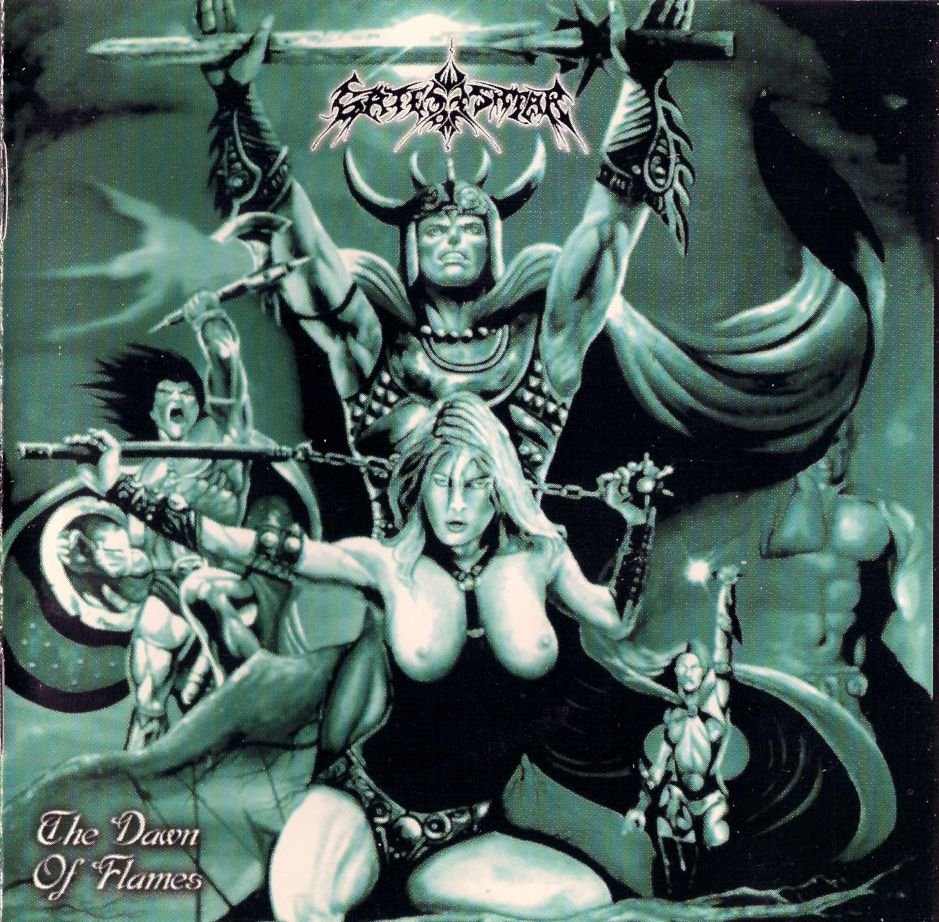
When talking about Swedish Melodic Death Metal from the 1990s, there are certain names that immediately come to mind, while others seem to have been pushed further into the background over the years. Gates of Ishtar belong to that second category for me. Coming from Luleå in northern Sweden, the band had already established themselves with their 1996 debut ‘A Bloodred Path’, but it was their second album ‘The Dawn of Flames’ that really showed how much potential they had as songwriters. Released through Germany’s Invasion Records in March 1997, the album contains eight songs and runs for just over forty-one minutes. It was recorded at Unisound in February 1997, with the band themselves handling the production alongside Dan Swanö, who also worked on the engineering and mixing and contributed keyboards to two songs.
The road to this album had already involved some changes within the band. Mikael Sandorf remained responsible for the vocals and lyrics, while Andreas Johansson and Tomas Jutenfäldt handled the guitars. Henrik Åberg, who had been involved with the band as a live guitarist, moved behind the drum kit, while Danjel Röhr came in on bass as a session musician for the recording. This is an important detail because ‘The Dawn of Flames’ has a very cohesive feeling despite the changes surrounding the lineup. The guitars are clearly the centre of the music, but the rhythm section gives the songs enough weight to stop the melodic side from becoming too polished or harmless.
What makes Gates of Ishtar interesting is that they were never simply another band trying to reproduce the most obvious version of the Gothenburg formula. There is certainly melody everywhere, but the riffs still have teeth. The guitars move between aggressive tremolo-picked passages, heavier rhythmic sections and more atmospheric melodic lines without turning the songs into collections of flashy guitar exercises. The melodies actually serve the songwriting. That becomes particularly apparent in ‘Trail of Tears’ and ‘Forever Scarred’, where the band manages to keep the momentum of Death Metal while allowing the guitar work to create a stronger emotional character around the riffs.
Mikael Sandorf’s vocals also help keep the record firmly connected to the heavier side of the genre. They are harsh and recognisably Swedish in character, but there is enough variation in the phrasing to prevent the vocals from simply sitting on top of the guitars. The production at Unisound gives the album a fairly clear sound without stripping away its aggression, and that balance is important. You can hear the individual guitar work, but the record still sounds like a Death Metal album rather than a collection of perfectly separated studio instruments.
The album also has a slightly different character from some of the more immediately recognisable Swedish Melodic Death Metal records of the period. ‘Perpetual Dawn’ is a good example, particularly with the keyboards supplied by Dan Swanö, because the atmospheric elements are used to expand the song rather than dominate it. The same applies to the title track, ‘Dawn of Flames’, where the longer running time gives the band more space to develop the ideas instead of rushing from one riff into another. Swanö’s keyboard contributions appear only on those two songs, which makes their presence feel like part of the arrangement rather than a permanent layer covering the entire album.
There is a certain melancholy running through ‘The Dawn of Flames’, but it never becomes overly sentimental. That is probably one of the album’s strongest qualities. The melodic guitar lines have enough darkness behind them to work alongside the Death Metal foundation, and the songs generally have enough movement to remain interesting after repeated listens. ‘Eternal Sin’ and ‘The Embrace of Winter’ further demonstrate that the band understood how to create atmosphere without sacrificing the heavier side of their identity.
At the same time, I would not pretend that every moment of the album is equally strong. Some of the melodic passages can feel somewhat familiar when viewed against the enormous amount of Swedish Death Metal that followed during the same period, and there are moments where the songwriting does not quite have the same impact as the strongest material. The production also belongs very clearly to its era. That is part of the character of the record, but listeners coming from modern productions may initially find it less immediate and less polished than contemporary Melodic Death Metal.
For me, however, those limitations are part of why ‘The Dawn of Flames’ remains worth revisiting. It captures Gates of Ishtar at a point where they were developing their own balance between aggression, melody and atmosphere rather than simply chasing whatever was already becoming fashionable. The album has enough hooks to stay in the head, enough Death Metal weight to keep things serious and enough melodic detail to reward repeated listening.
Gates of Ishtar would release ‘At Dusk and Forever’ the following year, making ‘The Dawn of Flames’ an important part of a relatively short but memorable run of albums. The band’s original era ended in 1998, and their later reunions have naturally brought renewed attention to those early records. Looking back now, I think ‘The Dawn of Flames’ deserves to be considered more than just another 1990s Swedish Melodic Death Metal record. It shows a band with a clear understanding of melody but still enough hunger in the songwriting to make the music feel genuinely heavy.