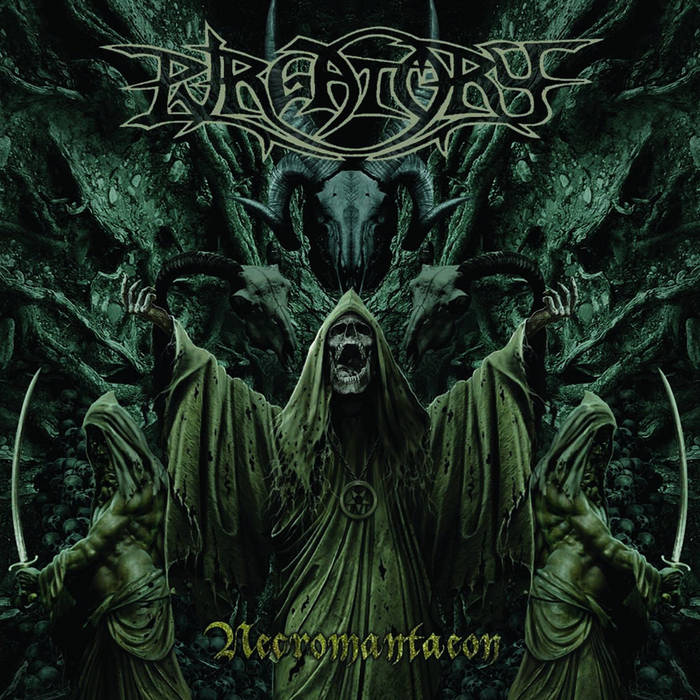
Of all the other Purgatory-ies this is the German one. Those guys aren’t new to the Death Metal scene – they exist since 1993 and ‘Necromantaeon’ is their sixth full-length album.
I’m not that much into German Death Metal but Purgatory managed to appeal to me with those nine songs of precisely executed brutality. Their music carries the explosive energy of Vader which is evident from the opening track ‘Reaping the Diseased’ to the final ‘The Collapse of Tides’. On the other hand tunes like ‘Downwards Into Unlight’ have the evil dark spirit of the early Swedish Death Metal scene.
Good words should go to the drummer Lutz – he provides tight and furious drumming with lots of double-bass and grinding swaths. Dreier’s vocals are deep and powerful and they feet perfect with the more darkened Death Metal sound of Purgatory. Strangely there aren’t any guitar leads – only in ‘Glorification of the Lightbearer’ some melodic guitar twists may be heard.
‘Necromantaeon’ is a solid Death Metal record and in case you like bands like Vader you should check it out. Purgatory are nothing new and unheard but what they do, they do it well and deserve credit for their service on the Extreme Metal front. (Zvetan)
— — — — — —
Purgatory are one of those German Death Metal bands that have been doing the job for so long that it almost feels strange they are not mentioned more often. Formed in Nossen, Saxony in 1993, they had already released five albums before Necromantaeon arrived in February 2011. This was their sixth full-length, clocking in at just over 32 minutes and containing nine tracks.
There was no reinvention here and, frankly, Purgatory did not need one. Necromantaeon is old school Death Metal played by musicians who clearly knew exactly what they wanted from it. The album comes straight in with the short instrumental ‘Arrival Of The Undivine’ before ‘Reaping The Diseased’ kicks the door open. From there, the band keeps things moving with aggressive riffing, heavy double bass and Mirko Dreier’s deep, rough vocals.
The Vader comparison came up in several reviews, and it is easy to understand why. There is that same sense of forward movement in the riffs, particularly when the band gets into the faster material. But calling Purgatory a Vader clone does the album a disservice. There are more things happening here. One contemporary review heard a stronger Deicide influence, while also picking out darker blackened passages and even some Bolt Thrower weight in ‘Downwards Into Unlight.’
That track is a good example of what Purgatory do well. They don’t need to maintain maximum speed for the entire record. When they slow the pace down and let the riffs grind, the music becomes heavier. ‘The Collapse Of Tides’ works in a similar way, closing the album with a slower, more oppressive approach rather than simply throwing another blast-heavy number at the listener.
The guitar work is straightforward but effective. There is nothing here that sounds like the band is trying to win a technical competition. The riffs are built to move the songs along, and the best ones have enough groove to stick after the track has finished. ‘Reaping The Diseased’ is probably the easiest example, with its fast attack and strong rhythmic pull. ‘Scourging Blasphemies’ goes for the throat in a more direct way, while the title track brings in a darker atmosphere and a spoken passage that breaks up the constant assault.
Dreier’s vocals are another reason the album works. There is no need for exaggerated theatrics. The delivery is deep, nasty and consistent, with enough variation to keep it from becoming one long growl over the same riff. A Metal Archives reviewer specifically praised the German character of his vocal style, comparing it with the sound found in other German Death Metal bands such as Fleshcrawl and Anasarca.
The production is powerful and modern without turning the band into something glossy. It was recorded at Rape of Harmonies Studios, with Patrick W. Engel and Purgatory co-engineering and co-producing, then mixed and mastered at Temple of Disharmony. The drums are prominent, and that gives the faster sections plenty of push.
That production choice was not universally loved. Some criticism was aimed at the drums sitting too far forward, but others praised the strength of the sound and the way it helped the album hit hard. I can understand both opinions. The drums certainly dominate in places, but the guitars still have enough weight to carry the riffs.
What I like about Necromantaeon is that Purgatory don’t try to make their music more complicated than it needs to be. This is a band that understands the value of a good Death Metal riff and doesn’t feel the need to bury it under endless technical playing. The songs are short, the album moves quickly and before you start wondering whether the next track will finally change direction, the record is already over.
That 32-minute running time is probably one of its biggest strengths.
There are nine tracks, but the album doesn’t feel padded. The opening instrumental is short, the majority of the songs sit around three to four minutes and only ‘The Collapse Of Tides’ pushes beyond five. Purgatory get in, do the damage and leave. There is something refreshing about that when so many Death Metal records seem determined to squeeze every possible minute out of a recording.
The lyrical side is also firmly in the band’s established territory. Death, Satan, blasphemy, darkness, ancient gods and the destruction of mankind are all over the record. The title track moves into Lovecraftian territory with Yog-Sothoth and Cthulhu, while ‘Reaping The Diseased’ draws on Mayan imagery and the mythology surrounding Ah Puch and Xibalbá. It all fits the music without feeling like the lyrics are trying to become more important than the riffs.
There was some criticism in 2011 that Purgatory were too close to familiar Death Metal territory and not distinctive enough. One review was particularly harsh about the lack of originality, while other reviewers were much more positive and simply enjoyed the band’s refusal to mess around with the formula.
I lean towards the second view.
Not every Death Metal band needs to reinvent the genre. Purgatory’s strength is consistency. They know the kind of record they want to make and Necromantaeon is a good example of them doing exactly that. The album has the German precision that people often associate with the scene, but it still has enough dirt and aggression to stop it sounding sterile.
And that is probably why the Vader comparison doesn’t bother me much. You can hear the influence, but there is enough Deicide, Morbid Angel, Immolation, Bolt Thrower and Blackened Death Metal atmosphere in the mix to give the record its own balance. One contemporary review specifically pointed to the darker elements and the variation in tempo as reasons the album worked beyond the Vader comparison.
For me, the strongest tracks are ‘Reaping The Diseased’, ‘Downwards Into Unlight’, ‘Scourging Blasphemies’ and Necromantaeon. The first two show the band’s ability to switch between speed and weight, while the latter pair bring more of the darker and blasphemous side into the record. ‘The Collapse Of Tides’ is also worth mentioning because it gives the album a proper ending instead of simply finishing with another fast track.
Necromantaeon is not trying to be clever. It is not Technical Death Metal, it is not polished modern Death Metal and it certainly isn’t interested in following whatever trend was fashionable in 2011. Purgatory took their established sound, sharpened the riffs, recorded it with a heavy production and delivered a short album that does exactly what it says on the tin.
There are stronger and more influential German Death Metal records, obviously. Purgatory themselves have a long catalogue to dig through. But judging Necromantaeon on its own terms, this is a very solid piece of old school Death Metal from a band that had already been at it for nearly two decades when they recorded it.
If you like your Death Metal direct, heavy and free of unnecessary decoration, there isn’t much to complain about here. (Deen “Brother Darkness” Gabriel)
