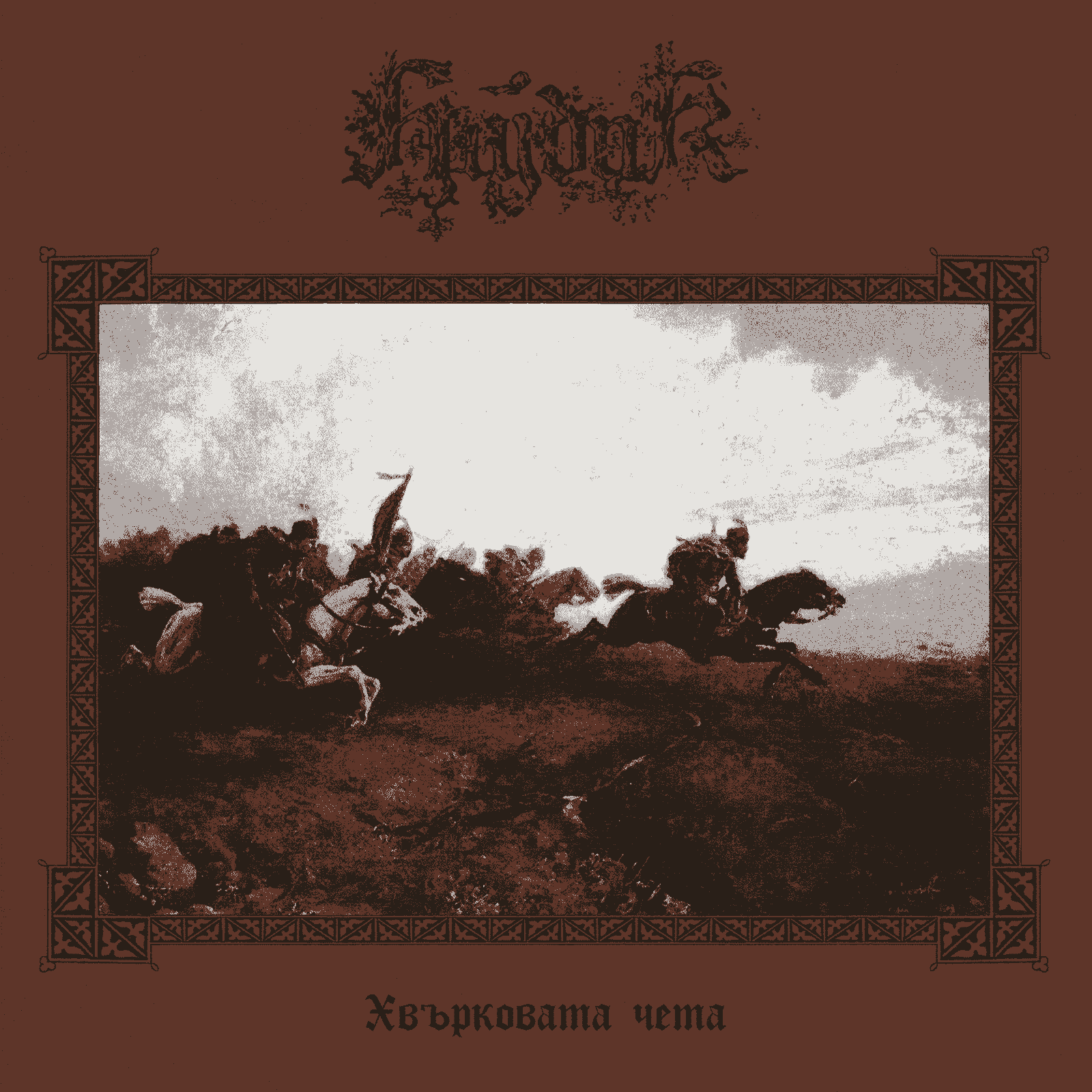
Hajduk is a Bulgarian one‑man raw Black Metal project by Белгун (Belgun), active since 2019, known for historically themed releases. Their 2026 debut full‑length ‘Хвърковата чета’ (Amor Fati) centers on the revolutionary figure Georgi Benkovski and his famed cavalry detachment. The title translates to ‘The Flying Band’ or ‘The Flying Company.’
Hajduk was founded in Sofia in 2019 by the musician Белгун (Belgun). The name ‘Hajduk’ refers to the historical Balkan outlaw‑freedom fighter archetype, bands of rebels resisting Ottoman rule. This historical lens is central to the project’s identity. The term implies mobility, daring, and revolutionary zeal.
There was an initial burst of activity in 2019, three well-received EPs released in the same year, establishing Hajduk’s raw, militant, historically charged aesthetic. Those three EPs were also reviewed on VM-Underground.
Hajduk’s sound is often described as raw Black Metal in the Darkthrone and Burzum lineage: lo‑fi, sharp guitars, primitive atmosphere, melodic narrative flow, using riff changes to mirror historical storytelling. And occasional folk elements, notably female vocals on ‘Три бюлбюла.’
Hajduk is unusual among raw Black Metal projects for its strict historical orientation. As mentioned earlier, this full-length 2026 album recounts the story of Georgi Benkovski, a leader of the 1876 April uprising against the Ottoman Empire, and the legendary Flying Company (Хвърковата чета) he commanded. It’s quite patriotic.
For over 38 minutes Hajduk draws, even within the genre, from a distinctly captivating melodic palette, lending the album a kind of ‘narrative’ flow: as the album progresses, the story of the uprising becomes perceptible in the very changes of the music itself. Brimming with wild pagan energy and revolutionary fever, the fastest and sharpest riffs appear at the album’s opening (‘Кърваво писмо’ and ‘Непобедима’), after which, around the midpoint, the mood grows increasingly somber. Also worth highlighting in this shift of atmosphere is the way a certain melancholy emerges, audible for instance in ‘Дим до бога’, most closely resembling the style of Drudkh’s albums.
The raw Black Metal genre is by nature capable of embodying a warlike revolutionary energy through its extremely sharp/abrasive guitar tones and the occasionally punk-driven rhythms.
The absolute summit of the album arrives with the fifth track, ‘Три бюлбюла’, a moment where Hajduk’s vision crystallizes into something unmistakably its own. What sets this piece apart is the unexpected interplay between the familiar barking‑croaking vocal attack and a layer of folk‑styled female singing, a contrast absent from the earlier tracks. The slightly slower pacing gives this duet room to breathe, and the folk timbre lifts the music into a solemn, almost epic register, a rare accomplishment within such a deliberately abrasive genre. The closest atmospheric parallel might be the liturgical aura of Batushka, yet the resemblance is only superficial; the track’s character is wholly singular, shaped by Hajduk’s own aesthetic logic.
This elevated mood dissolves in the closing composition, where the album shifts toward grief, heroic fatalism, and the slow burn of resignation. Here the band channels a spirit reminiscent of Drudkh’s mournful grandeur: drumless, glacial riff‑waves, airy synthesizer lines, and bitter croaked vocals tinged with a faint Burzum‑like austerity. The final surge of aggressive riffing acts as a last flare of defiance, neatly framing the album’s narrative arc and emotional trajectory. Taken as a whole, Hajduk’s debut full‑length stands as one of the most compelling raw Black Metal releases of recent years, a work of patience, imagination, and conviction, fully justifying the long wait.
Or: in relative simple words: fans of Drudkh, Hate Forest, Temnozor, Walknut, Mrtva Gora, Bane, Plaga and into insanely raw Balkan Black Metal with foreboding and menacing dark folk influences will know exactly what they’re getting!