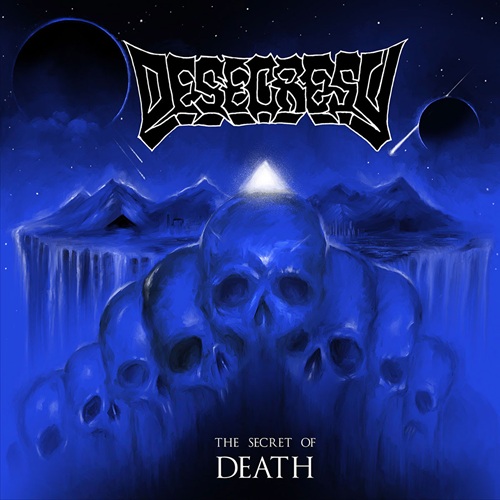
There are albums that do not seem to move forward, but rather sink downward. ‘The Secret of Death’, the new album by Desecresy, belongs to that kind of work where Death Metal does not operate as an explosion, but as pressure. It does not enter through speed or obvious technical display; instead, it descends slowly, like a dark mass moving beneath the earth, pushing from below with a constant, funereal and almost mineral force.
At this point, Desecresy does not seem interested in solving the old dilemma between innovation and consistency. Tommi Grönqvist has long chosen his own path: dense Finnish Death Metal with a strong doom spirit, thick riffs, deep vocals and an atmosphere that weighs as much as the music itself. ‘The Secret of Death’ does not try to present a radical transformation of that language. Its strength lies elsewhere: in persistence, repetition and the way the songs are built like underground chambers connected to one another.
There is something almost cinematic about ‘The Secret of Death’, but not in an epic or grandiose sense. Rather, it sounds like the soundtrack to someone waking up beneath the ground: the body covered in humidity, the mouth full of dirt, the flesh slowly beginning to rot, and yet still carrying an almost instinctive need to emerge back to the surface. Desecresy does not portray death as a clean ending, but as a subterranean agony, a consciousness trapped inside a body that has already begun to decompose.
The album has a very marked identity. Although there are tempo changes and internal movements, the general feeling is that of a heavy march, almost always trapped in a mid-paced pulse, dominated by thick, crushing and percussive riffs. Even when the drums become more dynamic, the weight of the guitars keeps everything anchored to a kind of sepulchral gravity. Desecresy does not run in order to escape the tomb; it digs deeper.
In that sense, ‘The Secret of Death’ connects strongly with a certain Finnish tradition where atmosphere is just as important as the riff. This is not bright, technical or excessively melodic Death Metal. It belongs to another zone: more humid, more closed, more primitive and more funerary. One could think of the distant echo of Rippikoulu, not as a direct copy, but as a spiritual reference: that feeling of ancient heaviness, slow death and sound rising from a forgotten crypt.
The production helps sustain that impression. The album sounds organic, primitive and huge, but not in a polished or modern way. The drums have an almost physical weight, as if every kick were falling onto compacted soil. The guitars do not search for surgical clarity, but for mass, body and depth. Everything seems covered by a layer of dust, moisture and darkness. It is not a beautiful sound; it is the right sound. And in an album like this, that matters much more.
Tommi’s voice is also essential. It does not simply feel like a guttural vocal placed over the music. It sounds like something emerging from beneath the earth’s crust, closer to an underground vibration than to a traditional human performance. It has something dry, deep and impenetrable, without falling into caricatured brutality. It does not seek to dominate through variety, but through presence. Every vocal line seems to push the album further downward.
But ‘The Secret of Death’ does not live only through weight. One of its most interesting elements lies in the leads and in certain melodic apparitions that cross the album like sick lights inside a dark chamber. These melodies are not there to beautify the material or make it more accessible. They work more like flashes of horror, small crystalline and ghostly figures appearing over the rhythmic mass to give the record another dimension. In those moments, Desecresy manages to let the music breathe without losing its funereal character.
There are also some synths and atmospheric details that help separate the movements, almost like fog between different rooms of the same crypt. They are not the main element, but they fulfill their purpose well: expanding the sense of mystery and reinforcing the album’s ritual character. Everything leads to the same place, but the path does not always have exactly the same texture.
Of course, the risk of such an approach is evident. ‘The Secret of Death’ may feel homogeneous to listeners expecting stronger contrasts, immediate hooks or major compositional turns. Some structures move within a recognizable pattern of weight, thick riffing, deep vocals and dark atmosphere. There are moments where the formula becomes familiar quite quickly. However, it would be unfair to judge this album only through surprise. Desecresy does not seem to want to surprise; it wants to submerge.
And for the most part, it succeeds. The album’s duration helps prevent that density from becoming excessive. It does not stretch itself beyond what its own language can sustain. When the leads appear with greater personality, when the drums open small changes in tension, or when the weight becomes almost ceremonial, ‘The Secret of Death’ reaches its strongest moments. There, the band shows that repetition is not always a lack of ideas; sometimes it can be method, obsession and atmosphere.
What makes Desecresy interesting is that the music does not need to behave like a collection of obvious songs. It works more like a complete construction, a continuous descent where each part reinforces the previous one. Some albums try to stand out through a particular track, a memorable chorus or a riff that immediately imposes itself. This one works differently. Its impact accumulates. It stays on the listener through weight, not through brightness.
For this reviewer, ‘The Secret of Death’ ends up being a true little gem within current dark Death Metal. Not because it tries to surprise with major changes, but because it understands perfectly the agony it wants to transmit. There are albums that speak of death through immediate violence; Desecresy does it through sinking, repetition and a heaviness that seems to breathe with difficulty beneath the ground. In that sense, the album feels deeply aligned with its own title: it does not reveal death as spectacle, but as a slow, closed and agonizing presence.
In the end, ‘The Secret of Death’ is deeply coherent with the universe of Desecresy. It does not bring a revolution, but it does not sound empty either. Its identity is very clear: dark Finnish Death Metal, doom-laden, monolithic, with primitive production, abyssal vocals and leads that bring horror without breaking the atmosphere. It may be too closed for some, but for those who enjoy Death Metal that does not only strike, but slowly buries, this album has a lot to offer.
Desecresy does not reveal the secret of death as an answer. It turns it into an underground architecture: heavy, ancient, dark and built for the listener to get lost inside it. For this reviewer, ‘The Secret of Death’ is a funereal little gem, perfectly aligned with the agony it proposes: an album that does not only hit, but drags, buries and leaves you breathing dust in the darkness.