Swedish Death Metal history tends to revolve around a handful of familiar names. Stockholm gave us the rotten, chainsaw-driven sound associated with Entombed, Dismember and Grave, while another generation of bands would take the music towards the more melodic direction that became increasingly prominent during the early nineties. Between these two camps were plenty of bands doing their own thing, often without the recording contracts, distribution or exposure needed to make a lasting impression outside the underground. Altar, from Kumla in Örebro County, was one of those bands. They were active from 1990 to 1995, having spent their earlier years under the name Wortox, and left behind a collection of demos and CD recordings that documented their development without bringing them the recognition enjoyed by some of their contemporaries.
What makes Altar worth revisiting is their approach to Death Metal. Their music was not simply another attempt to reproduce the sound coming out of Stockholm, nor did it follow the increasingly melodic direction that would become associated with Swedish Death Metal later in the decade. There was a more involved side to their writing, with changes in tempo, guitar passages that demanded attention and arrangements that went beyond the usual sequence of fast riffs followed by slower, heavier sections. The band still had the aggression expected from an early nineties Death Metal outfit, but there was more going on beneath the surface. Unfortunately, the scene was moving quickly, and a band could spend several years recording demos and playing its part in the underground without ever getting the break that might have taken it further.
Altar’s story began around 1988, when the group was known as Wortox. Before settling on that name, they had also operated under the names Suffocation and Epidemic, although no recordings were released under either of those earlier identities. Wortox eventually recorded ‘The Unknown’ in December 1989, leaving behind a demo that preceded the band’s change of name in 1990. The original lineup included guitarist Jimmy Lundmark, guitarist Mattias Olsson, bassist Magnus Ernfridsson, vocalist and bassist Magnus Carlsson and drummer Perra Karlsson during different stages of the band’s early existence. Ernfridsson died in 1990, and Carlsson took over bass duties before Wortox became Altar. Karlsson would leave the band, with Fredrik Johansson taking over on drums. These early changes are part of the band’s story, and they show that Altar did not emerge fully formed with the lineup that would carry them through most of their recorded career.
The core lineup eventually settled around Magnus Carlsson on bass and vocals, Jimmy Lundmark on guitar and Fredrik Johansson on drums. Carlsson was an important part of the band’s identity, handling both the low end and the vocal duties during the earlier recording period. Lundmark remained the guitarist throughout Altar’s existence, while Johansson provided the rhythmic foundation from 1990 onwards. Their roles should not be overlooked when discussing the later involvement of other musicians. Altar’s development was not the work of one notable name passing through the group; it was built around these musicians and the material they recorded over several years.
The 1991 demo ‘No Flesh Shall Be Spared’ marked an important stage in that development. Recorded at Gorysound Studios in August 1991, it was produced and mixed with Dan Swanö, who also contributed keyboards and backing vocals to ‘Decapitated’. Swanö was already becoming a familiar figure in the Swedish underground through his work as a musician, producer and recording engineer, and his involvement gave the demo a connection to the wider network of musicians working around the scene. The recording captured Altar at a point when the band was establishing its own musical identity, and the songs would later appear in revised form on their 1992 CD recordings.
The band’s connection with Finland’s Cartilage is another detail worth mentioning. Their split release brought Altar into contact with a neighbouring underground scene, at a time when independent labels, tape trading and split releases were important ways for bands to reach listeners beyond their immediate surroundings. There was no guarantee that a demo would lead to a full-length album or that a split release would bring wider recognition. Much of the underground depended on people finding a tape, exchanging recommendations and passing the music along. Altar’s recorded history belongs to that period, when a band’s reputation could remain concentrated among collectors and listeners who were prepared to look beyond the better-known releases.
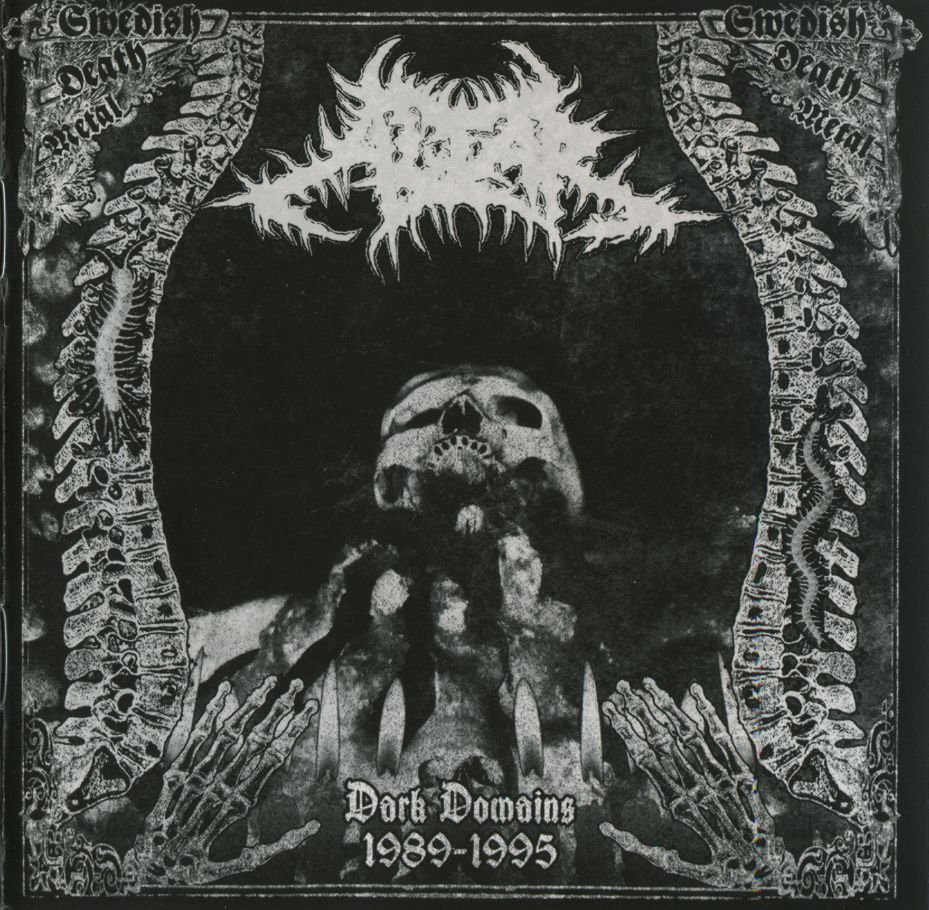
The 2012 compilation ‘Dark Domains’ gathers 17 tracks from Altar’s 1989 to 1995 period, bringing together material that had previously appeared on demos and CD recordings. Released through Singapore’s Konqueror Records in cooperation with Pulverised Records, the collection was remastered by Dan Swanö at Unisound Studio. It also includes archival photographs and new artwork by Juanjo Castellano. For anyone who missed the original recordings, the compilation offers a chance to hear the band’s development without having to track down separate releases from different years.
Konqueror Records deserves credit for its involvement here. As a Singaporean label, Konqueror’s contribution to ‘Dark Domains’ is a reminder that our local underground has never been limited to supporting bands from Singapore alone. Working alongside Pulverised Records, the label helped bring Altar’s recordings back into circulation, giving a band from the less frequently discussed side of the Swedish scene another chance to be heard. It is the sort of release that makes sense for a label interested in the older corners of Death Metal, where a band’s recorded history can otherwise remain scattered across demos and obscure releases. Altar might not have been one of the first names mentioned in every discussion of Swedish Death Metal, but their material was worth preserving, and this collaboration made that possible.
The first five tracks come from the 1992 CD recordings, beginning with ‘Nothing Human’, ‘Lifeless Passion’, ‘Daymare / A Message from the Grave’, ‘Decapitated’ and ‘Ex Oblivione’. This material gives a good impression of what Altar was capable of at the time. The guitar work moves between direct, aggressive riffs and more involved passages, while the rhythm section keeps the music tight without making every song sound as though it is racing towards the same destination. There is a noticeable interest in arrangement, with changes in pace giving the riffs room to develop. The songs retain the weight and harshness of early Death Metal, but the writing is not confined to a single formula.
‘Decapitated’ is particularly interesting because Swanö’s contribution goes beyond his work behind the recording desk. His keyboards and backing vocals appear on this version, adding another detail to a song that also appears earlier in the band’s recorded history. It is a small but worthwhile piece of information for listeners who follow Swanö’s work across the Swedish underground. The track itself sits comfortably within Altar’s approach, with the guitar work carrying the music while the rhythm section gives the arrangement its momentum.
‘Ex Oblivione’ also deserves attention in the context of the band’s connection with Cartilage. The split release remains a useful reference point for collectors interested in the less familiar exchanges between the Swedish and Finnish underground scenes. Altar’s material does not rely entirely on the raw, chainsaw-heavy guitar sound that became synonymous with Stockholm Death Metal. Their riffs have a more intricate character, and the arrangements allow for shifts in pace that keep the music moving without losing its aggression. This difference does not make them more important than the bands around them, but it does give their recordings a distinct place within the wider scene.
The three tracks from the 1993 demo, ‘Sleeping Prophet’, ‘Floodgates of Emotions’ and ‘Darklight’, show the band continuing to develop. Fredrik Eriksson joined on guitar for this period, giving the lineup a second guitarist alongside Lundmark. The material has a more involved feel, with the guitars exploring melodic passages and changes in direction while retaining the heavier foundation of the earlier recordings. These songs do not represent a complete break from Altar’s beginnings, but they show a band continuing to work on its arrangements rather than simply repeating the same approach. The additional guitar gives the material more room to move, and the differences become clearer when these tracks are heard alongside the 1992 recordings.
By 1994, the lineup had changed again. Johan Bülow, associated with Fallen Angel and other Swedish underground bands, was involved on guitar, while Mieszko Talarczyk took over vocal duties for the two demo tracks ‘Violent Acts’ and ‘Days Forever Grey’. This is where Altar’s history intersects with one of the most significant names in Swedish Grindcore. Talarczyk would become widely known as the vocalist and guitarist of Nasum, a band that went on to establish an international following through its ferocious blend of Grindcore and Extreme Metal. His work with Nasum would eventually overshadow much of his earlier musical history, but his time with Altar belongs to the years before that recognition arrived.
For listeners who know Talarczyk primarily through Nasum, hearing him on these two Altar recordings provides a different perspective on his career. He was working within a Death Metal setting here, rather than the rapid-fire Grindcore that would later define much of his musical output. The contrast is worth hearing, although the focus should remain on Altar themselves. Lundmark, Carlsson and Johansson had already established the band’s foundation, and the changing guitar lineup and Talarczyk’s arrival represent another stage in a career that was nearing its end. These recordings are interesting not simply because of the Nasum connection, but because they document what Altar was doing during its final years.
Talarczyk’s involvement also gives the compilation a more personal historical connection. He died in the Indian Ocean tsunami disaster in December 2004, and ‘Dark Domains’ is dedicated to his memory. That dedication is fitting, given his place in Altar’s final period and the much wider influence he would later have through Nasum. It is important, however, not to let this connection become the entire story. Altar had their own identity, their own recordings and their own place in the Swedish underground, and the material gathered here deserves to be heard on those terms as well.
The compilation then moves back to the 1991 ‘No Flesh Shall Be Spared’ demo, with ‘Severed on the Attic’, ‘Decapitated’, ‘Hallucinations’ and ‘No Flesh…’. Hearing these tracks after the later recordings changes the perspective somewhat. The demo has the rougher character expected from an early recording, but the basic ingredients of Altar’s sound are already present. The riffs move between heavier passages and quicker attacks, and the arrangements show an interest in keeping the songs from becoming too predictable. There is a directness to the performances that suits the material, and the recordings provide a useful point of comparison with the later versions included on the same disc.
The earlier version of ‘Decapitated’ is also worth noting because of Swanö’s contribution to the recording. His involvement with Altar is one of those connections that illustrates how closely linked musicians and recording studios were within the Swedish underground. Swanö’s work extended across numerous bands and projects, and his presence on this demo places Altar within that wider network without suggesting that the band depended on his name to establish its own identity. Their material stands on its own, while his contribution is a welcome part of the recording history.
The 1995 instrumental demo brings the collection towards the end of Altar’s existence, followed by the 1992 CD versions of ‘Severed on the Attic’ and ‘No Flesh…’. The inclusion of the repeated songs is useful because it allows the listener to compare the earlier demo performances with the later recordings. The differences in presentation and performance make the band’s development easier to hear, and the songs provide a link between the beginning and middle of their recorded history. The track sequence is not chronological, moving from the later demos back to the 1991 material before ending with the 1992 versions, but the repeated compositions give the collection a clear point of comparison.
Swanö’s remastering helps the instruments come through more clearly without stripping away the character of the original recordings. The guitar work and rhythm section are easier to follow, and the differences between the demo material and the later CD recordings remain apparent. This matters on a compilation covering several years of activity, since the tracks were not all recorded under identical conditions. The older material still sounds like a product of its time, rather than having been polished into something that no longer resembles the original demos.
The photographs and archival material also help give the release a connection to the band beyond the music. Altar’s career was short, and their recordings were spread across different releases that could be difficult to find years later. Bringing them together on ‘Dark Domains’ makes the band’s recorded history easier to follow, while the individual versions of selected songs provide a chance to hear how the material changed. For collectors interested in Swedish Death Metal beyond the familiar names, this is a useful way to revisit a band whose story might otherwise remain scattered across old demos and split releases.
‘Dark Domains: 1989–1995’ brings together the main stages of Altar’s recorded career, from the early demo material through the 1992 CD recordings, the 1993 and 1994 demos and the final instrumental. The lineup changes, the contributions of Dan Swanö and Mieszko Talarczyk and the inclusion of different versions of selected songs all give the compilation plenty to explore. Altar did not have the long career or discography that would make them an obvious choice in every discussion of Swedish Death Metal, but these recordings show a band that developed its own approach during a period when the scene was moving in several directions at once. With Konqueror Records and Pulverised Records bringing the material together, ‘Dark Domains’ gives Altar’s recorded history a place where it can be heard as a whole, rather than leaving it to collectors to piece together one demo at a time.
This release truly deserves a vinyl reissue!
