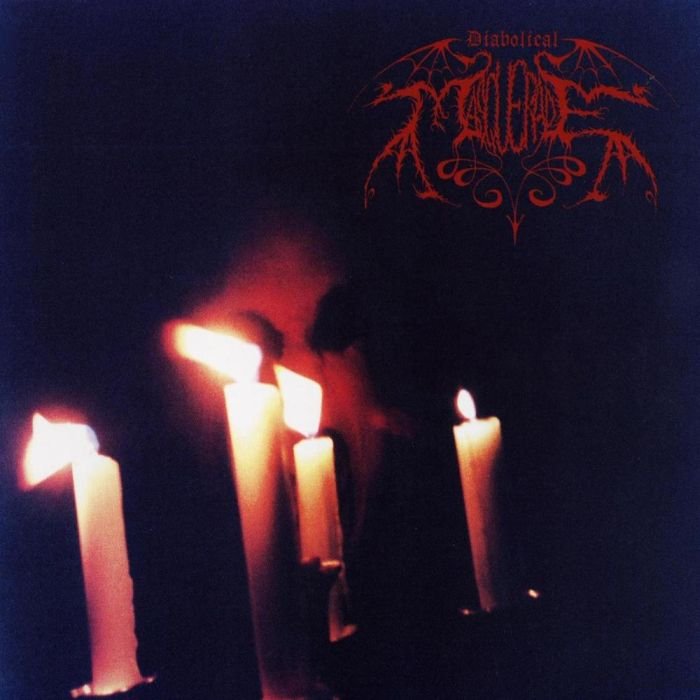
There was always something slightly mysterious about Diabolical Masquerade. Even the name suggested that this was going to be different from the usual Swedish Black Metal project, and ‘Ravendusk in My Heart’ certainly lived up to that feeling when it appeared through Adipocere Records in 1996. Behind the name was Anders ‘Blackheim’ Nyström of Katatonia, who created the entire project around his own ideas and took care of guitars, bass, vocals, keyboards, programming, effects, and lyrics. It was a very personal piece of work, but the record would also benefit enormously from the involvement of Dan Swanö.
Blackheim had already established himself through Katatonia, but Diabolical Masquerade gave him a completely different space to work in. The music still carries the cold guitar sound associated with Swedish Black Metal, yet there is much more going on beneath it. Keyboards appear in unexpected places, melodies move into strange territory, and the programmed drums give the music a mechanical quality that actually suits the project’s dark fantasy atmosphere. The songs feel deliberately constructed rather than simply performed, and that makes the album quite different from many of the rawer releases coming out of Sweden around the same time.
Dan Swanö’s contribution deserves particular attention because he was deeply involved with the actual construction of the recording. At Unisound Studios, he handled engineering, mixing, and production, as well as the drum programming and additional keyboards. He also provided additional vocals on ‘Under the Banner of the Sentinel’. This was not simply a case of bringing in a respected name to polish the finished product. Swanö was working directly with the material and helping shape how Blackheim’s ideas translated into sound. His studio experience gives the album considerable depth, especially in the way the guitars, keyboards, and programmed drums occupy their own spaces.
The production has aged remarkably well for something recorded in September 1995. The guitars retain enough bite to keep the Black Metal foundation intact, while the keyboards and effects are clearly audible without turning the whole thing into an overly polished production. The programmed percussion also makes sense within the album’s unusual character. It would have been easy for the mechanical rhythm section to make the music feel lifeless, but instead, it adds to the strange, almost artificial atmosphere surrounding the songs.
‘Ravendusk in My Heart’ also has a strong conceptual identity. Titles such as ‘The Castle of Blackheim’, ‘Blackheim’s Quest to Bring Back the Stolen Autumn’, and ‘Blackheim’s Forest Kept the Season Forever’ make it obvious that Blackheim was creating his own dark landscape rather than simply writing another collection of songs. The music follows that idea naturally. There are aggressive passages, but there are also quieter stretches, instrumental sections, and melodic movements that make the album feel like a journey through this imaginary world.
‘The Castle of Blackheim’ establishes the mood with its combination of sharp guitars and keyboards, while ‘Blackheim’s Quest to Bring Back the Stolen Autumn’ stretches the atmosphere further. ‘Beyond the Spiritual Moon’ is a short instrumental piece that breaks up the heavier material, and ‘The Sphere in Blackheim’s Shrine’ brings back the darker intensity. ‘Under the Banner of the Sentinel’ is particularly interesting with Swanö’s additional vocal contribution, while the later material continues developing the album’s fantasy-driven atmosphere rather than simply repeating the same musical idea.
One thing that stands out when looking at the Swedish underground of this era is how willing musicians were to operate in completely different musical worlds. Someone could be involved with Death Metal, Black Metal, Doom Metal, or more experimental material without treating those boundaries as permanent. Swanö was one of the clearest examples of this, and his involvement here makes perfect sense when you hear how much attention has been given to the studio side of the album. Blackheim was creating the vision, while Swanö understood how to give that vision a convincing physical sound.
I remember these kinds of records being far from common conversation in Singapore during those years. The bigger names were easier to encounter, but projects like Diabolical Masquerade required a little more curiosity. When something unusual appeared in a shop, you could spend quite a bit of time studying the cover and information before deciding whether it was worth taking a chance. There was also something exciting about recognizing a musician from another release and then discovering an entirely different side of what they were capable of. Diabolical Masquerade was exactly that kind of discovery for me.
‘Ravendusk in My Heart’ sits in an interesting place within the 1990s Swedish underground because it has the recognizable roots of Swedish Black Metal without being restricted by them. Blackheim’s songwriting gives the project its personality, while Swanö’s work behind the recording makes the strange arrangements sound deliberate and complete. It is atmospheric without losing its darker edge, melodic without becoming soft, and theatrical without turning into something detached from the underground that produced it.
For me, this is one of those 1990s records where the people involved are almost as fascinating as the music itself. Blackheim took the opportunity to create something that existed outside Katatonia, and Swanö brought his considerable musical and studio experience into the equation. The result is an album with its own world, its own rules, and a very recognizable personality, which is exactly why ‘Ravendusk in My Heart’ has remained such an interesting piece of the Swedish underground.