When talking about the early Greek Black Metal scene, Necromantia deserve a place alongside the names that helped establish its identity, but they were never a band that could be described simply by comparing them with their contemporaries. Formed in Athens in late 1989 by George Zacharopoulos, better known as Magus Wampyr Daoloth, and Makis Kanakaris, who took the name Baron Blood, Necromantia came from a circle of musicians who were shaping the sound of Greek Extreme Metal during those formative years. Alongside Rotting Christ and Varathron, they helped establish a scene with its own character, drawing on occultism, mythology and a darker, more ritualistic approach to Black Metal. The musicians were not strangers to one another’s activities, and their involvement in different bands and projects helped create a tightly connected underground where ideas and personnel crossed paths.
Magus was particularly active beyond Necromantia. Under the name Morbid, he contributed to Rotting Christ during the period that produced ‘Passage to Arcturo’, ‘Thy Mighty Contract’ and ‘Non Serviam’. He also formed Thou Art Lord with Sakis Tolis of Rotting Christ, while other projects and collaborations included N.A.O.S., Diabolos Rising and Raism. His work as a musician and producer made him an important figure in the Greek underground, and his involvement went beyond simply recording albums. Baron Blood, meanwhile, remained Necromantia’s other founding pillar until his death in 2019. His eight-string bass was central to the band’s identity, allowing Necromantia to build their sound without relying on the usual rhythm guitar. The debut also featured Dave P. on lead guitar, Inferno on keyboards and piano and Slow Death on backing vocals, with Nick Adams providing drums and Yiannis Papayiannis contributing tabla and percussion. Cabeza and Gothmog added backing vocals to ‘Les Litanies de Satan’. Released through Osmose Productions in 1993, ‘Crossing the Fiery Path’ was the result of musicians who had a clear idea of what they wanted to achieve rather than another band trying to imitate whatever was popular at the time.
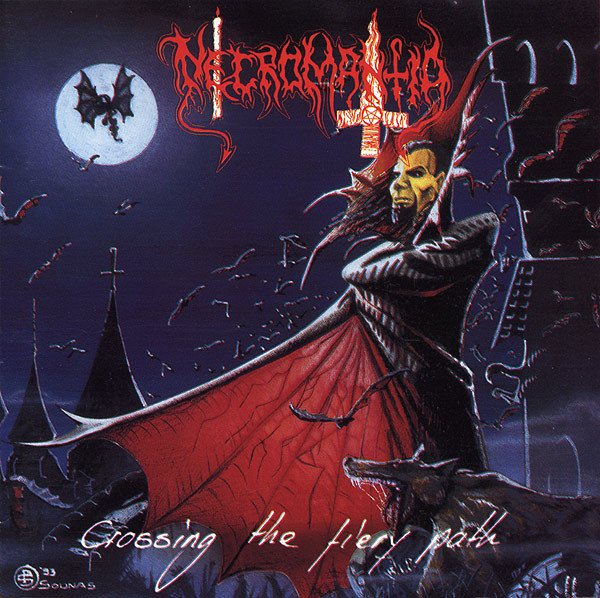
The artwork is another part of the experience that deserves attention. This was the kind of cover you could spend hours staring at while the album played, picking out details and imagining what might be happening beyond the scene in front of you. The image was adapted from the cover of Van Richten’s Guide to Vampires, a Dungeons & Dragons book, but you did not need to know its origins to get lost in it. The cover gave the mind somewhere to begin, while the rest of the story belonged to you. You could imagine an old castle hidden somewhere beyond the reach of ordinary people, a figure carrying knowledge that should never have been uncovered or a journey that would take someone into a place from which there was no easy return. You might listen to the same song the next day and invent an entirely different story. That was part of the pleasure of owning these records, especially when there was no internet ready to explain every image and detail. You had the cover, the music and your imagination, and you could spend an entire evening wandering through the world they seemed to open up. The artwork for ‘Crossing the Fiery Path’ has that connection to fantasy illustration, but the music gives it a darker dimension, leaving room for the listener to build a whole mythology around the album.
Musically, ‘The Vampire Lord Speaks…’ sets the scene before ‘The Warlock’ takes over with its lengthy composition. Necromantia are not in a hurry to get from one riff to the next. The music develops through changing passages, keyboards and lead guitar, with the bass providing a character of its own rather than simply following the rhythm guitar. Baron Blood’s eight-string instrument gives the music a deep, unusual foundation, and the absence of conventional rhythm guitar is not just a novelty. It is part of the band’s musical language. The keyboards and piano are woven into the compositions, helping shape the mood while the bass and lead guitar move the music forward. Magus’s vocals sit within this arrangement without needing to dominate every moment, allowing the music itself to carry much of the atmosphere. There is a theatrical quality to the longer pieces, but the album remains rooted in Metal rather than drifting into soundtrack territory.
‘Last Song for Valdezie’ gives the album an instrumental passage, while ‘Unchaining the Wolf (At War…)’ brings the heavier side of Necromantia back into focus. The short ‘Intro’ leads into ‘Les Litanies de Satan’, a piece based on Charles Baudelaire’s poem, with additional voices and percussion adding another dimension to the performance. The band’s interest in occult themes is clear, but the appeal lies in how they use the material to shape their music rather than relying on lyrical subject matter alone. The added percussion also shows that Necromantia were willing to bring instruments outside the standard Metal setup into their arrangements. This was part of what distinguished them from many other Black Metal bands of the period. They could take a composition somewhere unexpected without losing the dark character that held the album together.
‘Lord of the Abyss’ is particularly interesting because it was recorded back in December 1991, well before the main album sessions in spring 1993. It provides a glimpse into an earlier stage of the band’s development, while ‘Tribes of the Moon’ closes the original album. Across these songs, the eight-string bass remains an important part of what makes Necromantia sound different. The album does not depend on relentless speed or the constant repetition of familiar Black Metal patterns. Its compositions are built around atmosphere, unusual instrumental choices and a willingness to let the music take its time. This approach would remain a defining part of Necromantia’s identity, even as the band’s arrangements and songwriting continued to develop on their subsequent releases.
‘Crossing the Fiery Path’ remains an important release from the Greek underground, not just because of the period in which it appeared, but because Necromantia had a musical identity that was immediately recognisable as their own. Magus Wampyr Daoloth and Baron Blood brought together their ideas and experience to create something that stood apart from the usual guitar-led approach, while the musicians around them helped give the compositions their particular shape. The artwork, the occult themes and the unusual instrumentation all belong to the same world. You can listen closely to the arrangements, or simply let the music play while your eyes return to the cover and your imagination starts filling in the gaps again. For those of us who remember spending hours with physical releases, studying the artwork and making up stories that nobody else needed to know about, that connection between the music and the image is part of what makes an album like this so rewarding to revisit.