By the time Necromantia released ‘Scarlet Evil Witching Black’ through Osmose Productions in 1995, the band had already established itself as one of the more unusual names to emerge from the Greek Black Metal underground. Formed in Athens in 1989 by Magus Wampyr Daoloth and Baron Blood, Necromantia belonged to the same fertile circle of musicians that helped shape the early Greek scene alongside Rotting Christ, Varathron and other bands developing their own interpretations of Black Metal. Magus, whose real name is George Zacharopoulos, was also known as Morbid during his work with Rotting Christ, contributing to the band’s early recordings and playing a part in the development of the Greek underground sound. His involvement with Thou Art Lord, alongside Sakis Tolis of Rotting Christ, further connected him to that network of musicians who were active across several bands and projects. Magus was not simply a vocalist and bassist in Necromantia, but one of the key figures behind the band’s direction, with interests that extended into production, occult subjects and other musical collaborations.
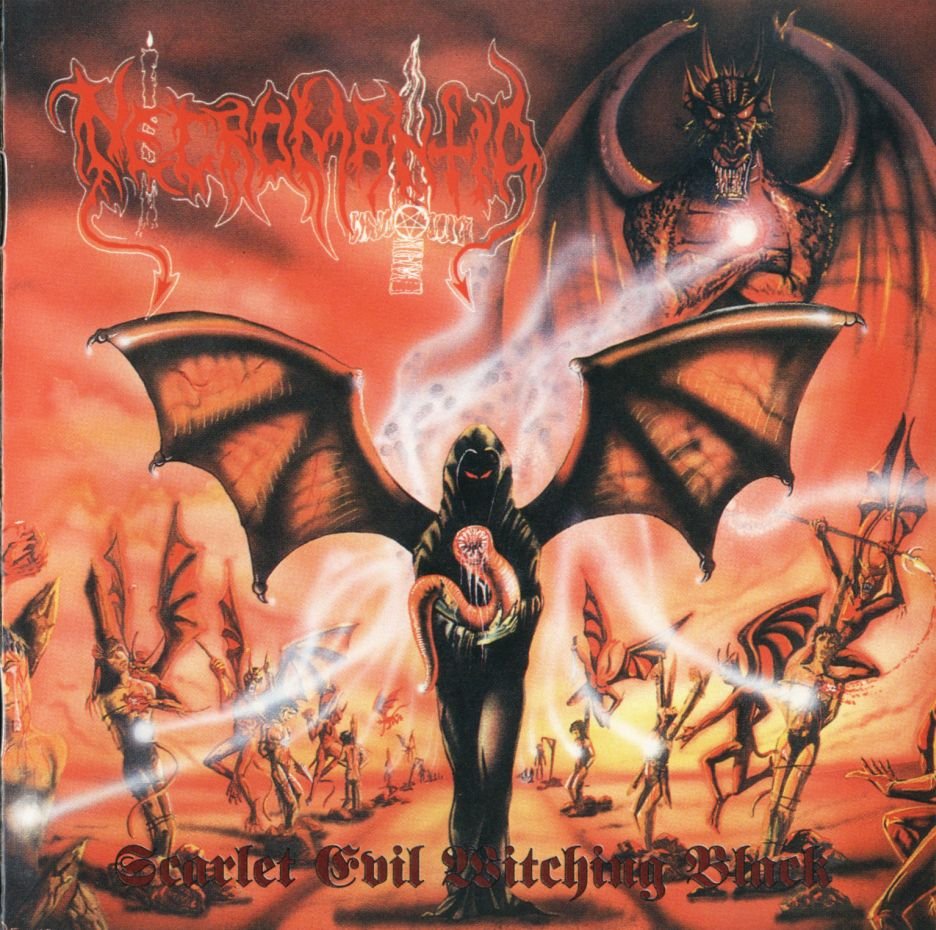
Baron Blood was the other central figure, and his eight-string bass remained one of the most recognisable features of Necromantia’s sound. The band did not use rhythm guitar on ‘Scarlet Evil Witching Black’, a decision that gave the bass an even greater role in the arrangements. David handled the lead and acoustic guitar parts, while Inferno contributed keyboards and piano. George Panou played drums, and Yiannis, known as The Worshipper of Pan, contributed saxophone and percussion. The album was recorded and mixed at Sin Ena Studio between March and June 1995, with digital mastering carried out at Zircon Mastering House. Christos Hajistamou handled the engineering and mastering, while Panos Sounas created the cover artwork. Andrea Meyer wrote the lyrics for ‘The Arcane Light of Hecate’, adding another name from the wider European underground to a record that brought together musicians and collaborators with their own histories and interests.
The artwork is a big part of what makes an album like ‘Scarlet Evil Witching Black’ memorable. The title itself is enough to set the imagination moving, and the cover gives you something to return to every time you put the record on. This was the sort of album you could leave playing while spending ages staring at the artwork, looking for details and imagining what might lie beyond the scene in front of you. A name like ‘Scarlet Evil Witching Black’ could send the mind in several directions at once. You could imagine a hidden gathering taking place in some ancient ruin, a sorceress guarding knowledge that had been passed down through generations, or a traveller who had wandered too far into a world that was never meant for ordinary people. The music would continue playing while the story in your head grew, and before long you might have an entire tale that had nothing to do with any official explanation of the artwork. That was the beauty of physical albums in those days. You did not need someone online to tell you what every image meant. You had the cover in your hands, the music coming through the speakers, and hours to let your imagination take over. It was never just about looking at an image once and moving on to the next record. You could return to the same artwork repeatedly and find yourself imagining something different each time.
Musically, ‘Scarlet Evil Witching Black’ develops the ideas introduced on ‘Crossing the Fiery Path’, but the compositions have a fuller and more elaborate character. ‘Devilskin’ opens the album with Necromantia’s familiar combination of bass-driven heaviness, lead guitar, keyboards and Magus’s vocals. The eight-string bass is not a novelty added to attract attention; it forms the foundation of the music, allowing the band to build arrangements that do not depend on the conventional rhythm guitar. David’s lead work provides another voice within the compositions, while Inferno’s keyboards and piano contribute to the dark, theatrical atmosphere without turning the album into a collection of background effects. The music moves between heavier passages and more elaborate sections, and the arrangements have enough room to develop their own character instead of following a single formula throughout.
‘Black Mirror’ continues the album’s occult atmosphere, before the two-part ‘Pretender to the Throne’ becomes one of its defining features. ‘Opus I: The Usurper’s Spawn’ and ‘Opus II: Battle at the Netherworld’ frame the album with a connected narrative, moving from the first part into a longer second chapter. This approach suits Necromantia’s interest in elaborate themes and compositions that feel as though they belong to a larger story. The band is not simply repeating a riff until the song ends; the music changes direction, with keyboards and lead guitar contributing to the unfolding drama. The second part is especially notable for its use of a melody associated with Richard Wagner’s opera Die Walküre, bringing a classical reference into the band’s own dark musical world. Necromantia were willing to draw from sources beyond Metal, and they used those influences as part of their arrangements rather than treating them as decoration.
‘The Arcane Light of Hecate’ brings the album’s mythological and occult interests to the foreground. Hecate, the ancient Greek goddess associated with magic, witchcraft and crossroads, is a fitting subject for a band whose identity was closely tied to occult themes. Andrea Meyer’s contribution to the lyrics also makes this track worth noting when considering the people involved in the album. ‘Scarlet Witching Dreams’ and ‘The Serpent and the Pentagram’ continue the dark atmosphere, with the latter drawing on familiar occult symbolism while remaining part of Necromantia’s own musical language. The saxophone and percussion contributions add colour to the album’s arrangements, helping distinguish it from Black Metal records that rely almost entirely on the standard guitar, bass and drum combination. These elements are integrated into the music rather than appearing as isolated curiosities, and that willingness to experiment is one of the reasons Necromantia stood apart from many of their contemporaries.
‘Spiritdance’ closes the original eight-track album, bringing the record to an end after its shifting compositions and elaborate themes. By this point, the band’s approach is clear: the bass is central, the lead guitar has room to move, and the keyboards help shape the atmosphere without overwhelming the Metal itself. Magus and Baron Blood had developed a sound that was recognisably Necromantia, and ‘Scarlet Evil Witching Black’ shows them pushing that identity further than on their debut. The music has a grander and more developed character, but it retains the unusual instrumental arrangement that made the band distinctive in the first place.
‘Scarlet Evil Witching Black’ stands as a strong example of what made the Greek Black Metal scene so interesting during the 1990s. While different bands from the region developed their own approaches, Necromantia followed a path that placed unusual instrumentation, occult themes and extended compositions at the centre of their sound. Magus Wampyr Daoloth’s activities with Rotting Christ, Thou Art Lord and other projects connect the album to the wider history of the scene, while Baron Blood’s eight-string bass remains an essential part of its identity. The artwork and the music belong together, giving the listener a world to explore rather than just a collection of songs. You can spend time following the arrangements and picking out the different instrumental parts, then find yourself staring at the cover again, imagining another story unfolding somewhere beyond its borders. For those of us who grew up with physical releases, that was one of the pleasures of discovering albums like this. The record stayed with you long after the music stopped, because the images and stories you built around it were your own.
