
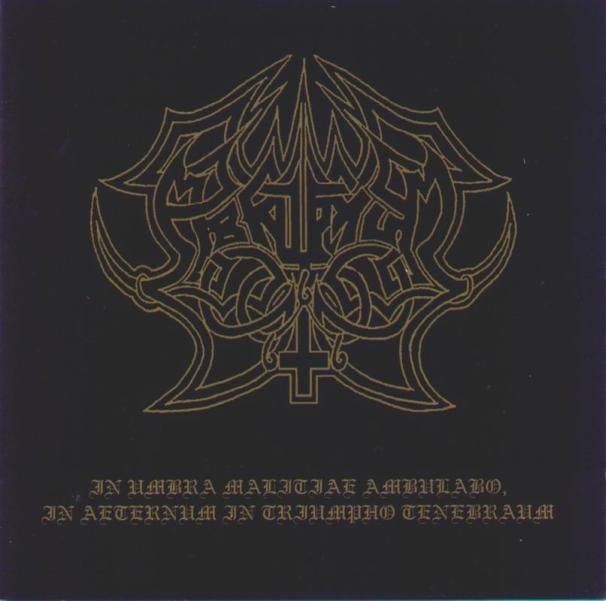
Imagine being left alone in a building after everyone has gone home, with no lights, no voices and no indication of how long you have been there. Somewhere beyond the room, something makes a sound. You cannot tell whether it is coming closer or moving away, and after a while you begin to question whether it was ever there in the first place. This is the sort of unease that Abruptum’s second album creates, except that It and Evil do not offer the relief of a door opening or daylight appearing. ‘In Umbra Malitiae Ambulabo, in Aeternum in Triumpho Tenebrarum’ was released through Euronymous’ Deathlike Silence Productions on 1 April 1994, but the sole composition occupying its sixty minutes had been recorded in May 1993. Its Latin title translates roughly as walking in the shadow of evil, forever in dark triumph, and the music takes that idea somewhere far removed from the usual Black Metal imagery.
Tony ‘It’ Särkkä and Morgan ‘Evil’ Håkansson had already established that Abruptum was not interested in following the same path as the Swedish Black Metal bands surrounding them. On the debut, ‘Obscuritatem Advoco Amplectere Me’, their unconventional approach was still developing. Here, the two musicians take that foundation and stretch it across one continuous composition, allowing long passages of dissonance, distorted instrumentation and unearthly vocal sounds to occupy the space where conventional songwriting would normally provide structure. Evil handles guitars, drums, piano and noise, while It contributes vocals, guitars, bass, drums and violin. Dan Swanö once again handled the engineering, connecting this recording to the early Swedish underground’s network of musicians and recording facilities.
The disturbing thing about this album is how little it offers the listener to hold on to. There are no clearly defined verses or choruses, no familiar sequence of riffs to anticipate and no dependable rhythmic pattern that makes the music feel secure. The guitar sounds seem to surface from a distance, sometimes resembling fragments of a recognisable metal composition before dissolving into dissonance. Percussion appears within the broader mass of sound, but it rarely provides the stable foundation expected from a metal drummer. Instead, the different elements seem to occupy their own spaces, occasionally colliding before disappearing into the surrounding noise.
It’s vocal performances are central to the experience. Rather than delivering conventional Black Metal shrieks or growls in clearly organised phrases, his voice becomes another instrument within the composition. There are distant cries, harsh vocalisations and passages that sound almost indistinguishable from the other distorted elements. Their effect depends partly on the recording itself. The sounds seem to come from different distances, with some buried deep in the mix and others suddenly emerging into focus. You are left listening for changes that may or may not mean anything, which makes the experience strangely absorbing despite the absence of familiar musical landmarks.
The piano and violin credits are particularly intriguing because they suggest a wider palette than the guitars and noise might initially imply. These instruments are not used to provide elegant melodies or moments of conventional beauty. Instead, they become part of Abruptum’s refusal to keep the composition within the boundaries of Black Metal. The possibility of an instrument traditionally associated with more structured music appearing within such a disordered arrangement adds another layer of uncertainty. You cannot simply identify the instruments, understand their roles and move on. Their sounds have to be considered in relation to everything happening around them.
There is also a historical detail worth remembering about the album’s release. Euronymous was willing to put Abruptum on the same Deathlike Silence Productions catalogue that carried releases by Mayhem, Burzum, Sigh and Enslaved. These bands were not making identical music, but the label brought together projects that pursued their own interpretations of Extreme Metal rather than following a single formula. Abruptum occupied a particularly unusual position within that group. Where many Black Metal bands relied on aggressive riffs and memorable compositions, It and Evil were prepared to abandon those familiar elements for long stretches of noise and dissonance. Euronymous’ support helped bring this uncompromising project to an audience that might otherwise never have encountered it.
The original CD presents the entire composition as one track, running for approximately an hour. Later vinyl editions divided it into two parts to accommodate the physical format. That distinction is more than a matter of tracklisting. On the original CD, the absence of a track break reinforces the feeling that the listener has entered a single uninterrupted sound world. There is no convenient point at which to pause and reset the experience. The vinyl division introduces a practical boundary that was not part of the original CD presentation, although the music itself remains the same extended composition.
Abruptum’s mythology has always been accompanied by stories about the musicians and the circumstances surrounding their recordings. The band’s presentation encouraged speculation, and the early Black Metal underground was hardly short of people willing to repeat the most sensational accounts. It is worth separating those stories from what can actually be heard on the record. ‘In Umbra Malitiae Ambulabo’ does not require any elaborate tale to explain its effect. Its unusual structure, murky sound and unsettling vocal performances already distinguish it from almost everything else released within the genre at the time. The recording itself is the most convincing evidence of how far It and Evil were willing to depart from conventional musical expectations.
What makes this album different from its predecessor is not simply that it lasts longer. The extended form changes the listener’s relationship with the music. On a conventional Black Metal album, even the most repetitive passage usually points towards a change, a new riff or the return of an established theme. Abruptum removes much of that reassurance. Sounds appear without necessarily leading anywhere, and the passage of time becomes part of the experience. You may find yourself waiting for a recognisable structure to emerge, only to realise that the music has no obligation to provide one.
‘In Umbra Malitiae Ambulabo, in Aeternum in Triumpho Tenebrarum’ remains one of the more extreme departures from conventional Black Metal to emerge from the early Swedish underground. It is not an album that can be judged by the usual standards of riff writing, technical performance or memorable hooks. Its identity lies in the relationship between its sounds and the deliberate refusal to organise them into something familiar. It and Evil created a recording that asks for patience while offering very little comfort in return. Even after the final sound disappears, the strange thing is how difficult it can be to decide whether the experience has actually come to an end.
