
Before Abruptum became one of the strangest names associated with the Swedish Black Metal underground, Tony Särkkä, better known as It, was already developing his own ideas about what extreme music should sound like. Born in Finspång, Sweden, on 15 December 1972, Tony was involved in music from his early teens, and his friendship with future Edge of Sanity mastermind Dan Swanö dates back to their schooldays. The two came from different musical backgrounds, but their friendship eventually brought them together in bands and recording projects. Tony’s early band Witches Sabbath was one of his first outlets for his interest in darker Heavy Metal, while his later work with Abruptum would take him into territory that was difficult to compare with anything else happening in Sweden at the time.
Abruptum’s origins go back to the late eighties, although the project’s first recordings appeared in 1990. Tony wanted to create music that conveyed a sense of evil and unease rather than simply playing fast riffs and adopting the familiar imagery of Extreme Metal. The first self-titled demo and ‘The Satanist Tunes’, both recorded in 1990, document the early development of that idea. The original lineup included vocalist All, also known as Jim Berger, and bassist Ext, alongside Tony. All handled the vocals on much of this early material, while Tony was responsible for the songwriting and much of the instrumental work. The band’s sound at this stage still retained recognisable Death Metal and Doom Metal elements, but the arrangements were already moving towards something more disjointed and unsettling.
One of the more interesting connections in Abruptum’s early history is Dan Swanö’s involvement in the recording process. Swanö recorded the first demo at Gorysound, his home recording setup, and has spoken about using an Alesis Microverb Ii to push the reverb to extremes. This was not an attempt to produce a clean, powerful metal recording. The effect was to stretch the instruments into a murky mass of echoes, making the music sound as though it were coming from somewhere far removed from an ordinary rehearsal room. Swanö later recalled that Abruptum’s sparse playing suited this treatment particularly well. When the guitars moved slowly and the drums kept repeating their patterns, the reverb had room to dominate the recording. It is a fascinating example of a production decision becoming part of a band’s identity.
The next stage came with the ‘Evil’ EP in 1991. By this point, Morgan Håkansson of Marduk, known within Abruptum as Evil, had joined the project, taking on guitar duties while Tony continued with the vocals and instruments. All was no longer part of the lineup. The partnership between It and Evil became central to Abruptum’s development, although their musical direction would eventually move far beyond the short compositions collected on ‘Evil Genius’. Morgan’s involvement is particularly interesting because his work with Marduk was associated with a much more direct and aggressive form of Black Metal. Abruptum offered him a very different outlet, one in which repetition, distortion and uncomfortable stretches of sound mattered more than conventional riff construction.
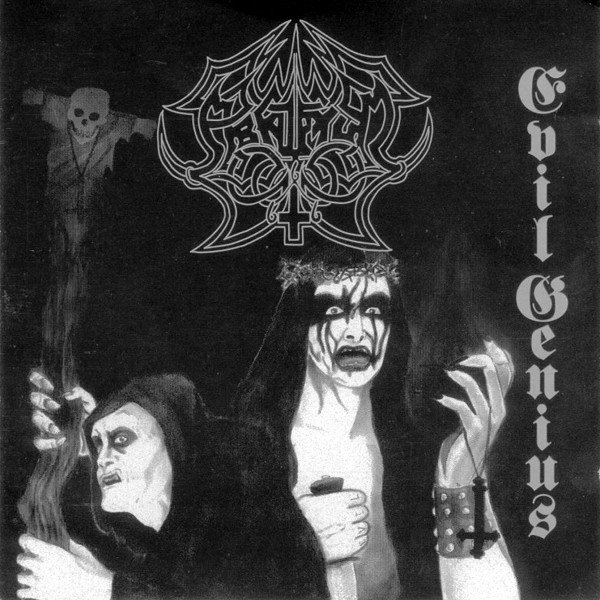
Released by Hellspawn Records in 1995, ‘Evil Genius’ gathers material from those formative years into one collection. It brings together the first two demos and the original ‘Evil’ EP, allowing listeners to hear the project’s development across its earliest recordings. It is important to understand that this is a compilation rather than a new studio album. The recordings were made several years before its release, and the differences between them are part of what makes the collection worth hearing. The original compilation also leaves out the ‘Orchestra of Dark’ demo, so it is not a complete document of every recording from that period.
The opening tracks, taken from the first demo, reveal a band that still had some connection to the Death Metal and Doom Metal underground. There are recognisable guitar figures, crude rhythmic patterns and vocals that sound less like a conventional performance than an eruption from somewhere beneath the instruments. The music is primitive, but there is a deliberate quality to the way the parts are allowed to collide. Rather than smoothing everything into a coherent arrangement, the recording leaves the rough edges exposed. The tracks from ‘The Satanist Tunes’ continue that development, with the instruments becoming increasingly difficult to separate as the echo and distortion take hold.
What makes these early recordings interesting is that Abruptum had not yet settled into the long, sprawling compositions associated with their later albums. The pieces here are comparatively short, and the collection moves through different ideas before the listener has time to become comfortable with any one of them. Some passages retain a recognisable metal framework, while others seem more interested in creating tension through repetition and dissonance. The occasional sudden burst of faster playing is especially effective because it interrupts the otherwise lumbering pace. The result is an uneven but revealing document of a project still discovering how far it could push its own musical ideas.
The two tracks taken from the ‘Evil’ EP bring the collection to its final stage. By 1991, Morgan’s involvement had helped establish the partnership that would shape Abruptum’s subsequent recordings. The music remains raw and abrasive, but the overall approach is becoming more distinctive. The guitars are not always there to deliver a memorable riff, and the vocals do not need to follow conventional phrasing. The atmosphere comes from the relationship between the instruments, the spaces between the sounds and the refusal to make everything sit neatly in place.
There has long been a mythology surrounding Abruptum, much of it encouraged by the project’s extreme presentation and the stories repeated within the Black Metal underground. Claims about what supposedly happened during the recordings have circulated for decades, but the more sensational versions should not automatically be accepted as fact. The music itself provides enough evidence of the duo’s unconventional approach without needing to rely on unverified tales. Euronymous famously described Abruptum as ‘the audial essence of pure black evil’, a phrase that became inseparable from the band’s reputation. It was a memorable endorsement from one of the most influential figures in the early Norwegian scene, although the actual recordings are far stranger than a slogan can convey.
Another detail worth knowing is that ‘Evil Genius’ was later reissued with additional material. The 2007 edition includes ‘De Profundis Mors Vas Consumet’, a track recorded in April 1991, expanding the compilation beyond the material presented on the original 1995 release. This is worth checking when comparing editions, because the tracklist and running time are not identical. For collectors interested in tracing Abruptum’s early development, the distinction between the original compilation and the later expanded version matters.
‘Evil Genius’ is not the place to begin if someone expects the fully developed, extended Abruptum sound found on the later albums. Instead, it documents the formative period, when Tony Särkkä was turning his ideas into recordings and finding musicians who were willing to follow him into increasingly unconventional territory. The combination of primitive metal, cavernous reverb, disjointed arrangements and raw vocals provides a useful glimpse into the project’s beginnings, before the compositions became longer and the music moved further away from conventional song structures.
For anyone interested in the history of Swedish Black Metal, ‘Evil Genius’ offers more than a collection of crude early recordings. It captures the point where Abruptum began to establish an identity that would remain difficult to categorise, even among bands deliberately pushing against the boundaries of extreme music. Tony’s vision, Swanö’s early recording contribution and Morgan’s arrival all form part of that story. The compilation may not present every stage of Abruptum’s early development, but it preserves an important piece of the underground history that led to the project’s more notorious work.
