Warp Chamber is not a band that arrived at Death Metal by comfortable or predictable paths. From their earliest appearances, the American project has been building its own identity through twisted structures, oppressive atmospheres, and an approach to the genre that seems to emerge from some particularly hostile corner of the underground. Throughout their career, Warp Chamber have managed to consolidate a chaotic, cavernous, and deeply alien sound, while also remaining precise and instantly recognizable. Their approach draws on the darkest and most dissonant elements of death metal, transforming them into something of their own rather than simply repeating the formulas of the bands that helped develop this strain over the past few decades.
With their appearance at Kill-Town Death Fest serving as an excellent meeting point, we spoke with Warp Chamber about the path that has brought them here, their origins, their approach to songwriting, the influences behind that claustrophobic sound, and the evolution of a band that continues to explore the least illuminated corners of contemporary Death Metal.
Let us open the chamber.
Greetings from VM-Underground, and thanks for taking the time to talk with us. For readers who may be discovering Warp Chamber for the first time, how would you describe the band, its sound, and what you are trying to create through your music?
Warp Chamber is a Death Metal band that formed in Olympia, Washington in 2016, and is now based out of Portland, Oregon. Our releases include the ‘Abdication of the Mind’ demo (Redefining Darkness), the ‘Implements of Excruciation’ LP (Profound Lore), and the Warp Chamber/Benothing split 7″ (Carbonized). We play fast, weird Death Metal and we’re inspired mainly by bands like Morbid Angel, Suffocation, and Timeghoul.
The name Warp Chamber suggests deformation, a closed space, pressure, dimensional travel, or even some kind of cosmic torture chamber. What does the name really represent for you?
As you touched on with your question, while the name suggests this vague, almost innocuous sci-fi concept, we think it manages to convey an element of horror and mystery which works well for the imagery we convey in our art and music. Beyond that, there really isn’t much deeper meaning; we bounced ideas around for months and Warp Chamber was the first one that we didn’t hate. For a while there in the beginning, googling “Warp Chamber” brought up a 20-hour video of the warp core from Star Trek, which we thought was pretty funny.
If you had to explain the essence of Warp Chamber beyond labels, what elements do you consider fundamental to your identity: brutality, atmosphere, science fiction, darkness, chaos, psychedelia, mental illness, death?
We’d like to think our music touches on all those elements. Even through numerous member changes, this band has always been a collaborative project within a somewhat insular, close-knit group of friends. Aesthetics aside, I don’t think there is anything more true to the essence of the band beyond our love for Death Metal and commitment to continually pushing the limits of our songwriting and musical capabilities. We just want to write big, brutal riffs with crazy drumming, extreme vocals, ripping solos and interesting dynamics. Of course, we are obviously mentally ill and addicted to murder, but any influence there is entirely unintentional.
Many listeners associate your sound with a form of abnormal, dense, and twisted Death Metal. Do you consciously seek that sense of disorientation, or does it appear naturally during the writing process?
We don’t often use “abnormal” or “dense”, but we do throw around “twisted,” along with “microwaved” and “deep-fried.” Our main focus is writing music that we like; sometimes that sense of disorientation appears more intentionally than others.
What bands, scenes, or records were important in shaping the initial sound of Warp Chamber? Not only within Death Metal, but also outside of it.
The old school Florida and New York scenes have always been big for us (Morbid Angel, Disincarnate, Cannibal Corpse, Suffocation, Immolation, Incantation). We also like Timeghoul, Pestilence, Nocturnus, Demilich and others who helped establish the more sci-fi horror themes within Death Metal.
In today’s underground there is a strong presence of bands exploring cavernous, cosmic, dissonant, or abstract Death Metal. Do you feel any affinity with that movement, or do you prefer to stay outside any category?
At this point, we’re intentionally not writing music that is cavernous, dissonant or abstract. It’s hard not to feel an affinity with the term cosmic – we don’t think we really sound like many of the contemporary bands in that scene, but we can’t really choose what our listeners identify us with.
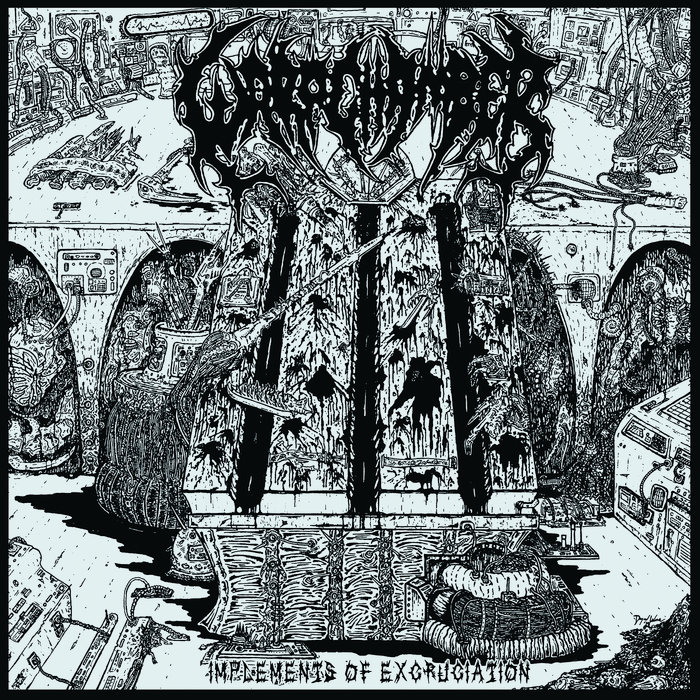
What was the main intention behind ‘Implements of Excruciation’? Do you see it as a statement of principles regarding what Warp Chamber wanted to become?
We learned a lot in that writing and recording process. At the time, we didn’t really know what we were doing, we were just focused on getting our chops up and figuring out how to write and play Death Metal. Moving forward, we are trying to write more extreme, intense, and brutal music that hopefully represents an advancement in our songwriting and playing. We are wrapping up recording our second album, which we think sounds a lot different than ‘Implements…’, and we are working on new music that’s even deeper-fried.
In terms of composition, how does a Warp Chamber song usually come to life? Does it begin with riffs, atmospheres, lyrical concepts, improvisation, or a more structured idea?
Sometimes it’s conceptual, but usually a song will begin with the riffs. One member will generally present their material for a song and the whole band will then offer feedback and edits until we get something that we are all happy with.
Your music has a very physical feeling, but also a mental one, almost as if it attacks from several planes at the same time. How important is it for you that the listener does not simply “listen” to the band, but is crushed by it?
Your words, not ours, buddy! We hope that we leave an impression when people listen to our music or see us live. If you come out to a show feel free to vomit, have a seizure, levitate, whatever you want!
Let’s talk about the recent European tour, ‘Profaning Creation Over Europe’, together with Degraved. How did the possibility of this first European incursion come about?
Degraved was invited by Killtown Booking and as those tours usually run with two bands, we were asked to come along.
The tour included 17 dates between April and May 2026. What expectations did you have before crossing the Atlantic, and how different was the reality once the shows began?
We didn’t know what to expect beyond the general reputation of European hospitality, which was excellent. Reception-wise, it’s been several years since our last full-length came out, so we were uncertain of how we would be received. It was a great tour; we made a lot of friends, got to play with some of our favourite bands, had great crowds every night, and got to meet a lot of people who have been with us since the beginning. We can’t wait to get back out there.
What was your first impression of playing in front of European audiences? Did you feel an immediate connection with the crowd, or was it something that developed night after night?
The tour started out really strong, and that momentum carried throughout the whole trip. The crowds seemed generally hungry for extreme metal and were all around really supportive. They love CDs out there. If any bands are reading this, bring a shitload of CDs.
Which cities or shows remained most strongly in the band’s memory during this tour?
Wroclaw Death Is Not The End Fest – check this fest out, it ripped!
Brussels with Undergang – the rotten kings held their disgusting court.
Öland at Dyestad – we ate some freshly slaughtered goat and played in a barn in the middle of nowhere. It was sick.
Europe is often spoken of as a very strong territory for underground Death Metal. From your direct experience, what differences did you notice between the European scene and the U.S. scene?
As previously stated, Europeans love CDs! There is a lot of infrastructure in place out there for touring musicians – venues that have been collectively run for decades, communal booking efforts, and more financial support from the government, at least in Western Europe. In the US, you’re kind of just left out in the cold. We’ve been really lucky, as we’ve always been generally taken care of out on the road, but the culture of underground touring in Europe offers a great deal more comfort and security than what anyone could realistically expect in the States. Maybe our experience is a little more coloured by the DIY touring we have done back home, we’ll have to keep you updated if we ever get offered to open up for a Cannibal Corpse run.
How was it sharing this tour with Degraved? Was there a previous connection between both bands, or did the brotherhood form on the road?
It was fun playing with them. We’ve played a lot of shows together over the years and we shared a couple members on this run. Check out their newest full-length, ‘Spectral Realm of Ruin’, out on Dark Descent.
On an underground tour, especially when crossing different countries, anything can happen: long drives, exhaustion, borrowed gear, strange food, incredible venues, or total disasters. What story from the tour best summarises the spirit of that experience?
Oh man, not really sure if there was any specific story-worthy moment, but pretty much all of those things came up at one time or another. We had gear issues from day one; if Degraved’s guitarists hadn’t brought their own portable power amps we would have been absolutely fucked for a good chunk of the tour. Luckily, it all worked out! We were all exhausted, our schedule was packed and we had three all-night drives, most of the guys got sick at one point or another and we stayed at some particularly “interesting” places. We were tested, but the spirit of Death Metal prevailed every time.
What did Warp Chamber learn as a band after this first European tour? Do you feel you came back stronger, more violent, or more focused?
The tour highlighted some ways that we can be a more professional band, and reinforced that we can be around each other 24/7 for multiple weeks with no major casualties. We definitely came back motivated to do it bigger, better, and soon!
Do you believe playing live changes the way you understand your own songs? Sometimes a song reveals its true power only when it is thrown in front of an audience.
Absolutely. A song can start getting stale and feel boring in the practice room but it might fill a role in the live set that we didn’t anticipate, people might really like it when we’re already tired of it, all sorts of stuff. We’ve been surprised to hear which songs people particularly vibe with live, it’s often not what we would expect from our vantage point.
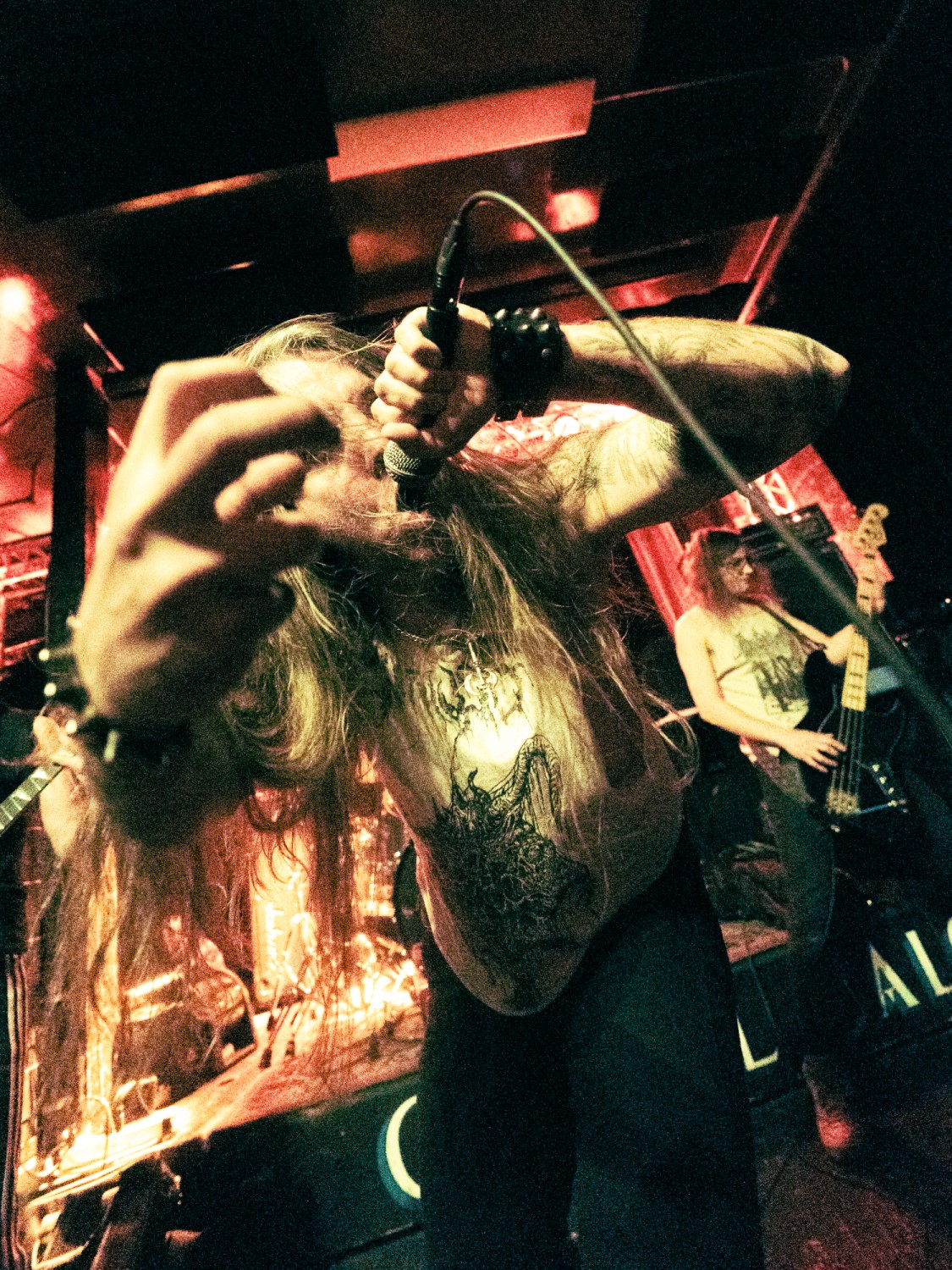
What do you seek to deliver to the current Death Metal movement? Does Warp Chamber want to preserve a tradition, destroy it, deform it, or open a crack toward something else?
We try to write music that we think is cool and we want to play shows with sick bands. We’re chasing the high/writing music that gives that feeling you get when you discover or even listen to a song or band that you love. Death Metal and tradition can be a funny thing. To some, tradition means do it the same way as the old bands that we all love, write about the same stuff, use the same imagery, etc. To us, the old bands that we love were figuring it out and exploring new territory. Sure, they had their influences and were taking lessons from them, but the “rules” weren’t solidified. That is, to us, the real tradition in Death Metal. Big ugly riffs played powerfully, songs about freaky shit, written by freaks and intended for freaks to enjoy.
For you, what does the underground really mean today? In an era of social media, algorithms, and fast consumption, does a real connection between bands, labels, fanzines, and maniacs still exist?
Our band would be nothing without the underground scene – from friends to maniacs, our labels and even this fanzine, we’ve only ever participated in this world. We did make an Instagram account like a year ago to help promote shows, but we really prefer the human-to-human connection. Everything good that Warp Chamber has been invited to take part in, from awesome tours and festival invites to putting releases out through Profound Lore, has happened through person-to-person connection, maniac-to-maniac love.
Before the internet, the underground moved through letters, physical demos, flyers, tape trading, and slow person-to-person communication between bands, labels, fanzines, and fans. What do you think that era contributed to extreme metal, and do you feel something important was lost when everything became faster and more immediate?
It is the foundation of our entire community! The internet didn’t add anything new, it just made everything faster and easier to commodify. We future-dwellers are forever in your debt!
How do you see the relationship between physical formats, vinyl, tapes, CDs, printed fanzines, and extreme music today? Is it still important, or is it just nostalgia?
Probably both. Some people don’t care, they just want the shirt and to listen to the songs on YouTube or Spotify, which is fine! To others it is very important to own the physical media. Metalheads are often into collecting, it’s a tendency that comes with our scene, I think they want a piece to hold onto from the music or show experience that they love. It’s awesome and directly helps support the bands way more than streaming. Also, nostalgia is a fine reason for collecting too, the world is fucked and if clutching on to a cassette makes you feel better, then go for it, we support you!
Are there any bands, scenes, or countries outside the United States that have surprised you lately because of their level of darkness, brutality, or authenticity?
Copenhagen Death Metal is completely fucking disgusting. Finnish Death Metal in general is even worse and more bizarre. Inside the US, Portland has some of our favourite current bands. Just look at whatever Headsplit releases, it’s all brutal.
What comes next for Warp Chamber after this European tour? Is there new material, more touring, splits, or any plans you can share?
We’re finishing up our new record, which has taken considerably longer than we expected, but it should be out soon! We already have some new material for the next release after that too so hopefully we’ll be recording a lot this next year. We’re playing a few shows in Canada with Hedonist and Grave Infestation, two killer bands, and then coming back to Copenhagen in September to play Killtown, which we’re super excited for. In November we’re playing Asakusa Death Fest in Japan with legendary bands like Anatomia and Intestine Baalism, then hunkering down for a ton of writing and recording in the winter. We will see what comes up after all that.
Finally, this space is yours. What message would you like to leave for the readers of VM-Underground and for all the Death Metal maniacs who continue supporting the underground around the world?
Only death is real, thank you for supporting local and international underground Death Metal, if you are reading this then you are a certifiably insane homicidal sexual maniac and the police have been notified and they are heading to arrest you right now. Stay sick!
