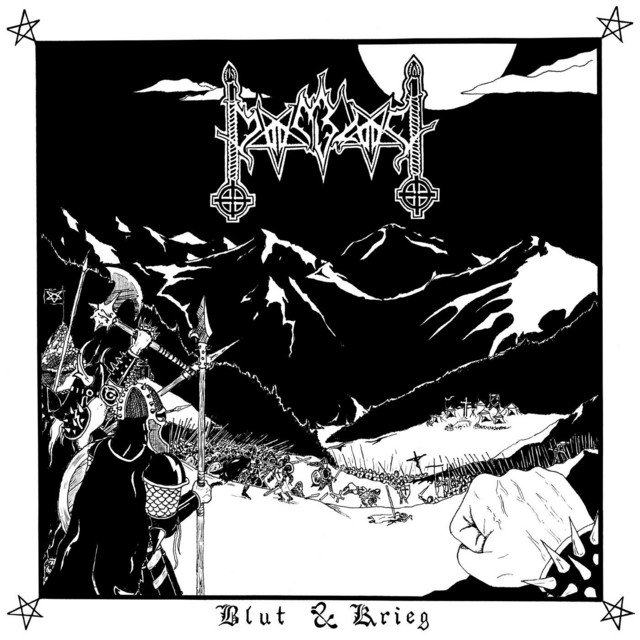
There was a time when discovering a Black Metal band could mean spending weeks trying to find out what else they had recorded, who was behind the music and whether another tape was circulating somewhere beyond the usual names. The underground operated through small labels, handwritten correspondence, tape trading and word of mouth, and bands such as Moonblood became known through a steady flow of recordings rather than the kind of promotional machinery that surrounds releases today. Coming out of Germany during the 1990s, Moonblood developed a following among listeners who wanted their Black Metal raw and uncompromising, but who also understood that aggression alone was not enough to make a memorable record. Their first full-length, ‘Blut & Krieg’, arrived in March 1997 and remains one of the defining recordings from that period of the band’s history.
Moonblood had already accumulated a substantial body of rehearsal recordings and demos before this album appeared. Occulta Mors handled the instruments while Gaamalzagoth took care of the vocals, lyrics and songwriting alongside him. The two operated with a clear understanding of what they wanted from their music, drawing from the primitive attack of early Black Metal while giving the compositions a broader, more epic character. ‘Blut & Krieg’, meaning Blood and War, was recorded at Studio Digan in February 1996, during the winter that would become part of the record’s identity. The original cassette was issued through Majestic Union in cooperation with Sombre Records, limited to 666 copies. Those details belong to the history of the release, but the music itself is what explains why the album continues to attract attention among listeners familiar with the German underground.
The short instrumental introduction, ‘Midnight’, establishes the atmosphere before ‘In a Bloody Night of Fullmoon’ opens the album properly. Moonblood do not immediately bury the listener beneath an endless barrage of blast beats. The guitars are given room to establish their melodies, and the drumming moves between driving passages and more measured sections that allow the riffs to develop. Gaamalzagoth’s shrieks cut through the arrangement with a roughness that suits the music, but the vocals do not carry the entire atmosphere on their own. The guitar work does much of that lifting, moving between cold tremolo passages and more expansive melodies that give the songs a sense of scale.
‘Shadows’ stretches these ideas across a longer composition, allowing the riffs to unfold without losing their connection to the main structure. Moonblood understood the value of repetition, but they were not simply content to recycle the same passage until the track ended. Changes in tempo and melody give the music direction, and the drums provide enough movement to keep the longer arrangements alive. There is a traditional European Heavy Metal sensibility buried within some of these melodies, although the delivery remains firmly rooted in Black Metal. That combination gives the album its own character, particularly when the music slows down and lets the guitar lines carry the atmosphere instead of relying on speed to do all the work.
‘…and Snow Covered the Lifeless Bodies’ is one of the strongest examples of this approach. The extended running time allows Moonblood to build a composition around its changing guitar melodies, moving through passages that feel bleak and distant before returning to more forceful sections. The music has an epic quality, but it does not depend on grand orchestration or elaborate keyboard arrangements to achieve it. The guitars do the job themselves, with Occulta Mors shaping the atmosphere through the riffs and their progression. There is a certain grandeur in the way the song develops, yet the performance retains the rough edges expected from a band whose roots were firmly planted in the underground.
The title track shifts the emphasis towards a more direct and martial attack. Sung in German, ‘Blut & Krieg’ has a different presence from the surrounding songs, with the language adding another dimension to the vocal delivery. It is a fitting centrepiece for an album that balances raw Black Metal with an expansive approach to songwriting. ‘Kingdom of Forgotten Dreams’ continues with the more melodic side of the record, while ‘Under the Cold Fullmoon’ allows the atmosphere to develop through its changing riffs and vocal passages. The latter is particularly effective when the guitars carry the melody forward and the vocals rise above the arrangement without overwhelming it. Moonblood were at their best when these elements worked together, giving the music a sense of movement without sacrificing its rough character.
The original cassette also included ‘My Evil Soul’ and ‘I Am All’, both recorded in September 1995 rather than during the main album sessions. Their inclusion makes this particular edition worth distinguishing from later versions with different track listings. ‘I Am All’ is especially memorable for its melodic passages and vocal performance, while the shorter ‘The Infernal Master Returns’ closes the album with a more compact burst of aggression. The sequence works because Moonblood had already established the atmosphere and songwriting approach across the longer tracks, leaving the final piece to bring the record to its conclusion without another extended composition.
What makes ‘Blut & Krieg’ stand apart from a collection of raw rehearsal recordings is the way the material has been developed into a proper album without losing the band’s identity. The production gives the guitars and drums enough definition for the arrangements to come through, while the overall sound remains rough enough to preserve the character of the music. The bass is not always prominent, but the guitar melodies and drumming provide a strong foundation. Gaamalzagoth’s vocals also benefit from the clearer presentation, revealing how effectively his shrieks fit the changing moods of the compositions. This is still underground Black Metal, but it is not music that depends on obscurity or poor sound quality to establish its atmosphere.
Looking back at the German Black Metal underground of the 1990s, Moonblood represent a period when bands could develop their own identities through a succession of recordings, each one adding something to the picture. ‘Blut & Krieg’ captures the duo moving beyond the limitations of the rehearsal tape while retaining the coldness, aggression and melodic instinct that made their earlier material distinctive. It is an album for listeners who appreciate Black Metal with strong riffs, memorable guitar melodies and compositions that take their time to develop. More than simply documenting another chapter in Moonblood’s prolific history, it shows how raw Black Metal can be both primitive and expansive without losing the spirit that made the underground worth following in the first place.