
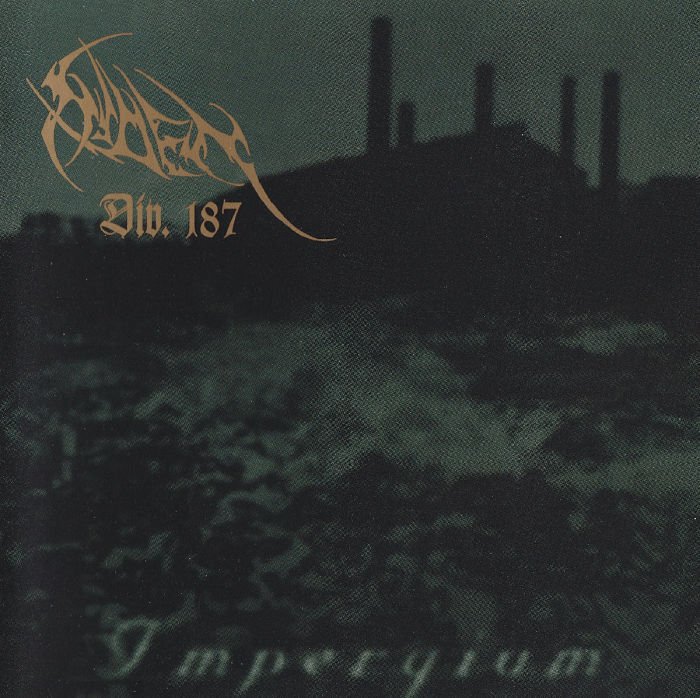
Niden Div. 187 were one of those Swedish names that seemed to exist slightly outside the usual circle, despite the musicians involved already having strong connections to other bands. Formed in 1995, the project brought together Henrik ‘Henke’ Forss on vocals and Jocke Pettersson on drums, both connected with Dawn, alongside guitarist Leo Pignon and bassist Jonas Albrektsson. That combination gave Niden Div. 187 a serious underground pedigree, but the music itself was never about showing off who was playing in the band. It was brutally direct Black Metal with very little wasted movement.
Their first recording was the ‘Towards Judgement’ demo, recorded at Nidengate during the winter of 1995-96. It was originally an independent cassette, with only around 40 copies reported, before Necropolis Records picked it up and issued it as a CD. That alone says something about how quickly the material caught attention. What began as a small underground recording became the band’s first official release, and the four songs already had the furious character that would define ‘Impergium’.
‘Impergium’ was recorded and mixed at Nidengate Studio in 1996, with Morth handling the recording, engineering and mixing. The album was released in 1997 and contains ten tracks running just under 26 minutes, which is exactly the right amount of time for this kind of assault. There is no attempt to stretch the material unnecessarily. The riffs come in hard, the drums drive everything forward, and Henke’s vocals sound genuinely vicious without needing any theatrical presentation.
The opening title track gets straight to the point before ‘Genocide’ takes the pace even higher. ‘Judgement Dawns’ is brief and forceful, while ‘In the Twilight of War’ and ‘A View in the Mirror Black’ demonstrate the band’s ability to keep the guitars moving through several ideas without losing their momentum. ‘The Execution’ provides a short instrumental break before ‘Funeral Pyres’, ‘Hate’, and ‘Mass Burial Disorder’ return to the full attack. ‘The End’ closes the album proper, leaving the four ‘Towards Judgement’ recordings as an interesting document of where the band had come from.
What really separates Niden Div. 187 from a lot of mid-’90s Black Metal is the sheer physicality of the playing. The guitars have a sharp Swedish character, but the songs are driven with an almost Death Metal-like force. Jocke Pettersson’s drumming gives the music tremendous propulsion, while Leo Pignon’s guitar work keeps the riffs recognisable even when everything is moving at high speed. Henke’s vocals sit right in the middle of that attack and give the whole thing its hostile personality.
The connection to Dawn is particularly interesting because you can hear that these musicians were capable of creating something very different from their other work. Niden Div. 187 was not simply another version of Dawn with a different name. The music here is stripped down, violent, and compact, with the songwriting built around impact rather than atmosphere or elaborate arrangements. That makes ‘Impergium’ a very different experience from some of the more expansive Swedish releases appearing around the same period.
I think this is another example of why the mid-’90s Swedish underground was so fascinating. You could follow one musician into another band and suddenly find yourself listening to something completely different. Niden Div. 187 had musicians coming from established underground circles, yet the project remained very much its own beast. In Singapore, these kinds of records were not something everyone around you was necessarily talking about, which made coming across them even more memorable. Sometimes a name would appear among other releases and you would only later realise how many connections were sitting behind it.
‘Impergium’ has stayed interesting because it does not need a complicated explanation. It is a short, furious piece of Swedish Black Metal built around strong riffs, relentless drums, and Henke Forss’ unmistakable vocals. The ‘Towards Judgement’ material makes the story even better, because you can hear the raw foundation of the band before the full-length arrived. Together, they document a brief but memorable chapter in the Swedish underground and a group of musicians who clearly knew how to make their presence felt.
