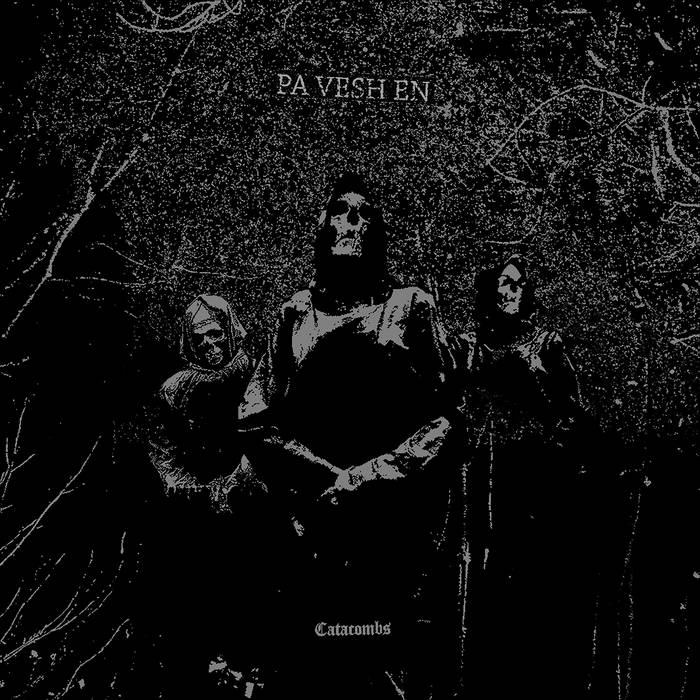
In the space of eight years, or a bit more, Belarusian Raw Black Metal entity Pa Vesh En has released a solid stack of recordings.
This is one is a compilation of songs performed during 2017-2019, remixed and (re)mastered in June, 2023.
They’re tracks from the early albums ‘Church Of Bones’ and ‘Pyrefication’ , the two 2017 demos ‘Knife Ritual’ and ‘Dead Womb’, the split and at least one EP, ‘Cryptic Rites of Necromancy’ are included on the ‘Catacombs’ compilation.
Within that time, Pa Vesh En’s approach has changed from bleak and depressive Black Metal with Industrial + creepy noisy elements to a more solid and cohert style.
I personally like what they do, how they’ve progressed and all. And they’re filed/coded by me next to other audiotive terrorists like Black Cilice or Μνήμα for that matter. This one got filed wrong in the archives of VM-Underground and was gathering dust until unearthed by a zealous contributor. Tssss.
Within the modern European black metal movement, few bands have managed to construct an aura as mysterious and uncompromising as Pa Vesh En. Since its emergence in 2017, drawn international attention for its relentless pursuit of atmosphere, darkness, and sonic extremity. Cloaked in secrecy, typically referred to as a “one-man band”, Pa Vesh En embodies the very spirit of the underground, eschewing personal publicity while letting its music stand as the sole testament to its vision. Over a period of just seven years, the project has amassed a formidable and ever-evolving discography, continuously challenging the boundaries of raw black metal and attracting critical acclaim across Belarusian, Russian, Ukrainian, and Western European as well as American outlets. Throughout its history, Pa Vesh En has remained a strictly anonymous entity; the single member takes on all roles, handling vocals, guitars, bass, and drums, with neither pseudonym nor face ever revealed to the public. This rare adherence to anonymity, particularly in the social media era, aligns the project with the classic black metal tradition of spectral personas and unhindered artistic focus. Notably, Pa Vesh En is one of the few Belarusian black metal acts recognized at both regional and global levels without any traceable “band” or public leader.
From the outset, Pa Vesh En has positioned itself as an uncompromising advocate of “Raw Black Metal”-genre-defining traits include abrasive, lo-fi production, dissonant riff structures, and vocals smothered in a fog of effects and reverb. The themes that run through the project’s work are consistently bleak and existential: darkness, death, obsession, blackness, murder, negation, and magic are recurring motifs in both lyrics and album aesthetics. There’s a, let us say, spiritual kinship with Depressive Suicidal Black Metal (DSBM), but with a broader reach into sonic experimentation, Dungeon Synth, and Dark Ambient veins.
While Belarusian rock and metal have been historically hindered by censorship and political instability, especially regarding live performances and official media outlets, the metal underground endures and has surfaced in global conversations mainly through a handful of exceptional acts. Bands such as Gods Tower, Vietah, and Raven Throne have previously brought international attention to Belarusian extreme music, with Pa Vesh En standing as the most internationally visible raw black metal act from the country in the late 2010s and 2020s.
Singer-songwriters and regional experts, such as Artyom Prishchepov from the band Evoking Winds, regularly place Pa Vesh En among the ‘top 10 Belarusian Metal bands,’ testifying to the project’s pioneering status and esteemed local reputation.
It is also important to note that, given the Belarusian government’s history of blacklisting and restricting non-mainstream artists, Pa Vesh En’s underground status is not simply a matter of aesthetic choice, but a pragmatic response to the sociopolitical environment in which extreme music is produced in Belarus. The project’s lack of live performances helps evade the attention of authorities while amplifying the mythos around its music.
This remixed material, 10 tracks in total, uncovers a striking dimension in Pa Vesh En’s music, one that may have been present from the very beginning but muted by the rawness of the original production.
The opener, ‘Call of the Dead’ (from ‘Pyrefication’), now cuts with a sharper edge. The sonic space feels broader, darker, and more cavernous, while the percussion strikes with greater clarity and force. The result is a track that sounds even more desolate and abrasive than its first incarnation. Following this bleak introduction, the sudden acceleration of ‘A Moonlight Hunger’ and ‘A Funeral Procession’ can catch listeners off guard. Their relentless drumming and storm‑like turbulence create a sense of chaos, with tortured vocals buried deep in the swirling mix, as if screaming from within a distant tempest.
By contrast, ‘Chalice of Blood’ takes on a mournful, doom‑laden character. Its slow, looping guitar riff recalls the atmosphere of 1990s blackened doom, and it feels like an extended prelude to something larger. Its origin on the early demo Knife Ritual makes sense, Pa Vesh En was still probing song structures and experimenting with form. ‘The Relentless Plague,’ also from that demo, feels similarly exploratory, layering textures into a dense, chaotic mass that borders on overwhelming.
The journey through the early recordings of 2017–2018, such as those collected on ‘Catacombs,’ reinforces the band’s uncompromising bleakness. The riffs repeat obsessively, each cycle digging deeper into despair, with no respite offered, only abrupt endings that feel like being struck down mid‑fall, left dangling over a psychological abyss.
Still, certain pieces do stand apart. ‘Entwined with Snakes’ impresses with its hammering percussion and the ominous roar that threatens to consume the track before it suddenly cuts off. ‘Grotesque Abomination’ (from ‘Pyrefication’) embodies a frenzied, almost deranged energy. Finally, ‘Walks with the Dead’ closes the collection on a sorrowful note, its cold synthesizer tones lending the song a tragic, funeral weight, steeped in anguish and dread.
The recording as a whole can be an intense, even unsettling experience, marked by spectral, anguished screams that sound as though they rise from souls trapped in endless night and damnation. The song structures themselves are unpredictable, often disorienting the listener and leaving them exposed to sudden jolts, followed by a hollow sense of loss, unease, or even fleeting shock. Yet, if one sets aside the wailing in the background and concentrates on the instrumentation, a striking intensity emerges within the half‑melodic, half‑chaotic tempests. The guitars ring with a sinister, metallic edge, while the drumming is weighty and at times thunderous.
For long‑standing followers, the act of comparing these remixed versions with their originals offers its own fascination, revealing how the new interpretations highlight different textures or instruments, sometimes enhancing and sometimes altering the impact. For those encountering Pa Vesh En for the first time, ‘Catacombs’ serves as a fitting introduction, an encapsulation of the project’s earlier work, pointing both to where it once stood and to the directions it may yet explore.
A sublime initiative, if you ask me and obligatory in every Pa Vesh En collection!