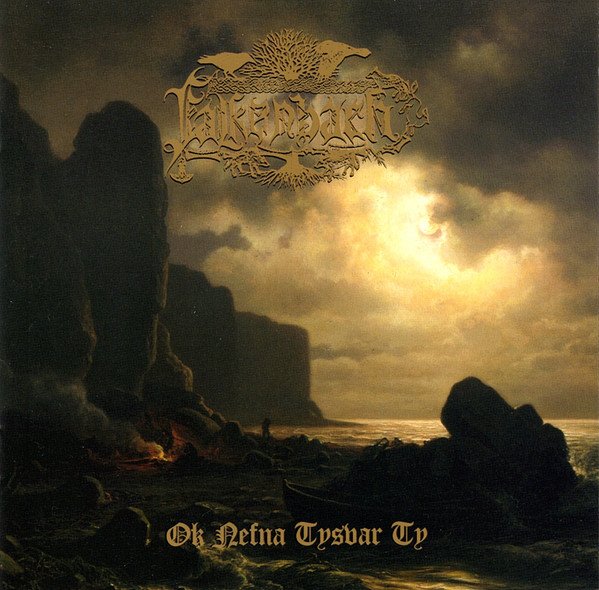
By 2003, Falkenbach had developed well beyond the rawer Black Metal foundations of its earlier material. Vratyas Vakyas had established a recognisable sound built around Norse mythology, sweeping guitar melodies, acoustic passages and vocals that moved between harsher Black Metal delivery and more traditional, hymn-like singing. ‘Ok Nefna Tysvar Ty’ brought these elements together in a more expansive form, placing Falkenbach firmly among the acts carrying the Viking Metal tradition into a new decade. For anyone familiar with Bathory’s ‘Hammerheart’ and ‘Twilight of the Gods’, the musical parallels are hard to miss. The importance of Quorthon’s work to the musical world Falkenbach inhabits seems difficult to overlook, particularly in the way epic Extreme Metal can be built from memorable guitar melodies, measured arrangements and a strong connection to Norse mythology.
Bathory’s transformation during the late 1980s and early 1990s changed the possibilities for bands working with these themes. ‘Hammerheart’ and ‘Twilight of the Gods’ moved away from the raw, hostile approach of the earliest records towards longer compositions, acoustic passages, clean vocals and a sense of history that went beyond the usual imagery of Extreme Metal. That combination became a reference point for later Viking Metal acts. Falkenbach approaches similar territory through its own blend of Black Metal and Pagan Metal, but the shared musical vocabulary is evident in the way the melodies carry the compositions and the arrangements give the songs room to breathe. It is not simply a matter of writing about Norse gods or using acoustic guitars: the connection lies in the overall musical vision.
Released through Napalm Records in 2003, ‘Ok Nefna Tysvar Ty’ was Falkenbach’s third full-length album, following ‘…En Their Medh Riki Fara…’ in 1996 and ‘…Magni Blandinn Ok Megintíri…’ in 1998. Vratyas remained the central creative force, while guest musicians including Tyrann on additional vocals, Hagalaz on acoustic guitar and Boltthorn on drums helped broaden the arrangements. Their contributions gave the album a fuller range of textures, particularly where the heavier passages give way to acoustic or vocal sections.
‘Vanadis’ opens the album with an immediate sense of grandeur. The guitar melodies have a strong presence, and the arrangement builds its atmosphere through the interaction between the heavier passages and the more melodic sections. Rather than relying on speed alone, Vratyas allows the song to unfold at a pace that gives the central themes room to register. The result brings to mind the more expansive side of Bathory, where a carefully developed melody could carry as much weight as an aggressive riff.
‘…As Long as Winds Will Blow…’ continues in a similarly epic direction, combining harsher vocals with arrangements that feel almost ceremonial in places. The influence of the Viking Metal tradition is particularly apparent here. The songs are not driven solely by aggression, but by a sense of movement and purpose, with the melodies returning in ways that make them memorable. This approach recalls the lessons of ‘Hammerheart’ without making Falkenbach sound like a tribute act.
‘Donar’s Oak’ draws on the Germanic tradition surrounding Donar, the deity known in Norse mythology as Thor. The subject fits naturally into Falkenbach’s musical world, with the arrangement giving the composition a strong identity rather than leaving the mythology as decoration. ‘The Heralder’ and ‘Walkiesjar’ continue to balance Black Metal aggression with folk-influenced passages, while ‘Farewell’ brings the album to a more reflective close.
One of the album’s strengths is the way the acoustic guitar, clean vocals and distorted guitars belong to the same musical framework. The quieter passages do not feel like interruptions, and the heavier sections retain enough bite to keep the Black Metal roots audible. This is an important part of the Bathory connection. Quorthon’s Viking era demonstrated that atmosphere and melody could expand Extreme Metal without stripping away its identity. Falkenbach takes that idea into its own territory, giving the songs a more pronounced Pagan Metal character while keeping the guitar work at the centre.
Looking at ‘Ok Nefna Tysvar Ty’ today, Bathory’s legacy is an important part of understanding the musical ground on which Falkenbach stands. The comparison should not erase Vratyas Vakyas’s own songwriting or the identity he built across these albums. Rather, it helps explain why Falkenbach speaks so strongly to listeners who value the Viking era of Bathory. The connection is audible in the epic arrangements, the emphasis on melody and the sense that the music is reaching towards something older than the Extreme Metal scene itself. For listeners drawn to that side of Quorthon’s legacy, this album offers a substantial continuation of the tradition, shaped by a musician who made it distinctly his own.
