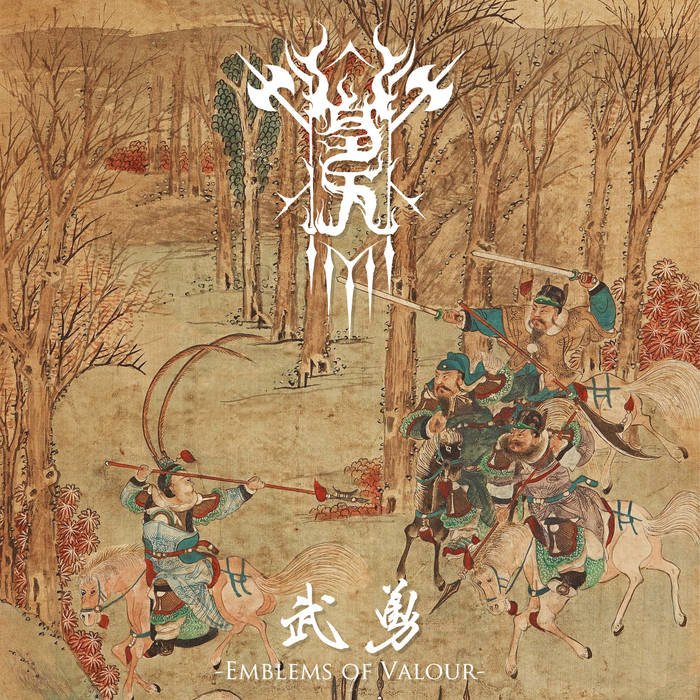
Welkin is one of those Singapore projects that is difficult to put into the usual local Black Metal box. Hasthur has been working on the project since his teenage years and the earlier material was heavily rooted in Finnish Black Metal, but ‘武勇 / Emblems Of Valour’ is where he really starts sounding like he has found something of his own.
The whole album is based around the Three Kingdoms period of Chinese history and the stories of Liu Bei, Guan Yu and Zhang Fei. That alone makes it stand out in a scene where you can usually predict the lyrical territory before the first song has finished. There is no shortage of Black Metal dealing with Norse mythology, Satanism, paganism, forests, winter and various forms of European medieval history. A Singaporean musician taking Chinese history and traditional Chinese musical ideas and building an entire Black Metal record around them is a much more interesting proposition.
More importantly, Hasthur didn’t just change the artwork and song titles and leave the music sounding like another Finnish Black Metal record.
He has actually worked Chinese musical ideas into the riffs.
That is the part that deserves attention. Hasthur has spoken about composing riffs with characteristics of classical Chinese music in mind, and you can hear the difference in the melodies. The guitar lines have a certain shape and movement that gives the record a distinctly Eastern character without turning the whole thing into some forced Folk Metal exercise. There are no cheap attempts to throw a traditional instrument into the background and call it cultural authenticity. The influence is mainly in the actual writing.
The four songs are long, with the shortest running over eight minutes and the other three around eleven minutes each. That could have been a problem, especially with a one-man Black Metal project where there is nobody else around to tell the composer that perhaps a particular riff has been repeated enough times.
Fortunately, Hasthur has a good ear for melody.
‘Fires Of Rebellion’ opens the album with the kind of melodic Black Metal that will immediately make people think of the Finnish bands he openly acknowledges as influences. Sargeist, Satanic Warmaster and Noenum are obvious reference points, particularly in the guitar work, but there is more going on here than simple imitation. The melodies are more heroic than miserable, and that difference becomes increasingly important as the album progresses.
‘The Flying General’ is probably where the Chinese influence becomes most convincing. The opening lead has a very distinctive melodic quality and doesn’t sound like something that was written first and then given a Chinese title afterwards. There is a sense of movement in the melody that works surprisingly well with the Black Metal framework.
The title also refers to Lü Bu, the famous warrior of the Three Kingdoms period, and the music suits the subject without turning into a soundtrack for a video game. Although, admittedly, some of the melodies have enough heroic sweep to make you wonder whether Hasthur secretly spent half his childhood playing old Three Kingdoms games.
‘208 Battle Of Red Cliffs’ takes the concept further. The Battle of Red Cliffs is one of the best-known episodes of the Three Kingdoms era, and here the scale of the subject gives Hasthur an excuse to make the music bigger and more dramatic. The guitars remain rooted in Black Metal, but the melodies have that triumphant quality that runs through the whole album.
That is another thing separating Welkin from the Finnish bands that influenced the early material.
Finnish Black Metal often has that combination of melancholy and triumph, but Welkin replaces the European pagan atmosphere with Chinese historical imagery. The basic musical language may have originated somewhere else, but the subject matter changes the way the music comes across.
The final track, ‘Emblems Of Valour’, is the longest at over eleven minutes and probably the clearest statement of what Welkin is trying to achieve. It is dedicated to Liu Bei, Guan Yu and Zhang Fei and centres on the ideas of loyalty, honour, brotherhood and military valour. Hasthur has spoken about being particularly affected by the story of Guan Yu’s loyalty and how that inspired the final riff of the title track.
That personal connection comes through.
Whether someone shares Hasthur’s admiration for these historical figures is another matter. The album is very serious about its ideas of honour, loyalty, ancestry and heroic virtue. There is no tongue-in-cheek treatment of the subject and no attempt to distance itself from the historical romanticism.
This is where Welkin becomes more interesting to discuss outside the music.
Hasthur’s writings and interviews show that his interest in Chinese history and culture goes well beyond simply enjoying ‘Romance Of The Three Kingdoms’. He talks openly about ancestry, Han Chinese identity, Chinese history, traditional culture, Daoism, Nietzsche, Heidegger, Ernst Jünger and Yukio Mishima. There is a strong philosophical and cultural-nationalist streak running through the project.
That doesn’t automatically make the music supremacist, and I wouldn’t label it that way without evidence. But there are certainly moments where the emphasis on blood, ancestry, heroic Chinese history and the virtues of an earlier civilisation can come across as strongly ethnocentric. That is part of the project and it is reasonable to notice it rather than pretending the album is simply four songs about ancient battles.
At the same time, there is something refreshing about a Singaporean Black Metal musician taking his own cultural background seriously instead of borrowing an entire identity from Scandinavia.
That is probably the biggest achievement of ‘Emblems Of Valour’.
Hasthur is very open about his early Finnish influences and even admits that the first Welkin releases were heavily based on bands he admired and lacked the personal identity he wanted. On this album, he has taken those influences and put them into a completely different historical and cultural setting.
The music still sounds like Black Metal.
It just doesn’t sound like another European Black Metal record wearing Chinese clothing.
The vocals work well with the music too. Hasthur doesn’t have an especially extravagant vocal style. The harsh vocals are there to drive the songs rather than dominate them, and the backing vocals from Schtarch of Holyarrow add some extra weight on two tracks. The voice is quite restrained compared with the theatrical approach used by some epic Black Metal bands, which actually helps the music. The guitars are carrying most of the emotional weight.
And those guitars are the reason this album works.
There are plenty of melodies here that stay in the head after the album is finished. Hasthur understands that epic Black Metal doesn’t necessarily require keyboards covering everything in a thick layer of fantasy atmosphere. A strong guitar melody can do the job by itself.
The production is also much better suited to the material than a deliberately filthy demo sound would have been. Everything is clear enough to follow, but the guitars retain their edge. Considering this is a one-man project with Hasthur writing, recording, mixing and mastering everything himself, the level of control is impressive.
There is also no need to pretend that every minute is perfect. The four-song structure means some riffs are revisited longer than necessary, and the extended running times occasionally make the songs feel slightly stretched. The album demands that you sit with it rather than simply throw it on in the background. Some listeners will enjoy that; others will probably find themselves checking the remaining time during the longer passages.
For me, the strongest material is where Hasthur keeps the melodies moving. Whenever the guitars combine that Finnish Black Metal attack with the Chinese melodic influence, Welkin sounds most convincing. The record becomes less interesting when it settles too comfortably into familiar Black Metal patterns.
That is probably the area Hasthur should explore further.
The Chinese influence is already there. It doesn’t need to become more obvious or more theatrical. If anything, going deeper into traditional Chinese melodic structures while keeping the Black Metal foundation could take Welkin somewhere genuinely distinctive.
There is a lot of talk these days about bands having to sound ‘unique’, usually followed by another album that sounds exactly like six other bands. Welkin has at least made a serious attempt to solve that problem through its own background and interests.
‘武勇 / Emblems Of Valour’ is not simply interesting because it comes from Singapore, either. The record stands on its own as melodic and epic Black Metal with a clear identity. The Three Kingdoms concept gives the album a consistent narrative, while the Chinese musical influence gives the riffs something beyond the usual Finnish template.
It is also worth remembering that Hasthur was still very young when this was made. That makes the level of ambition here even more noticeable. He isn’t making a short Black Metal demo based around three riffs and a corpsepaint photograph. He has built a forty-minute concept album around a specific historical period, written all the music himself and developed a musical language that is already considerably more individual than the early Welkin material.
There is still room for him to grow, particularly in arrangement and restraint. Some of the longer passages could be tightened and the next step should be finding even more ways to make the Chinese influence part of the songwriting without making it predictable.
But ‘Emblems Of Valour’ is a very good record and one of the more distinctive Singapore Black Metal releases of its period.
The refreshing part isn’t simply that the album is Chinese-themed. It is that Hasthur has taken something personal and cultural and actually made it part of the music. The result may not appeal to everyone, especially listeners who have no interest in the historical and philosophical ideas behind it, but there is no mistaking what Welkin is trying to do.
After the early years of following Finnish Black Metal very closely, Hasthur finally stopped looking north for the whole identity of the project and started looking back towards his own cultural history.
That was the right move.