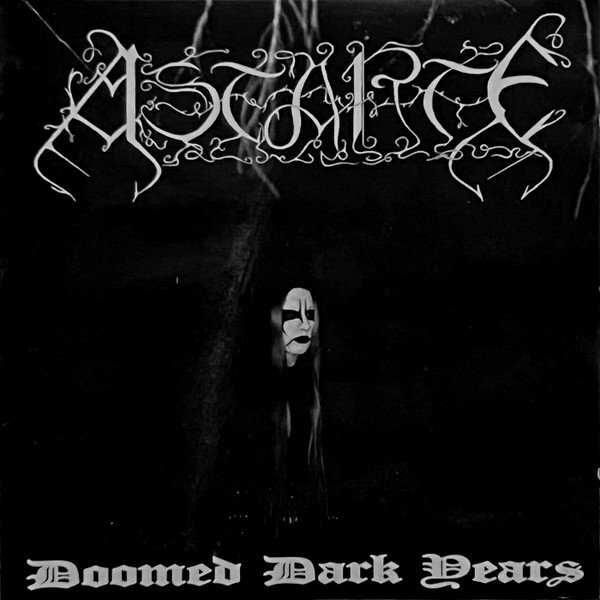
Before Astarte became known outside the Greek underground for a very different incarnation of the band, there was ‘Doomed Dark Years’, and this debut deserves to be judged on its own terms. Emerging from the ashes of Lloth, Astarte entered the 1998 underground with a record that sits firmly within the darker side of the Greek Black Metal tradition while still carrying plenty of the coldness that was coming out of Northern Europe at the time.
What immediately separates ‘Doomed Dark Years’ from a lot of anonymous second wave worship is the amount of space given to atmosphere. These aren’t short, frantic blasts thrown together to prove how evil the band could sound. Several pieces stretch well beyond the usual three or four-minute format, allowing the riffs to develop gradually and giving the keyboards room to become part of the actual structure rather than simply sitting on top of everything like some cheap gothic decoration.
The guitars are generally straightforward, but that works in their favour. There is a certain repetition throughout the album, though it feels intentional rather than lazy. Riffs return, build tension and eventually give way to slower passages or bursts of faster Black Metal. The result is a record that feels more interested in creating a sustained atmosphere than constantly throwing new ideas at the listener.
The keyboards are probably the element that will divide listeners. They are very much a product of the era, sometimes grand and dramatic, sometimes almost haunting, and they give the album a distinctly Greek character. This isn’t the stripped-down Scandinavian approach where every atmospheric element has to disappear behind a wall of distorted guitars. Astarte were clearly comfortable allowing melody and darkness to exist alongside the rawer material.
The three-part ‘Thorns of Charon’ is where this approach becomes most apparent. Rather than treating the album as eight unrelated songs, Astarte use the extended composition to create a much broader sense of movement. ‘Voyage of Eternal Life’ and ‘The Rise of Metropolis’ work in a similar way, taking their time and letting the atmosphere settle instead of constantly chasing speed.
Then there is the title track, which gets closer to the more direct side of the band without abandoning the album’s overall mood. The harsher sections have enough bite to prevent the keyboards and slower passages from turning the whole thing into atmospheric Metal, while the production gives the guitars enough clarity to actually hear the riffs underneath everything.
And that production is important. ‘Doomed Dark Years’ isn’t some deliberately filthy cassette recording masquerading as authenticity. It has a reasonably clear late ’90s sound, but there is still enough roughness around the edges to keep it connected to the underground. The programmed drums are noticeable, particularly compared with a live drummer, but they don’t completely undermine the record.
What is most interesting about this album today is how much it captures that transitional period in European Black Metal. The first wave had already become history, the Norwegian explosion had changed the entire underground, and bands across Europe were taking those ideas and filtering them through their own local scenes. Astarte did exactly that. You can hear the Northern influence, but the atmosphere, keyboards and songwriting give the record a character that doesn’t simply reduce it to another Scandinavian imitation.
There are certainly moments where the album could have used tighter songwriting, and at 54 minutes the repetition becomes more apparent than it would on a shorter record. But that is also part of what makes ‘Doomed Dark Years’ worth returning to. It isn’t polished, perfectly paced or designed around instant gratification. It is a slow-burning underground record that reveals more of its personality once you stop expecting every song to immediately grab you by the throat.
For anyone digging into the less celebrated corners of 1990s Greek Black Metal, this is one that deserves to be pulled back out of the shadows. Astarte would go through plenty of changes in the years that followed, but ‘Doomed Dark Years’ remains the clearest document of where they started: atmospheric, melodic, dark and firmly rooted in the underground of its time.