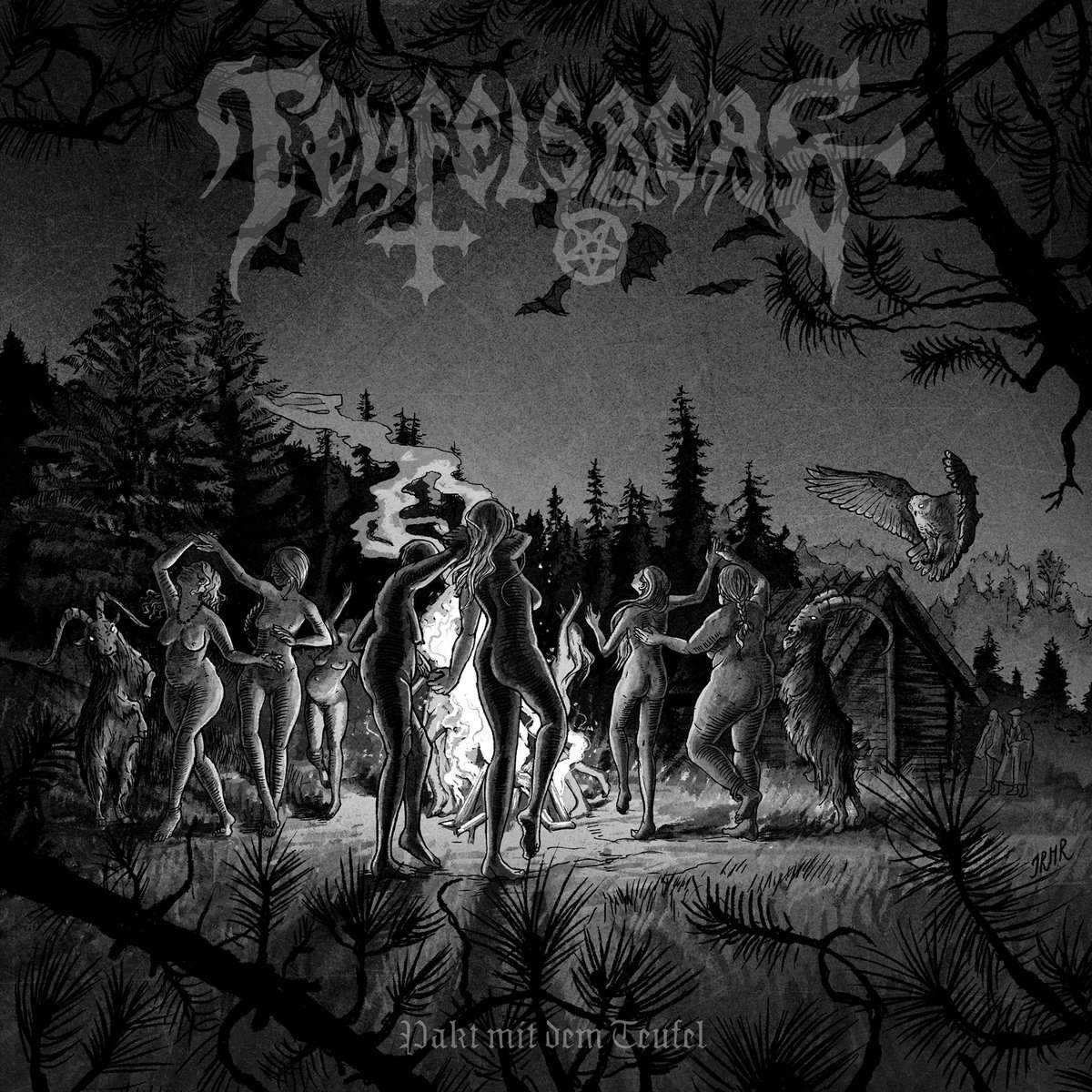
‘Pakt mit dem Teufel’, the second album from Polish one-man band/genius Black/death Metal Teufelsberg is an album that doesn’t just play, it breathes, it claws, and it drags the listener into a space where Black Metal is stripped of all polish and left to rot in its most primal form.
From the opening moments, there’s a sense of deliberate animosity, a refusal to comply, as if the record itself is sneering at the idea of accessibility.
‘Pakt mit dem Teufel’ is not just a continuation of Teufelsberg’s debut, ‘Ordre du Diable’, it feels like a sharpening of the blades, a more venomous strike that takes the raw foundations of the first record and pushes them into an even darker, more ritualistic territory.
Where the debut was already steeped in primitive Black Metal antics, this second album is more confrontational, more suffocating, and more deliberate in its descent into the abyss.
The ingredients, like the bellowing, hysterical vocals, the suffocating oppressive atmosphere, the glorification of the Devil; they’re all here, combined with the old school approach, the relentless pounding percussion and the sand papered abrasive barrage of guitars. And everything gets plunged into the icy water of darkness.
What makes this record so compelling is its tension between chaos and hypnosis. Tracks like ‘Der Ruf des Mephistopheles’ erupt with malicious laughter before detonating into lightning-fast drumming and riffs that slice like rusted blades. Yet elsewhere, the band lingers, stretching a single idea into a trance, letting repetition become suffocating until it tips into something ritualistic. That balance, between frenzy and fixation, creates a listening experience that feels unstable, dangerous, and alive.
A track like ‘La Beauté du Diable’ is slow, torturous piece that drags the listener through a mire of repetition. The guitars crawl rather than gallop, creating a hypnotic effect that borders on suffocation. Unlike the more straightforward aggression of Ordre du Diable, this song shows Teufelsberg’s willingness to stretch time, to let atmosphere become as punishing as speed. It’s a descent, not a sprint.
Or take ‘Gospel of Diabolical Freedom’ where the band channels the merciless energy of early European Black Metal. The rhythm section barely holds the madness together, while the riffs and vocals clash in a way that feels unstable, almost collapsing. Midway, the track shifts into a slower, hammering riff that recalls the old-school Polish underground. It’s a moment of grim triumph, a reminder that Teufelsberg’s roots are as important as their experimentation.
‘Wpiekłowstąpienie (In Herrlichkeit inmitten der Flammen)’, the closing piece of the album is hypnotic, built on simple drum patterns and repetitive guitar figures that spiral into trance. There are faint touches of keyboards, not as ornament but as a mocking glimmer of light within the suffocating darkness. It’s one of the most impressive moments on the record, because it shows restraint, violence through atmosphere rather than speed.
There are moments where the music seems to collapse under its own weight, only to reassemble into something even more grotesque. The album thrives on contradictions: it is both primitive and deliberate, both suffocatingly bleak and strangely celebratory in its devotion to the left-hand path. The production is raw, but not careless, it amplifies the filth, the grain, the sense that this music was meant to be heard in a damp cellar lit only by candle stubs.
Even the moments of unexpected melody, like the brief keyboard flourishes in ‘Wpiekłowstąpienie (In Herrlichkeit inmitten der Flammen),’ don’t offer relief so much as a mocking glimmer of light before the flames consume everything again.
The ‘Ordre du Diable’ debut was already raw, primitive, and hostile, but it still carried the energy of a debut, direct, furious, and eager to establish identity. ‘Pakt mit dem Teufel’ feels more assured, more ritualistic/mature. The production is still filthy, but the pacing is more varied: moments of trance-like repetition sit alongside sudden bursts of chaos. Where the debut was a declaration, the second album is a pact: an oath sealed in blood. Slower, heavier, and even more suffocating.
And thematically, both albums dwell in the same infernal territory: devotion to the left-hand path, rejection of modernity, and celebration of darkness. But ‘Pakt mit dem Teufel’ leans harder into ritual and invocation. The laughter, the chants, the hypnotic passages, they all suggest not just rebellion, but worship. If the debut was about defiance, this one is about surrender: giving oneself fully to the abyss.
The atmosphere is again quite claustrophobic, hostile, and unsettling. It’s not an album that invites you in, no, it drags you down. There’s a sense of ritualistic immersion, as if each track is another step deeper into a cavern where light cannot reach. Compared to the debut, it feels less like a performance and more like an actual ceremony.
Is it a good album? Absolutely, if ‘good’ means uncompromising, filthy, and true to the spirit of underground Black Metal. It’s not for easy listening, nor does it want to be.
‘Pakt mit dem Teufel’ is a record that thrives on its ugliness, its lunacy, and its refusal to yield. It surpasses the debut in depth and atmosphere, proving Teufelsberg are not just repeating themselves but digging deeper into their own infernal vision. I said it, a maximum score from yours truly here and get yourself a pact with the devil, droogies!