
There are albums that sound as though they were recorded in a rehearsal room, albums that sound as though they belong in a forgotten cellar, and then there is Abruptum’s ‘Obscuritatem Advoco Amplectère Me’. Released by Euronymous through Deathlike Silence Productions in March 1993, this debut album is a fifty-minute descent into hell where conventional Black Metal songwriting seems to have been abandoned in favour of something deeply uncomfortable. Two compositions occupy the entire record, each lasting around twenty-five minutes, and neither offers the listener the usual landmarks of riffs, choruses or predictable changes in pace. The title translates roughly as ‘I call upon obscurity to embrace me’, and it is difficult to imagine a more appropriate name for music that seems determined to shut every door behind you.
By 1992, when the album was recorded, Tony ‘IT’ Särkkä and Morgan ‘Evil’ Håkansson had established Abruptum as a project that refused to follow the musical direction of their better-known contemporaries. Evil was associated with Marduk and the aggressive Swedish Black Metal scene, while IT pursued something considerably more difficult to classify. Here, the guitars do not necessarily provide riffs that can be followed or remembered, and the percussion does not always establish a dependable rhythm. Instead, fragments of sound emerge from the murk, disappear, and return in altered forms. IT handled the vocals and songwriting, while Evil supplied the instruments and noise. Dan Swanö was responsible for the engineering, adding another intriguing connection to a record that sounds worlds apart from the more recognisable metal productions associated with his name.
The opening part establishes the album’s character through long stretches of abrasive sound, distorted instrumentation and vocals that seem to come from somewhere beyond the reach of ordinary language. There is no welcoming introduction and no gradual invitation into the music. The listener is dropped straight into an environment where the sounds never quite settle into place. A guitar may briefly suggest a familiar Black Metal figure before dissolving into a distorted blur, while the percussion appears and recedes without providing the reassuring structure of a conventional song. The tension comes from not knowing what the music will do next, and from the uncomfortable feeling that it might not lead anywhere familiar.
The second part continues this approach but explores the available sounds differently, with changes in distortion, feedback and vocal treatment providing variations across its extended running time. The two pieces are not simply identical walls of noise. Their details matter, particularly when a sound that has been lurking in the background suddenly becomes prominent, or when a brief passage of relative clarity makes the surrounding distortion seem even more disorientating. Abruptum understood that unease does not always require speed or volume. Sometimes it is the absence of a stable musical structure that makes a recording difficult to settle into.
One of the lesser-known details surrounding this album is the role of Dan Swanö. His Gorysound setup had already become an important recording point for Swedish underground bands, and his engineering work on Abruptum helped preserve the project’s murky character. Rather than attempting to separate every instrument and make the recording conventionally clear, the sound allows different elements to overlap and obscure one another. The result is not simply poor production. The recording has a particular sonic identity, and the distortion becomes part of the composition itself. Swanö’s involvement is a reminder that the Swedish underground was not a collection of isolated camps. Musicians and recording engineers moved between projects that could sound radically different from one another.
Euronymous’s involvement also places ‘Obscuritatem Advoco Amplectère Me’ within a significant period of early Black Metal history. Deathlike Silence Productions released records that reflected a deliberate commitment to music outside mainstream metal conventions, and Abruptum fitted that outlook in its own peculiar way. The album appeared under the label’s Anti Mosh catalogue as number 004, alongside releases by bands such as Burzum, Mayhem and Sigh. Yet Abruptum was not merely another group adopting the imagery or musical vocabulary associated with the emerging scene. Its two extended compositions challenged the very idea that Black Metal needed to be built around riffs and conventional song structures.
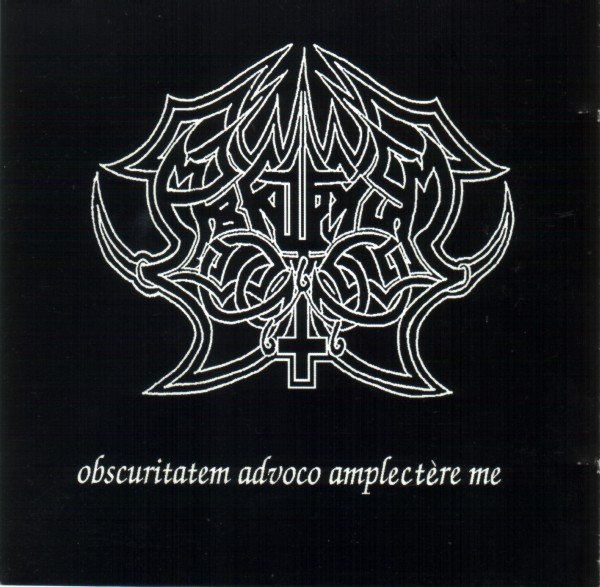
The original artwork is another detail worth mentioning. Some early editions featured an almost entirely black cover, withholding the usual visual information found on a metal release. There was no elaborate illustration to explain the music, no dramatic scene to guide the listener’s imagination. The presentation was as stark as the recording itself. Later editions made the album’s identity more explicit, but that early approach suited the record particularly well. It left the music to establish its own unsettling character without offering a convenient image to interpret.
Abruptum’s reputation has often been accompanied by sensational stories about the circumstances surrounding its recordings. Tales of extreme behaviour and supposed acts performed in the studio became part of the project’s mythology, but such accounts should not be treated as established fact merely because they have been repeated over the years. The music does not need those stories to justify its reputation. The distorted vocals, dissonant sounds and refusal to provide conventional musical resolution already make this a deeply unsettling listening experience. Treating the rumours as the main attraction would also overlook the unusual musical decisions that distinguish the album from countless other attempts to sound dark or sinister.
‘Obscuritatem Advoco Amplectère Me’ is not an album that rewards casual listening in the same way as a strong Black Metal record built around memorable riffs and driving percussion. Its appeal lies in the details that surface during those long compositions, the strange interaction between instruments and noise, and the way the recording repeatedly denies the listener a comfortable point of reference. The music can feel claustrophobic without relying on a constant barrage of sound, because the uncertainty itself becomes part of the experience.
For anyone exploring the history of Swedish Black Metal, this debut represents a different branch of the underground, one that was never particularly concerned with making itself accessible or imitating the prevailing sound of the time. IT and Evil created something that sits awkwardly between Black Metal, experimental noise and the earliest forms of what would later be described as Death Industrial. It is a difficult record, but its refusal to conform is precisely what gives it historical significance. ‘Obscuritatem Advoco Amplectère Me’ does not invite the listener into its world. It leaves the door open just long enough for the sounds to emerge, then lets the darkness do the rest.
