
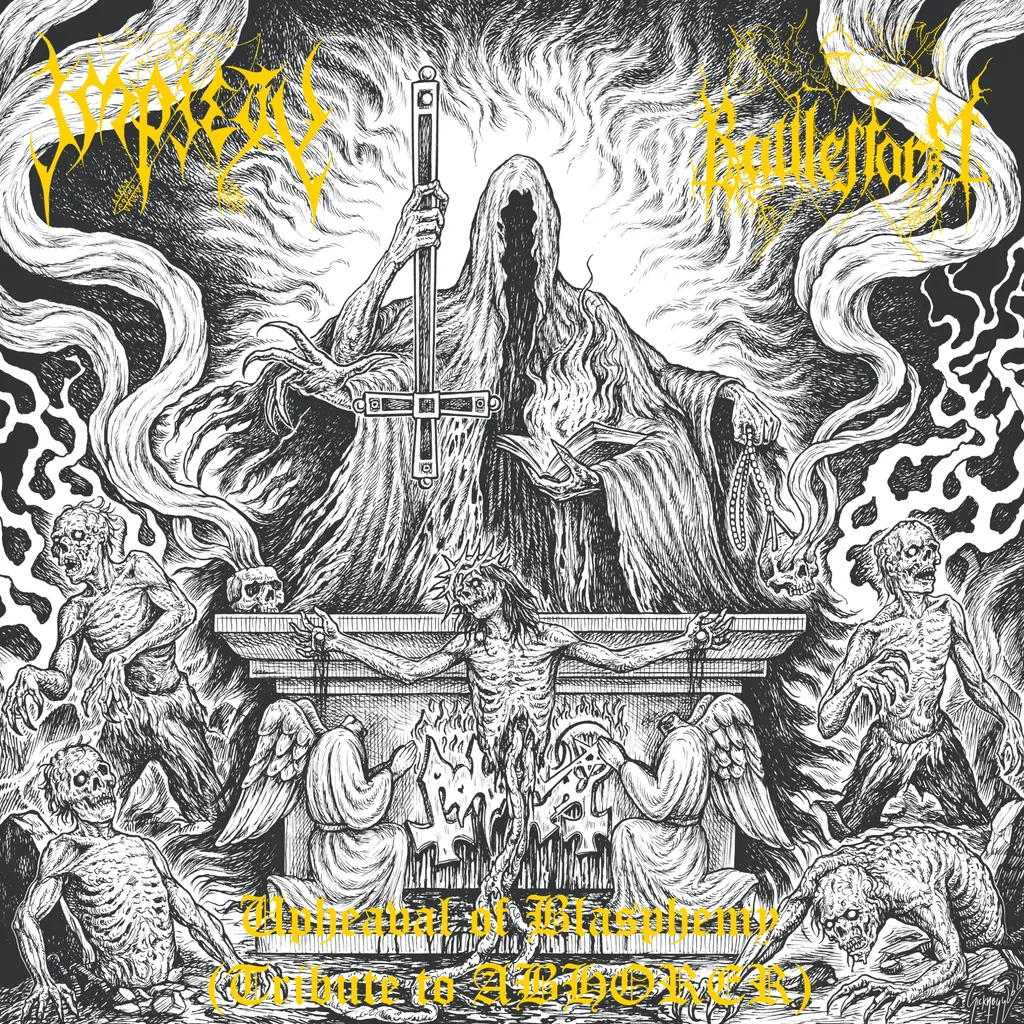
A tribute release involving Impiety, Battlestorm and Abhorer was always going to get my attention, especially when the material being revisited comes from one of the most important periods of Singapore’s Extreme Metal history. What makes this release interesting is that the original Abhorer material is presented alongside two Singapore bands from different generations interpreting those songs in their own way. The original ‘Upheaval of Blasphemy’ recordings occupy one side, while Impiety and Battlestorm take on Abhorer from two different positions within the local underground. It gives the record a proper sense of continuity without turning it into some polished nostalgia project.
The original Abhorer tracks remain the foundation of the release. ‘Upheaval of Blasphemy’ came out in 1993 through Shivadarshana and the material still carries that primitive, hostile character that made Abhorer such an important name in Singapore. The recordings have the kind of roughness that belongs to their period, with the riffs pushed forward aggressively and the whole performance carrying that sense of musicians operating without any concern for modern production standards. Having the original material here is important because the tribute would lose much of its meaning if we were only hearing newer bands reinterpreting songs that had already been removed from their original context.
Then we get to Impiety, and this is where the release becomes particularly relevant because their connection with Abhorer is not something invented decades later for a tribute. These bands came from the same Singapore underground and their members knew each other personally. There was plenty of movement between bands and projects, and the relationship between Abhorer and Impiety was part of that tightly connected environment. Impiety’s version of ‘Heathendom Incarnate’ therefore comes from musicians who understood exactly where this material came from rather than somebody discovering the song through an old compilation and deciding it would make a good cover.
Impiety do not approach ‘Heathendom Incarnate’ like a historical reconstruction. Their version has the experience and aggression of a band that has spent decades developing its own sound, so the song naturally comes out sounding like Impiety attacking Abhorer rather than Impiety pretending to be Abhorer. That distinction matters. The original song has its primitive Singapore character, while Impiety bring their own speed, guitar attack and vocal presence into it. Shyaithan has always been extremely direct about his dislike of anything he considered watered down or fashionable, and that old attitude is still relevant when listening to the performance here because the cover retains the violence instead of turning the song into some safe tribute to the past.
Battlestorm take the other side of the split with ‘Abandonment of Chastity’, and their involvement gives the release another dimension because they belong to a later generation of the Singapore underground. Hades has openly acknowledged the influence of Abhorer and Impiety alongside his interest in South American Extreme Metal, but Battlestorm have never simply sounded like a rehashed version of those older bands. Their cover is therefore coming from musicians who grew up with the history rather than musicians who were directly involved in creating it.
‘Abandonment of Chastity’ works because Battlestorm are able to attack the song from their own direction. The older Abhorer material provides the framework, but the performance has the harsher, more developed character you would expect from Battlestorm. It is interesting hearing that contrast against Impiety on the same record because both bands are dealing with the same source material from completely different points in time. Impiety have the personal connection to that original Singapore period, while Battlestorm approach it as a later generation that inherited those records and influences.
The connection becomes even more tangled when you remember that Djinn has played in both Battlestorm and Impiety, having been part of Impiety’s lineup between 2017 and 2019 before continuing with Battlestorm. This kind of overlap is one of those things that makes a Singapore release like this more interesting when you know the local scene. The bands were never completely separate islands. Musicians moved around, friendships developed, people rehearsed together and different generations of musicians ended up crossing paths. The fact that one musician has a direct connection to both bands on this split adds another small piece to that already complicated family tree.
There is also something satisfying about the choice of material. Rather than taking the obvious route of turning the whole record into a collection of familiar Abhorer songs played by whoever happens to be available, the release keeps the original ‘Upheaval of Blasphemy’ material intact and then gives the two participating bands a chance to show what those songs mean from their own positions. It makes the record feel like a conversation between different periods of Singapore Extreme Metal rather than a simple collection of covers.
The production also deserves attention because the split works better when the original and newer performances are allowed to retain their own character. The older Abhorer material sounds like a document from its period, while the Impiety and Battlestorm recordings have the weight and aggression of modern productions. I would much rather hear that contrast than have the original recordings remastered until they lose the character that made them historically important. The whole point is hearing the distance between the eras while still recognising the connection.
For me, the strongest part of this release is therefore the way the three names interact. Abhorer provide the songs and the historical foundation, Impiety bring the perspective of musicians who were part of that old Singapore circle, and Battlestorm show what that lineage looks like from a later generation. The release does not need to pretend that the Singapore underground was some perfectly united brotherhood either: there were rivalries, arguments, rumours, changing lineups and different circles, and those things were part of what made the scene what it was. The fact that these bands can now appear together on a tribute to Abhorer is interesting precisely because of all that history behind them.
The title ‘Upheaval of Blasphemy’ is therefore appropriate because the release takes material from a very specific moment in Singapore’s past and places it directly beside two later interpretations. Impiety’s connection is obvious once you know the history, while Battlestorm demonstrate that the old records continued to have an effect on musicians who came after them. Hearing both covers together makes the generational difference clear without needing to force the comparison. One band comes from the same original underground environment, the other grew up with that environment as part of its musical inheritance.
As a split, this works because there is an actual reason for these bands to be sharing the release. The Abhorer material is strong enough to justify revisiting, Impiety have a genuine historical connection to the songs, and Battlestorm bring a different generation into the picture without sounding like they are simply dressing themselves up in somebody else’s old uniform. For anyone interested in Singapore Extreme Metal, the record carries the music as well as the history, and that combination makes this much more worthwhile than a routine tribute release assembled simply because the original band has a cult reputation.
