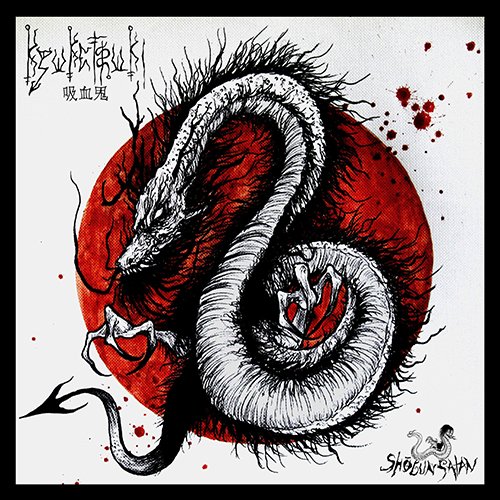
After releasing his ‘Harakiri Black Metal’ at the beginning of the month, Maxime Taccardi (K.F.R., Griiim, Lamentum, etc.) has just released a new album by Kyūketsuki, his Japanese horror-inspired Black Metal project. It’s called ‘Shōgun Satan’. Recorded in June 2026, mixed and mastered at Opus Magnum Studio in Belgium.
Kyūketsuki – Shōgun Satan continues Yūrei’s vampyric, Japanese‑horror‑infused raw Black Metal aesthetic, expanding it into a more narrative, folkloric, and cinematic direction.
The album blends vampyric raw Black Metal, Japanese folklore (Nobusuma, Han’nya, ghost legends), cinematic horror storytelling with a rather lo‑fi treble‑forward production and occasional atmospheric passages. This album is not as restrained and diverse in mastering and sound as ‘Harakiri Black Metal’. It’s more feral, the drums are quite heavy and varied than on most of the other projects. One notices it directly. The same goes for the abrasive guitars.
The lyrical themes, decay, ego, sin, vampirism, ancestral curses, are more poetic and narrative than on ‘Harakiri Black Metal’. The title track’s lyrics explicitly frame the Shōgun as a metaphysical tyrant ruling over chaos and human fragility.
‘Shōgun Satan’ is Kyūketsuki’s most fully realized nightmare to date, a vampyric, folkloric Black Metal ritual where Japanese ghost‑lore, lo‑fi violence, and mythic grandeur fuse into a single, cursed narrative. It’s still raw, still solitary, still unmistakably Yūrei, but now sharpened into something more cinematic, more symbolic, and more spiritually diseased.
Kyūketsuki’s 2026 full‑length ‘Shōgun Satan’ marks a decisive shift in the project’s evolution: the raw suicidal vampyric Black Metal of ‘Harakiri Black Metal’ mutates into a myth‑driven, folkloric horror opera, still carved in lo‑fi stone but now pulsing with narrative ambition. What emerges is an album that feels less like a collection of tracks and more like a ritual chronicle, a cursed manuscript documenting the rise of a vampiric warlord in a realm where ghosts, demons, and ancestral rot coexist.
Where Kyūketsuki once leaned heavily on vampyric despair, ‘Shōgun Satan’ expands the mythology.
The album draws on Nobusuma, the bat‑like vampire of Japanese folklore, Han’nya, the jealous demon‑woman mask, Onryō, vengeful ghosts and Shōgun imagery, authority twisted into metaphysical tyranny.
This fusion gives the album a mythic gravity. The Shōgun becomes a symbol of cosmic cruelty, a ruler of decay whose dominion is not military but spiritual. The lyrics (where decipherable) reinforce this: ego, sin, blood, memory, and ancestral curses form the album’s philosophical backbone.
What makes ‘Shōgun Satan’ compelling is its commitment.
Kyūketsuki doesn’t imitate Japanese aesthetics, it inhabits them.
The album feels like a cursed Noh performance staged inside a collapsing temple. It’s theatrical, but never polished; mythic, but never pompous. The lo‑fi grime becomes part of the storytelling, like soot on an ancient scroll.
The album’s uniformity, a Kyūketsuki trademark, may alienate listeners seeking dynamic shifts, though. Some tracks blur together, and the mix occasionally buries details that deserved more prominence. But these flaws are also part of the project’s identity: rituals are repetitive, and curses rarely evolve.
‘Shōgun Satan’ is a singular, atmospheric triumph in the micro‑underground.
It’s not innovative in a genre‑expanding sense, but it is deeply original in its fusion of vampyric Black Metal with Japanese mythic horror. The album feels like a secret text, something whispered, not advertised.
Kyūketsuki has carved out a niche that no one else occupies: vampyric folklore Black Metal, drenched in blood, ghosts, and ancestral dread.
The folklore inside ‘Shōgun Satan’ isn’t decorative, it is the album’s spiritual skeleton. Kyūketsuki pulls from vampiric yōkai, vengeful ghosts, demonic masks, and Shōgun‑era symbolism to build a mythic world where power, ego, death, and haunting intertwine.
Japanese Folklore in ‘Shōgun Satan’
Nobusuma is a lesser‑known yōkai described as a giant bat‑like creature that attacks travelers at night, suffocating them or draining their life. In folklore, it is both a predator and a symbol of night‑bound fear.
In the album, Nobusuma becomes ‘The King of Vampires’, elevated from a regional monster into a mythic sovereign. This fits Kyūketsuki’s vampyric identity: Nobusuma is not just a creature but a metaphysical ruler of nocturnal hunger, a counterpart to the Shōgun’s earthly tyranny.
The Han’nya mask from Noh theatre represents a woman transformed into a demon by jealousy, grief, or betrayal. It is one of Japan’s most iconic symbols of tormented femininity and spiritual corruption.
In ‘Warai Han’nya’ (‘Laughing Han’nya’), Kyūketsuki twists the mask into a grotesque, mocking presence, a demon who laughs at human suffering. The track’s shrill, theatrical energy mirrors the mask’s emotional intensity.
The onryō is a ghost driven by vengeance, sorrow, or injustice. It is a central figure in Japanese horror, pale, long‑haired, silent, relentless.
‘A Sorrowful Ghost’ clearly invokes this archetype. The track’s atmosphere and the stop‑motion video (filmed with the artist’s own blood) reinforce the idea of a ghost whose grief becomes a curse.
The Shōgun was the military ruler of Japan for centuries, a symbol of absolute authority, discipline, and war. Kyūketsuki transforms this historical figure into ‘Shōgun Satan’, a metaphysical tyrant ruling over chaos, vampirism, and spiritual corruption.
This is not historical Japan, it is a mythic Japan, where the Shōgun becomes a demonic sovereign.
Cherry blossoms (sakura) symbolize impermanence, beauty, and death. Their brief bloom is a metaphor for the fragility of life.
Kyūketsuki’s ‘Black Cherry Blossom’ corrupts this symbol: beauty becomes rot, bloom becomes decay, and the traditional aesthetic of sakura is inverted into something vampyric and funereal.
We could go deeper into the symbolism and mythological realm of the album, though it is the music that counts.
‘Shōgun Satan’ is an album that will blow you away and requires several listening sessions. This is pure cinematic art!
Conclusion: ‘Shōgun Satan’ stands as Kyūketsuki’s most complete artistic statement so far: a vampyric folklore opera carved in distortion, ritual cadence, and ancestral dread. Where earlier releases felt like violent outbursts or suicidal confessions, this album feels constructed, narrative, and mythologically anchored. Every track contributes to a single spiritual landscape, a realm ruled by the Shōgun Satan, haunted by onryō, stalked by Nobusuma, mocked by Han’nya, and crowned with blackened cherry blossoms.
The album’s strength lies in its unity. The production, though raw, is purposeful; the riffs, though repetitive, are hypnotic; the vocals, though buried, feel like invocations rather than performances. Kyūketsuki has found a way to make lo‑fi aesthetics serve storytelling, turning distortion into fog, reverb into shrine‑echo, and repetition into ritual.
What emerges is a world where Japanese myth is not referenced but inhabited. The folklore is not decoration, it is the album’s architecture. The Shōgun becomes a metaphysical tyrant, Nobusuma, a vampiric sovereign, Han’nya a demonic chorus, and the ghosts a reminder that suffering never dies, only transforms. ‘Shōgun Satan’ is not an album of innovation; it is an album of conviction.
It commits fully to its cursed universe, and that commitment becomes its power.
Kyūketsuki has crafted a work that feels secretive, ritualistic, and spiritually diseased, a Black Metal text meant not to impress but to haunt.