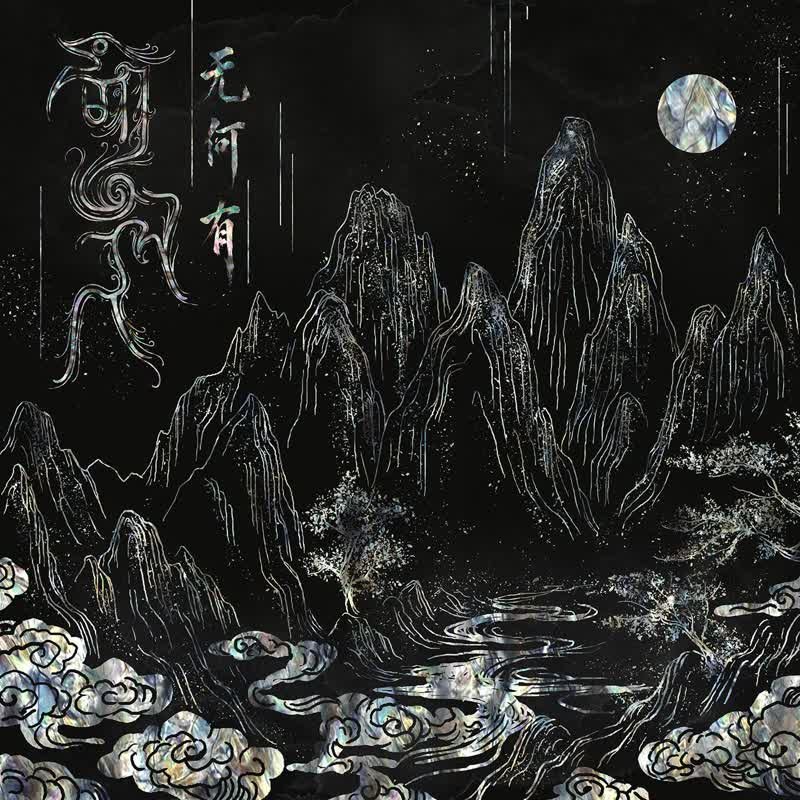
纼钩 (Xié Gòu) is a Chinese Funeral Doom Metal/Experimental band/duo with Drone influences and remarkable traditional Chinese instruments such as 古琴 (guqin), 箜篌 (konghou), 埙 (xun), 嗩吶 (suona), 骨笛 (bone flute) and bamboo flutes or temple percussion, all played by Jianqi (traditional instruments, clean vocals) and guitars, bass, harsh vocals handled by Ying.
‘无何有 (Wu He You)’ is the first full-length, consisting of 2 monolithic tracks, and the follow-up to the ‘絜鉤’ EP from 2025.
The combination of all these exotic instruments and influences suggests music in the aesthetic lineage of: Dopamine (slow depressive/doom atmospheres), Zuriaake (ritual Chinese instrumentation), Vengeful Spectre (traditional timbres in blackened contexts), WV Sorcerer Productions artists (ritual ambient and doom hybrids).
The album is a wild assortment of ideas, not unlikely the music from Maxime Taccardi; it’s Doom at its core but layered with Oriental influences, a very omnipresent ritualistic Sludge hammering through both tracks with a very disturbing and dark atmosphere.
Xié Gòu’s core is unmistakably Funeral Doom, but executed with a distinctly Chinese sensibility: extremely slow, often hovering around the threshold of stillness, long, droning chords with extended decay; distortion is soft‑clipped, creating a ‘fogged’ harmonic field rather than Western-style crushing weight. The bass is subharmonic rumble used more as atmospheric grounding than rhythmic anchor. Ying’s harsh vocals are low, cavernous, and distant, mixed as if echoing through temple corridors rather than dominating the front of the soundstage.
The overall effect is gravity without aggression, doom as ritual, not doom as punishment.
And Jianqi’s role is the key to the project’s identity. The traditional instruments reshape the Funeral Doom template: these instruments do not ‘decorate’ the doom, they define the emotional architecture. Instead of keyboards or synth pads, Xié Gòu uses ancient timbres to create atmosphere.
The production is intentionally raw but spacious: the reverb is long, naturalistic, suggesting stone, earth, and cavernous emptiness. Stereo field for the guitars is wide; traditional instruments centered or slightly offset, creating a dialogue between ancient and modern timbres.
Dynamics: not crushed; the quiet passages breathe, allowing ritual instruments to resonate fully. Noise field: faint environmental hiss, possibly intentional, adding to the ‘field recording inside a shrine’ feeling.
This is not lo‑fi incompetence, it is ritualistic minimalism.
Tracks likely follow non-linear, meditative structures. The music behaves more like a ceremony unfolding than a conventional metal composition.
The album title comes from Zhuangzi, specifically the concept of: 无何有之乡, “the land of no‑thingness”.
This is not nihilism. In Daoist philosophy, 无何有 is the fertile emptiness, the space where form has not yet arisen. It is the origin point of all things.
The pure potential before manifestation, a state of non-action (无为), as well as a realm beyond duality.
Choosing this title signals that the album is not merely ‘funeral’ in mood, it is metaphysical, concerned with the nature of existence and non-existence.
This aligns with Daoist and pre‑Qin cosmology, where death is not an end but a return to the undifferentiated state.
‘无何有 (Wu He You)’, a continuous track‑by‑track sonic speculation of the album reveals the following details: each movement aligns with classical Daoist metaphysics.
The album opens with ‘无形之初’ , Beginning Without Form, a movement that emerges from near‑total silence. A single breath‑tone from the xun drifts into the void like wind passing through an abandoned shrine, its clay timbre soft and hollow. Gradually, guitars materialize not as riffs but as fog‑like harmonic smears, suspended without direction, as if unsure whether they are sound or memory. Sparse temple percussion marks time in slow, irregular intervals, each strike a reminder that form is beginning to coalesce from the formless. This opening is not music in the conventional sense; it is the sonic equivalent of Zhuangzi’s primordial emptiness, the moment before shape, intention, or identity arises.
From this embryonic state, the album descends into ‘土中之息’ , Breath Within the Earth, where Funeral Doom weight first asserts itself. Guitars fall into glacial, descending chords, each one stretching across ten or more seconds, collapsing like ancient stone slabs sinking deeper into soil. The bass becomes a subterranean rumble, a tectonic presence rather than a rhythmic anchor. Over this, the guqin introduces sliding harmonics that shimmer like faint light filtering through layers of earth. Ying’s vocals appear for the first time, low, cavernous growls mixed deep within the reverb field, more invocation than narration. The track feels like a slow burial, but not a tragic one; it is a peaceful return to origin, a descent into the womb of the earth where life and death are merely phases of the same breath.
The third movement, ‘骨鸣之道’ , The Way of Bone Resonance, shifts the album’s ritual axis. Here, the bone flute becomes the central voice, its primitive timbre cutting through the doom fog like an ancestral signal carried across centuries. Guitars transition into sustained tremolo‑drones, vibrating with the hypnotic persistence of ritual chanting. Percussion grows more pronounced, each strike deliberate, ceremonial, echoing pre‑imperial shamanic rites. The track feels older than the instruments themselves, a sonic reconstruction of rites performed long before written history, where bone, breath, and earth were the only tools of communication with the unseen. It is the album’s most ancestral moment, a reminder that ritual sound is a bridge between the living and the dead.
After this invocation, the album retreats into profound stillness with ‘无为之境’ , Realm of Non‑Action, its slowest and most minimal passage. Funeral Doom recedes almost entirely. Guitars become faint harmonic clouds drifting at the edges of perception. The guqin and xun dominate, weaving a meditative space that feels closer to dark ambient than metal. Percussion disappears; vocals may be absent or whispered, barely human. This movement embodies the Daoist principle of wu wei, non‑action, non‑force, the power of allowing things to unfold without interference. It is the emotional and philosophical center of the album, a void that feels full, a silence that feels alive. In this stillness, the listener is invited to dissolve into the realm where action and intention lose meaning.
From this suspended state, form begins to unravel in ‘形散之歌’ ,Song of Dissolving Form, where Funeral Doom returns with renewed weight. Guitars regain their crushing presence, but now intertwined with sharp, ritualistic bursts of suona, piercing cries that slice through the density like ceremonial horns announcing the dissolution of ego. Bass pulses with tectonic force, and Ying’s vocals reach their most intense expression, long sustained growls that feel like lamentation for the self that is fading. The track embodies the tearing of identity, the collapse of boundaries, the moment when form scatters and the individual dissolves into the greater field of being. It is violent only in the sense that transformation is often uncomfortable; its brutality is metaphysical, not emotional.
Finally, the album arrives at its title track, ‘无何有’ ,The Land of No‑Thingness, the longest and most expansive movement. It begins with silence, then the faintest guqin harmonics, then the breath of the xun, then guitars entering like distant thunder. All elements converge slowly, patiently, as if reenacting the cosmological cycle of emergence and dissolution. In the final third, the instruments merge into a single massive drone, guitars, guqin, and xun blending into a unified harmonic field that feels less like sound and more like a state of being. Vocals appear only briefly, a final invocation before fading. The track does not end with a climax; it simply dissolves, returning to silence, completing the cycle of form arising from emptiness and returning to emptiness again. It is the sonic embodiment of Zhuangzi’s 无何有之乡, the land of no‑thingness, the fertile void from which all things come and to which all things return.
There is more than meets the eye/ear on this album, unless you are thinking I’m full of crap.
Conclusion: ‘无何有 (Wu He You)’ is a mature, profound and very intriguing Funeral Doom album with Ambient, Sludge and Drone influences and laced with Chinese philosophy and traditional instrumentation.
An album definitely worth checking out.